Celebrate UC’s record Ride Cincinnati effort with your support
Faculty, staff and student bikers participate in annual cancer care fundraiser

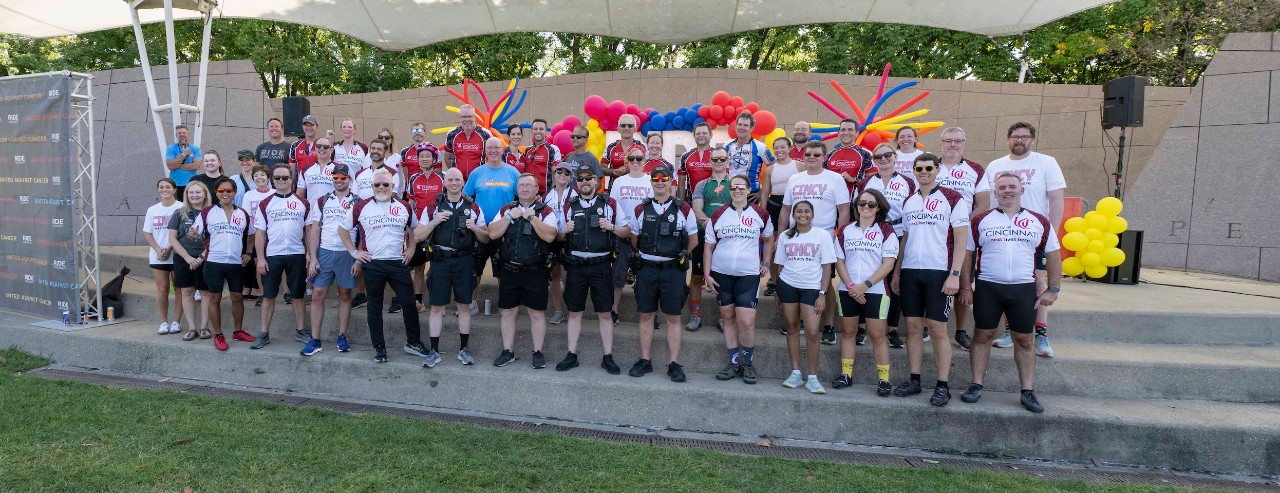
The University of Cincinnati sent a record number of riders to participate in Ride Cincinnati September 14, and there’s still time to support their effort.
This year marks the second that UC President Neville Pinto challenged every college and unit across the institution to send a rider to help raise support for cancer research and cancer care at the University of Cincinnati Cancer Center.

UC President Neville Pinto came to Ride Cincinnati to support all the riders from the University of Cincinnati. Photos/Joseph Fuqua
In total, UC sent 78 riders, exactly doubling the number from 2023, and donations have so far exceeded $25,000. You can track their progress and support our Bearcat riders with a donation through November 14. (Note, additional UC employees are also spread across established biking teams from the UC Cancer Center and other areas who are not included in these totals.)

The Bearcats support crew handed out water and fuel for riders at the University of Cincinnati tent, led by teams from Equity, Inclusion & Community Impact and the President's Office.
“Ride Cincinnati is truly an inspiring collective effort to raise support for cancer care in our city,” said Bleuzette Marshall, UC Vice President for Equity, Inclusion & Community Impact. “We are incredibly proud of all the riders, donors and volunteers who represented UC so well.”

Nearly 700 total riders took part in Ride Cincinnati 2024. Photos/Joseph Fuqua
This year, UC riders represented in branded “Next Lives Here” jerseys and T-shirts thanks to team sponsorships established by UC’s Trademarks and Licensing group with apparel partners Horn Legend and Champion. Each UC rider rode between 10 and 64 miles, and together, they pedaled 1,494 miles — roughly long enough to stretch from Cincinnati to Denver.
Ride Cincinnati is truly an inspiring collective effort to raise support for cancer care in our city. We are incredibly proud of all the riders, donors and volunteers who represented UC so well.
Bleuzette Marshall, UC Vice President for Equity, Inclusion & Community Impact


UC Bearcats cheerleaders helped cheer on all the riders at Ride Cincinnati 2024. Photos/Joseph Fuqua
Impact Lives Here
The University of Cincinnati is leading public urban universities into a new era of innovation and impact. Our faculty, staff and students are saving lives, changing outcomes and bending the future in our city's direction. Next Lives Here.
Tags
- College-Conservatory of Music
- College of Pharmacy
- Equity and Inclusion
- College of Medicine
- College of Arts and Sciences
- College of Allied Health Sciences
- UC Foundation
- College of Cooperative Education and Professional Studies
- College of Education, Criminal Justice, & Human Services
- Blue Ash College
- Clermont College
- College of Design, Architecture, Art, and Planning
- Graduate College
- President's Office
- College of Law
- College of Nursing
- Lindner College of Business
- College of Engineering and Applied Science
Related Stories
University of Cincinnati and Hamilton County work to lower overdose deaths
September 17, 2026

University of Cincinnati researchers and Hamilton County officials are using overdose data to identify Cincinnati hot spots and place free NaloxBoxes and fentanyl test strip dispensers where they are needed most to help prevent opioid overdose deaths.
From curiosity to career
September 17, 2026
Fall campaign story 2026 - College of Education, Criminal Justice, and Human Services.
From uncertainty to innovation
September 17, 2026
Fall campaign story 2026 - College of Engineering and Applied Science.