Defining different types of dementia
UC expert featured in Lake Charles, Louisiana news report

The University of Cincinnati's Russell Sawyer was featured in a Lake Charles, Louisiana television station KPLC story defining the differences between frontotemporal and alcohol-induced dementia following actor Bruce Willis and talk show host Wendy Williams publicly revealing dementia diagnoses over the past few years.
“It usually presents with changes in people’s personality and changes in language that affect people’s ability to both perform their jobs and eventually take care of themselves,” Sawyer, MD, assistant professor in the Department of Neurology & Rehabilitation Medicine in UC's College of Medicine and a UC Health physician, said of frontotemporal dementia.
Genetics may play a role for up to 40% of patients with frontotemporal dementia, he added. “Either gene therapy in which we change out the gene for a new functional gene or replacing the proteins that we’re missing" are potential treatments.
Alcohol-induced dementia is the direct effect of drinking too much for too long and is associated with memory loss, difficulty with problem-solving and impaired judgment.
“Two drinks per week over a one-year period of time was associated with both smaller brains, and more thinking and memory problems,” Sawyer explained.
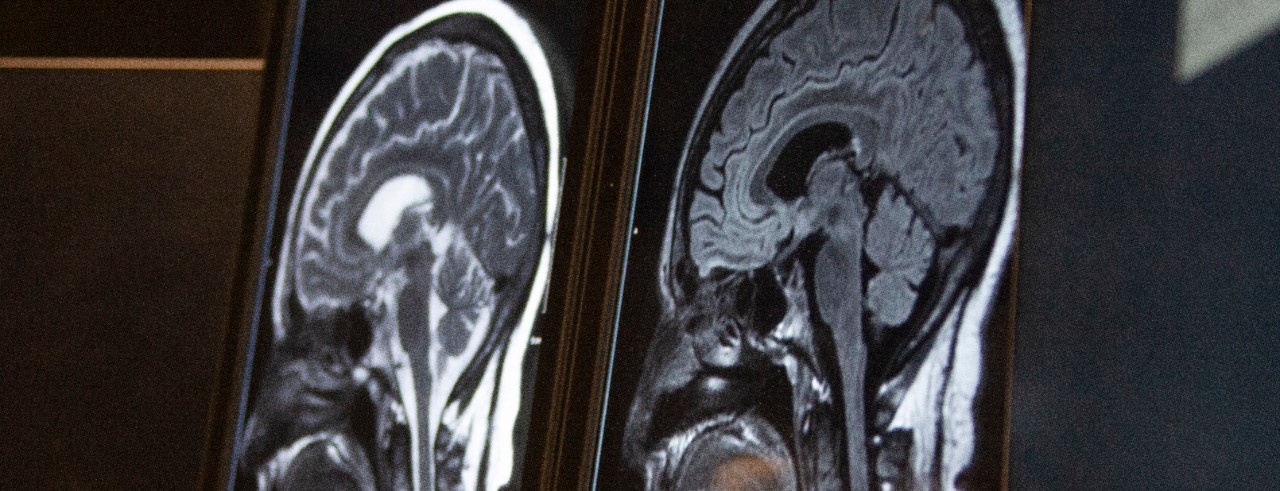
Featured photo at top of MRI brain scan. Photo/Ravenna Rutledge/UC Marketing + Brand.
Related Stories
UC emergency physicians safely eliminate thousands of unnecessary CT scans
September 28, 2026

An emergency medicine-led initiative has helped the University of Cincinnati eliminate thousands of unnecessary computed tomography (CT) scan requests, saving about $6.2 million, as Radiology Business recently reported.
UC researchers examine ethics of evolving AI
September 28, 2026

Spectrum News highlighted research by the University of Cincinnati to examine questions about harm, trust and fairness surrounding artificial intelligence.
Stroke rates nearly double in younger adults
September 28, 2026

National media including CNN, Newsweek and U.S. News & World Report highlighted new research from University of Cincinnati experts that found strokes among adults ages 20 to 54 nearly doubled over almost three decades, even as short-term survival after stroke improved.