How technology is changing approaches to treat hearing loss
UC expert part of WVXU's Cincinnati Edition panel discussion

According to data from the CDC, more Americans are developing hearing problems earlier in life, yet current devices and treatments can be costly, making them less accessible.
The University of Cincinnati's Daniel Sun, MD, told WVXU's Cincinnati Edition that hearing loss can be thought of like a piano, with different interventions needed based on different situations.
"Hearing loss starts on the right side and slowly works itself toward the left side, toward the bass sounds," said Sun, the Myles L. Pensak, MD, Endowed Professor in Neurotology and Skull Base Surgery, director of the Division of Neurotology, neurotology fellowship program director and associate professor of otolaryngology in the University of Cincinnati College of Medicine, and a UC Health physician. "So the very first things that can be detected...are the very, very right hand side keys of the piano. And then eventually it works itself more and more towards the middle and the left, and that’s when it becomes more noticeable to everyday folks."
The FDA recently authorized new software that can transform Apple’s AirPods Pro 2 into inexpensive hearing aids. Sun said it's a great public health effort to provide hearing aids to more people that need them, but it is not a one-size-fits-all remedy.
"Over the counter hearing aids are only approved for individuals with mild to moderate hearing loss of a specific type, so it’s still important to keep in mind to check with an audiologist or a physician if the hearing loss is more severe," he said. "[If this is] happening at a younger age, get an actual hearing test to determine what may actually be going on."
Over the counter hearing aids, or those built in to AirPods and other headphones, can be thought of like reader glasses you can buy at the drug store without a prescription, but having different hearing between two ears may be a sign you need a formal hearing test from an expert.
Listen to the Cincinnati Edition segment.
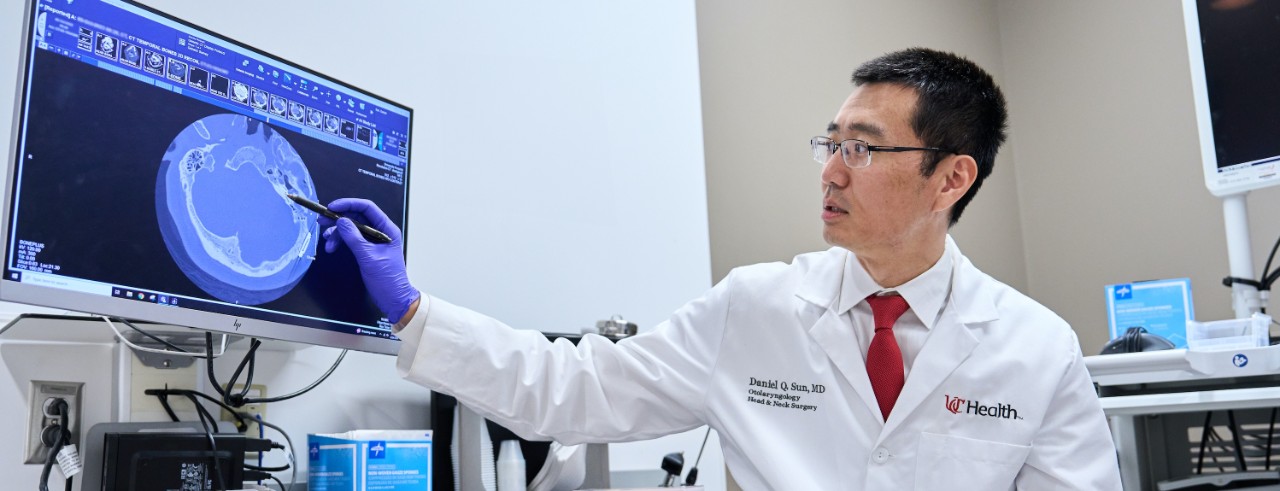
Featured photo at top of Sun pointing to a scan on a monitor. Photo/UC Health.
Related Stories
Mistakes to avoid when shopping for a product dupe
August 13, 2026

The University of Cincinnati’s Kelly Dobos was featured in an AARP article discussing ways to determine if “dupe” cosmetic products really are comparable to the more expensive name brand.
Ancient warming event hints at potential climate tipping point
August 12, 2026

Researchers say a spike in temperatures during an ice age 304 million years ago could inform what climate scientists are learning about rapidly changing conditions today.
What is a trademark?
August 11, 2026

Sean Owens, an adjunct professor in the Donald P. Klekamp College of Law, discussed trademark law with the Dayton Daily News. Owens is also a partner at intellectual property law firm Wood Herron & Evans in Cincinnati.