Winter can bring increased risk of stroke
UC expert joins Fox 19's morning show

The University of Cincinnati's Lauren Menzies joined Fox 19's morning show to discuss risk factors for stroke in the winter and stroke signs to look for.
Research has suggested changes in barometric pressure may explain why winter is associated with a higher risk for stroke, but Menzies said that has never fully been proven and there are other factors at play.
"We’re not taking the best care of ourselves that we normally do during the holidays," said Menzies, MD, adjunct assistant professor in UC's College of Medicine and a UC Health physician. "We’re distracted, we’re eating a lot more sodium, we’re drinking a lot more than normal, we’re eating foods that we probably normally wouldn’t. And I think those contribute."
Menzies recommended people with high blood pressure or heart disease to stick to low sodium diets over the holidays. Additionally, people who are flying to visit family should be sure to pack their medications on carry-ons so that it does not get lost if their checked luggage does.
"We want to make sure also when we’re taveling long distances to see family that we’re geting up and moving on a regular basis," she added. "Sitting for a long time can put you at risk for clots and also at risk for strokes."
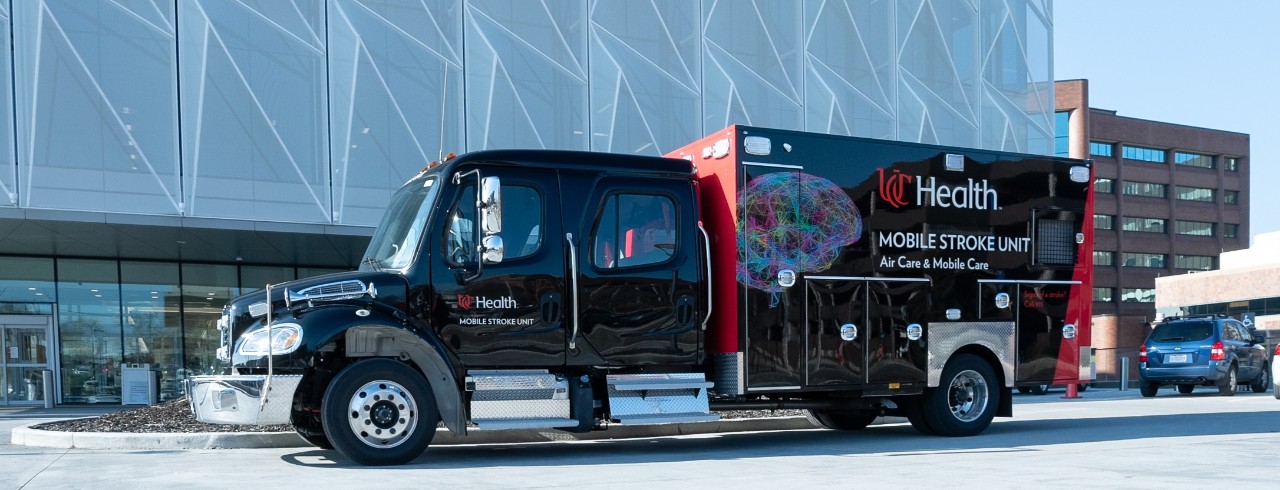
Featured photo at top of UC Health's mobile stroke unit courtesy of UC Health.
Remember how to identify a stroke
Because of the quick onset of stroke, it is important to know the FAST mnemonic device that details the most common signs of stroke and how to respond:
- F: Facial drooping
- A: Arm or leg drop, or weakness in the arm or leg
- S: Speech issues, such as slurred speech or an inability to get your words out
- T: Time is of the essence; call 911 immediately
Related Stories
Bidirectional link between oral, kidney health calls for patient education, access
August 4, 2026

Despite growing awareness of the connection between oral health and chronic health conditions, patient awareness and access to dental care remain limited, according to University of Cincinnati experts who recently spoke with Healio | Nephrology News & Issues.
'Be human in it': UC College of Medicine welcomes Class of 2030 at 31st White Coat Ceremony
August 4, 2026
The University of Cincinnati College of Medicine welcomed 185 first-year medical students in the Class of 2030 at the 31st annual White Coat Ceremony.
UC-built detector at CERN looks for enticing evidence to explain dark matter
August 4, 2026
A physicist from the University of Cincinnati and his research partners from around the world conducted an experiment at CERN’s Large Hadron Collider in Switzerland to look for evidence that might help explain one of science’s most baffling questions: dark matter.