
High school program draws local students to engineering
Kallab Hailu Abebe was inspired to enroll in engineering after his Next Engineers experience

In a handful of cities around the world, including Cincinnati, GE Aerospace Foundation partners with local organizations and universities to run the Next Engineers program, a global college- and career-readiness program working to increase the diversity of young people in engineering.
Through one key initiative, the Next Engineers: Engineering Academy, high school students spend three years learning to think like engineers. Kallab Hailu Abebe, a graduate of the first cohort of Engineering Academy students, shares the impact the program had on him and how it led him to enroll at the University of Cincinnati for his mechanical engineering degree.

The Engineering Academy is a very important program that can put you above and ahead entering college
Kallab Hailu Abebe UC mechanical engineering student
Abebe, who is now a first-year student at UC, learned about the Engineering Academy program through a friend of his father's, who is an engineer. Knowing his son's lifelong interest in engineering, Abebe's father shared this recommendation with him, leading him to research Next Engineers.
"The Engineering Academy is a very important program that can put you above and ahead entering college," Abebe said.
For Abebe, the programming took place over three years while he was a student at Colerain High School in Cincinnati. UC serves as the educational partner for local Cincinnati Next Engineers programming, so Academy students come to UC's campus on designated Saturdays to participate in engineering design challenges, career coaching from various industry and acacdemic professionals, and college-readiness workshops. The partnership with GE Aerospace Foundation is one of many pre-collegiate initiatives provided by the College of Engineering and Applied Science's (CEAS) Office of Professional Development and Community Impact. Through the design challenges, students not only learn how to design and think like engineers, but how to collaborate with others on a team.
"The final year of the program, we had to do a yearlong project," Abebe said. "We were split into groups of 10 and each assigned a role within the group and had to work together."
Students were challenged to design and build projects such as bridges, catapults, gliders, and Abebe's favorite — a dome capable of collecting and filtering rainwater to make it safe to drink. While it was the most demanding design project of Abebe's Academy experience, it was also the most rewarding. As part of the engineering design process, he and his teammates thoroughly researched the problem, collaborated to develop a solution, and experimented with various methods and materials to achieve their objective, Abebe explained.
"It was the first time I'd ever done anything like this, which made it more challenging. But going over theory and the engineering process has helped me in my undergraduate program," he said.
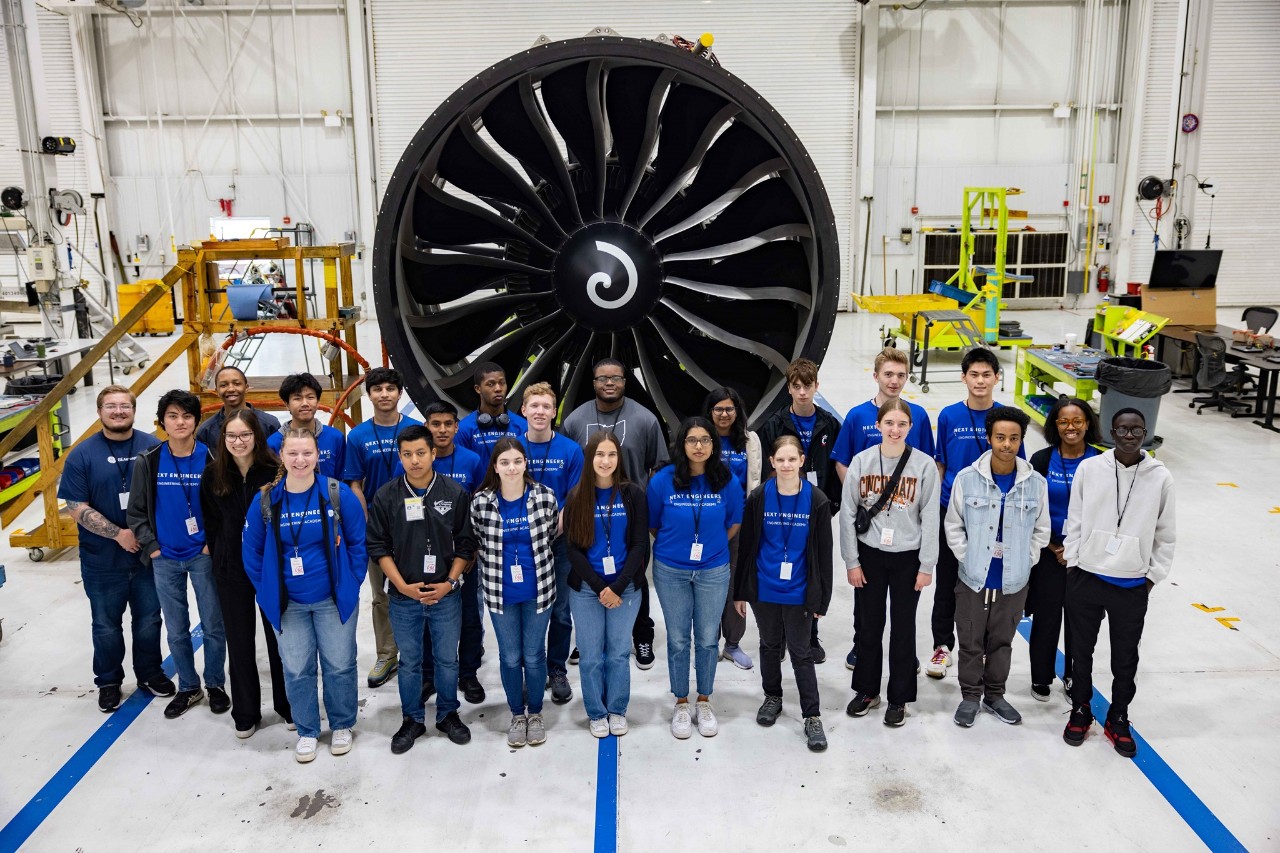
Through the program, students went on various industry visits, including to GE Aerospace's testing plant located in Peebles, Ohio. Photo/GE Aerospace
Along with hands-on design projects, students went on industry visits, getting exposed to what engineering looks like in the real world. Touring the GE Aerospace testing plant in Peebles, Ohio, was a standout experience for Abebe. There, the group was able to get an up-close look at the equipment and watch footage of an actual test. This visit was impactful for Abebe because he has a strong interest in engines and transportation, which is what led him to choose mechanical engineering for his degree.
His experience in the Engineering Academy program put him a step ahead of his peers once he arrived at CEAS as a student. For example, in the Engineering Foundations course all CEAS first-year students are required to take, Abebe was already familiar with the engineering process and theories being presented in class, something he shared helped him greatly.
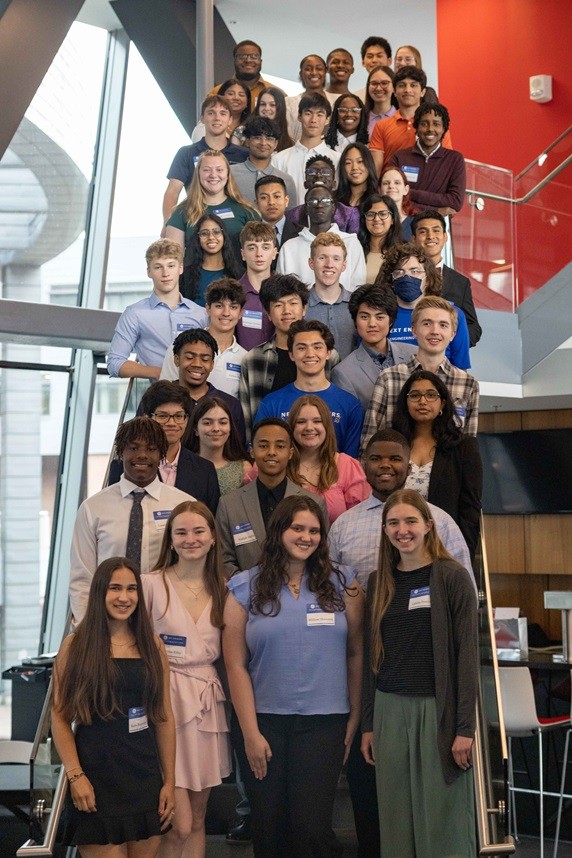
The first cohort of UC Academy graduates were honored with a graduation ceremony. Photo/GE Aerospace.
"Through the Next Engineers program, we are not just shaping young minds, but empowering them to shape the future of engineering," said Whitney Gaskins, PhD, associate dean of the CEAS Office of Professional Development and Community Impact.
In 2024, UC graduated its first cohort of Academy students. Those who complete the program and go on to pursue an engineering degree at an institution of higher education will receive a scholarship. Engineering Academy taught Abebe what it means to be an engineer, and he looks forward to building on this strong foundation throughout his years at UC and beyond.
Interested in Next Engineers?
To find out more about Next Engineers and other initiatives for high school students, visit the CEAS Office of PDCI.
Featured image at top: University of Cincinnati's Mantei Center. Photo/UC Marketing and Communications.
Related Stories
Dylan Mulvaney visits CCM, where she got 'the best degree in the world'
October 6, 2026

UC College-Conservatory of Music alumna Dylan Mulvaney (BFA Musical Theatre, '19) visited campus to meet with current students on Friday, Oct. 2. During the 2.5 hour Q & A session, Dylan talked about her career, shared advice and answered questions from CCM's current Musical Theatre students.
FAA turns to AI to reform air traffic control
October 6, 2026

WKRC Local 12 turned to an aerospace engineering professor at the University of Cincinnati to explain the risks and benefits of a proposal by the Federal Aviation Administration to use artificial intelligence to revamp air traffic control in the United States.
Connecting through alternative communication
October 5, 2026
As a professional cheerleader and second-year student working toward a master’s in speech-language pathology at the University of Cincinnati, Grace Harahan shares what drives her to explore and advocate for alternative communication methods.