
Honoring excellence in nurse anesthesia
Celebrating National CRNA Week and the legacy of UC's Nurse Anesthesia program

National CRNA Week is the annual celebration of the nearly 74,000 Certified Registered Nurse Anesthetists (CRNA) and residents in nurse anesthesiology programs in the United States.
Since the first formal nurse anesthesia education program was established nearly 120 years ago in Portland, Ore., much has progressed in the profession and health care. Similarly, the University of Cincinnati College of Nursing Nurse Anesthesia program, established as the Cincinnati General Hospital School of Anesthesia in 1945 and currently ranked No. 11 in the nation by U.S. News & World Report, has evolved to meet changing demands by preparing nurse anesthetists ready to meet with excellent clinical and leadership skills.

Pictured (from left): Vera Griner, Louise Harris, Betty Fleenor, Geraldine Jones, Eileen Depuy, Evelyn Harris, Esther Reece, Carolyn Nicholson and Wanda Wilson celebrate the program's 30th anniversary in 1975. Photo/UC College of Nursing
A significant milestone in the profession’s advancement was the establishment of the American Association of Nurse Anesthesiology (AANA), in 1931. The organization’s mission to advance, support and protect nurse anesthesiology has raised the bar for the profession, its practitioners and educators through several initiatives throughout the years, including tightening accreditation standards for nurse anesthesia programs in the mid-70s.
Among the new accreditation standards, nurse anesthesia schools were required to extend their programs to 24 months and instructors were expected to begin completing continuing education in curriculum, instruction and testing. In addition, all full-time instructors were encouraged to have a bachelor’s degree. General Hospital's nurse anesthesia school quickly met these new standards and, in the coming decades, remained well ahead of accreditation requirements—establishing its Master of Science in Nursing program with an anesthesia major seven years before programs were required to teach at the master’s level and its Doctor of Nursing Practice (DNP) program nearly a decade before required.
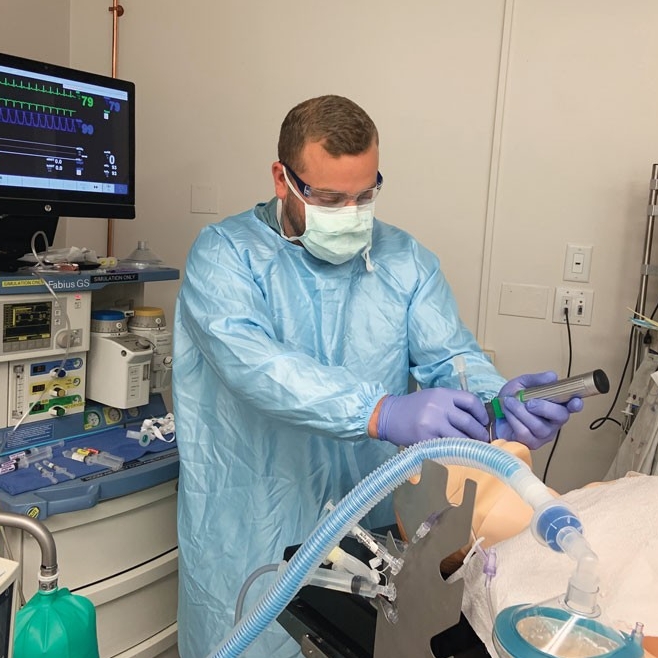
CRNA student practices intubation in the nurse anesthesia program's simulation lab. Photo/UC College of Nursing.
CRNAs bring a high level of training and expertise to patient care, especially in rural and underserved areas. Today, nurse anesthesia education and the profession still are changing at a rapid pace, spurred by the increasing need for anesthesia providers, new technology and process improvements.
In keeping with tradition, UC Nurse Anesthesia program has developed a curriculum that prepares professionals to promote evidence-based practice, patient safety and quality improvement in health care settings as they develop organizational and systems leadership skills. Our students also get to bring their expertise to the local community with targeted quality-improvement projects, including the implementation and evaluation of enhanced recovery after surgery (ERAS) protocols and maternal care initiatives; providing hands-on, ultrasound-guided intravascular access and peripheral nerve block education; creating preoperative processes to decrease surgical case cancelations and improve patient care for adults with disabilities, and creating anesthesia protocols for transplant surgery.
As the role of nurse anesthetists has experienced global growth and recognition, the college’s nurse anesthesia program has broadened its horizons to form international partnerships and became one of only 13 non-physician anesthesia programs/schools in the world to receive level three accreditation—the highest level—by the International Federation of Nurse Anesthesia (IFNA), an organization dedicated to the advancement of educational standards and practice for anesthesiology across the globe.

UC Nurse Anesthesia students in Paris, France, for a week of networking and education alongside Institut de Formation Interhospitalier Theodore Simon (IFITS) students.
The nurse anesthesia profession has grown from informal participation in anesthesia care to its status as an integral part of the health care system and continues to evolve with an emphasis on education, autonomy and patient safety. Likewise, much progress has taken place throughout the eight decades since the UC program was founded. But one aspect has not changed: the program’s tradition of producing top-notch nurse anesthetists who make an impact wherever they go.
Related Stories
UC's Anita Afzali, MD, receives American College of Gastroenterology International Leadership Award
October 27, 2026
The University of Cincinnati's Anita Afzali, MD, receives the American College of Gastroenterology's 2026 International Leadership Award for advancing global digestive health education, research and partnerships.
AI breast cancer survival model from Cancer Center could improve accuracy and personalize care
October 23, 2026
UC Cancer Center researchers, including lead author Wedad Alatebi, developed a deep learning survival model for breast cancer that combines detailed clinical and genetic information, potentially offering physicians a more accurate tool to guide treatment decisions.
UC expert explains potential impact of Pennsylvania’s new vape product law
October 22, 2026

UC professor Ashley Merianos speaks to the Pittsburgh Post-Gazette about Pennsylvania’s new vape law, youth vaping prevention, enforcement challenges and possible unintended consequences.