
OrSense cutting-edge technology helps improve donor experience at Hoxworth Blood Center

Are you one of those donors who hates the finger prick before you donate blood? Those pricks are now a thing of the past at Hoxworth Blood Center, University of Cincinnati.
New screening methods for iron levels: OrSense
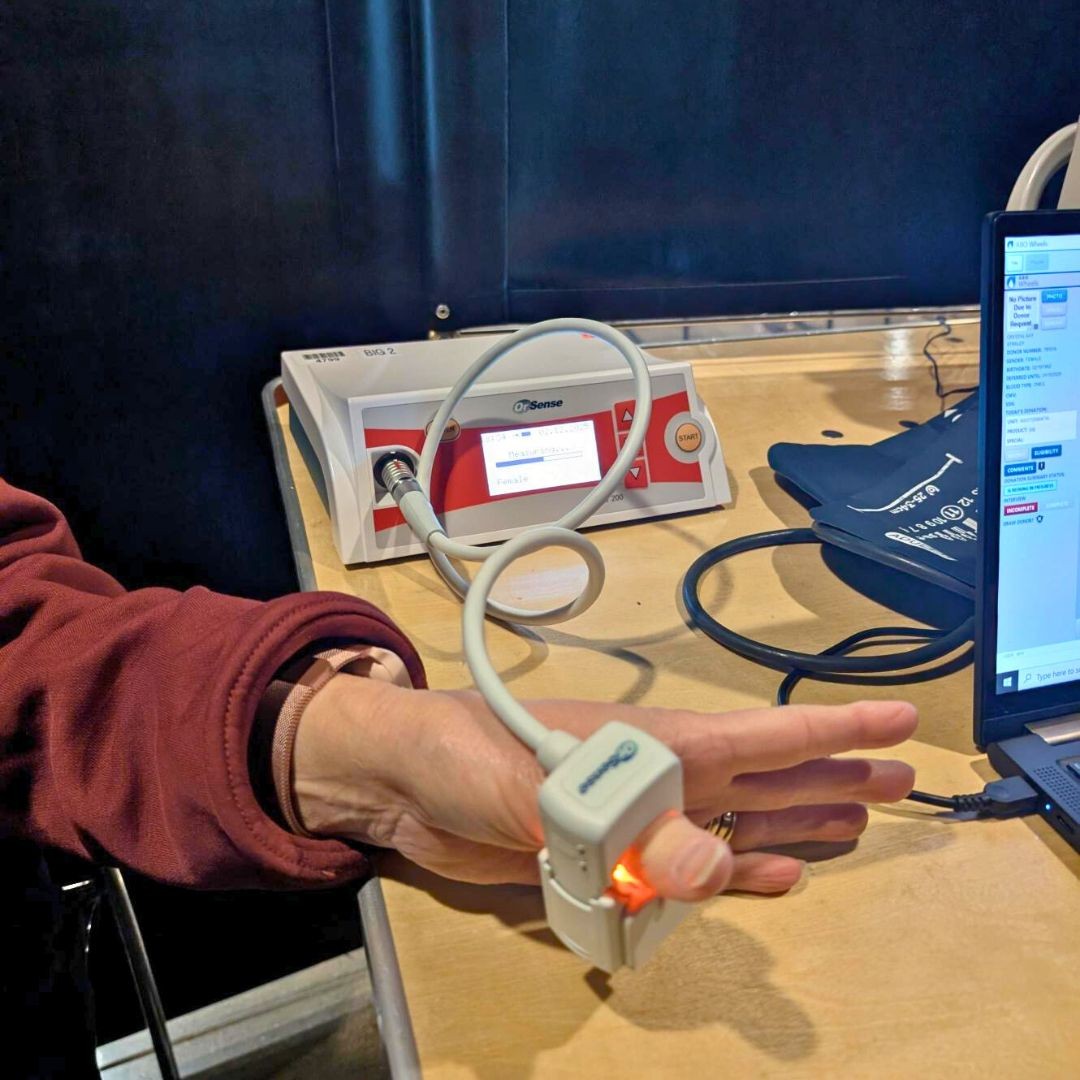
OrSense device on person's finger
Hoxworth is beyond excited to announce that we have switched to the OrSense device, similar to a blood pressure cuff for your finger, which measures hemoglobin.
Not only is this more comfortable for the donor, but eliminates biohazard waste.
With OrSense, we honor our generous donors by making hemoglobin screening seamless and noninvasive—no finger pricks, no discomfort, just a better donation experience.
Michael Wilson Division director of donor services, Hoxworth Blood Center
How does OrSense work?
OrSense is a ring-shaped sensor that fits over the thumb. Pressure is applied by the sensor and temporarily stops the blood flow to the finger, creating new blood dynamics. The OrSense device can then use a painless signal-to-noise ratio to determine hemoglobin.
Hemoglobin is defined as a protein containing iron in red blood cells that carries oxygen and carbon dioxide. This is simply another way to read iron levels, but it is a much more comfortable process for the donor.
The Food and Drug Administration requires all blood donors to complete a screening and mini-physical to make sure they are healthy and eligible to donate blood. Part of that process includes measuring iron levels. One method to check iron levels is called hematocrit. This has been the most common method for decades. Hematocrit looks at the composition of red blood cells, white blood cells and platelets. It is reported as a percentage.
To get that information, a device called UltraCrit pricks the finger to get a small sample of blood. In addition to the UltraCrit device, this method required alcohol swabs, gauze and sometimes bruising and finger pain. But not anymore!
Leading the way in blood bank innovation
Hoxworth Blood Center is proud to improve the donor process, have fewer deferrals and eliminate waste from the old method.
At Hoxworth Blood Center, innovation isn’t just a buzzword — it’s a commitment to enhancing the donor experience, improving efficiency and advancing the future of blood banking. By implementing cutting-edge technology like OrSense, we are redefining what it means to donate blood — making the process more comfortable, seamless and donor-friendly. In adopting this groundbreaking screening method, Hoxworth continues to lead the industry with forward-thinking solutions that prioritize both donors and patients.
When you donate with Hoxworth, you’re not just giving blood — you’re partnering with a pioneer in the field, ensuring that life-saving donations are collected with the highest level of care and innovation.
Because at Hoxworth, "Saving Lives Close to Home" starts with leading the way.
Tags
Related Stories
Rewarding blood & platelet donors this October at Hoxworth
September 30, 2026
As the need for lifesaving blood and platelets continues, Hoxworth Blood Center at the University of Cincinnati is giving donors extra reasons to give this October with an exclusive Buddy-themed wearable blanket and the launch of its new Platelet Power Points rewards program.
This September, give blood for local patients fighting cancer and sickle cell disease
September 18, 2026
September is dedicated to raising awareness of several serious diseases, including sickle cell disease and childhood cancer. For patients in Greater Cincinnati fighting these diseases, awareness is only part of the equation. They also need lifesaving blood products.
Sharing good news about Cincinnati area kidney recipient
July 31, 2026
Daneal received a kidney transplant after being on the transplant list for several years.