
Putting it all together: The UC Nursing capstone experience

Throughout UC’s Bachelor of Science in Nursing program, students gain a deep foundation in both the science and the art of healthcare. They learn anatomy and physiology, pharmacology, pathophysiology and evidence-based practice, while also building skills in critical thinking, communication, ethical decision-making and compassionate patient care. Clinical placements, co-ops and study abroad programs help students develop confidence in their role through hands-on, real-world experiences in a variety of healthcare settings.
During the program’s final semester, all knowledge and experience acquired comes together at the Capstone course. Through this experience, students reflect on their academic and clinical journey and design an evidence-based project that connects their education with the realities of professional practice. Whether focused on improving patient outcomes, enhancing nursing workflows, promoting professional development, or impacting community health, the capstone project challenges students to think critically, act creatively and demonstrate their readiness to enter the nursing profession.
With guidance from a faculty advisor who offers support throughout the course, student groups begin by selecting a target patient population and identifying a key issue to address through an educational intervention. They then define how success will be measured and dive into current research to evaluate the evidence. From there, they develop a detailed plan that includes learning objectives, a content outline, and a strategy for evaluating outcomes.
Around the midpoint of the course, students share their project development, implementation, evaluation, and preliminary results with their classmates, fostering peer collaboration and constructive feedback. Following this, they present their work to key collaborators directly impacted by their educational intervention, which is ultimately implemented in a real-world setting. To conclude the course, each group creates and submits a project poster, which is showcased during the Undergraduate Scholarly Showcase in the final week of classes.
Capstone projects reflect the many interests and strengths of our students, as well as their commitment to improving patient and community care and advancing the nursing profession on many fronts. Here are a few examples showcasing the range of topics and approaches the 2025 senior class has taken:
Benefits of kangaroo care in the NICU
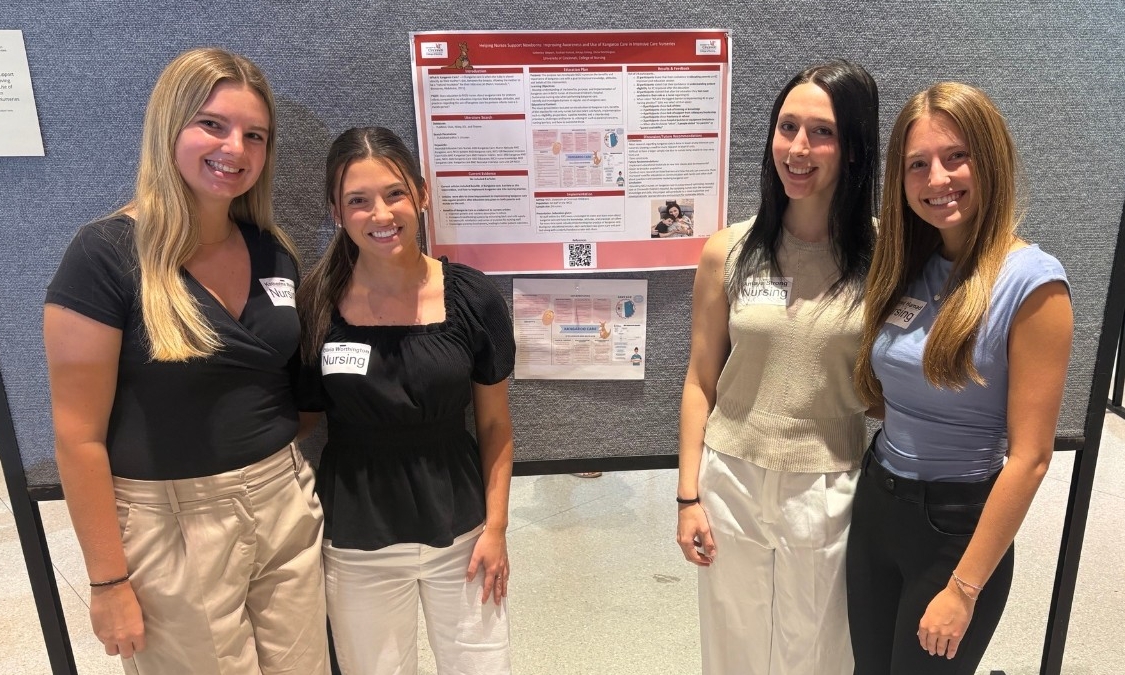
Kangaroo Krew team members presenting at UC's Undergraduate Scholarly Showcase. Photo provided.
Amaya Strong, Katherine Wolpert, Olivia Worthington and Rachael Hamad created and delivered an educational intervention for the Level IV NICU at Cincinnati Children’s Hospital nurses to reinforce the importance of kangaroo care, dispel misconceptions and address implementation barriers. Despite its benefits, kangaroo care—a method of skin-to-skin contact proven to support premature infant development—is less consistently practiced in high-acuity NICUs due to medical complexity and uncertainty among staff. Materials created by the team will be integrated into the NICU's new hire orientation resources, planting the seed for more widespread and confident use of kangaroo care in critical care settings.
Use of telehealth to reduce hospital readmission rates

Backstreet Girls team members presenting at UC's Undergraduate Scholarly Showcase. Photo provided.
Emma Firestein, Grace Hall, Simpreet Sandhu, Sokhna Baro, and Trinity Marsh tackled the persistent challenge of hospital readmissions at UC Medical Center. Based on their clinical and co-op experiences, the group identified key barriers faced by patients—particularly older adults, non-English speakers, and those without reliable transportation—in following through on discharge instructions. Their capstone project focused on educating nurses about the benefits of telehealth and encouraging them to refer patients for virtual follow-up care, aiming to improve post-discharge support and reduce preventable readmissions.
Importance of post-code debriefing
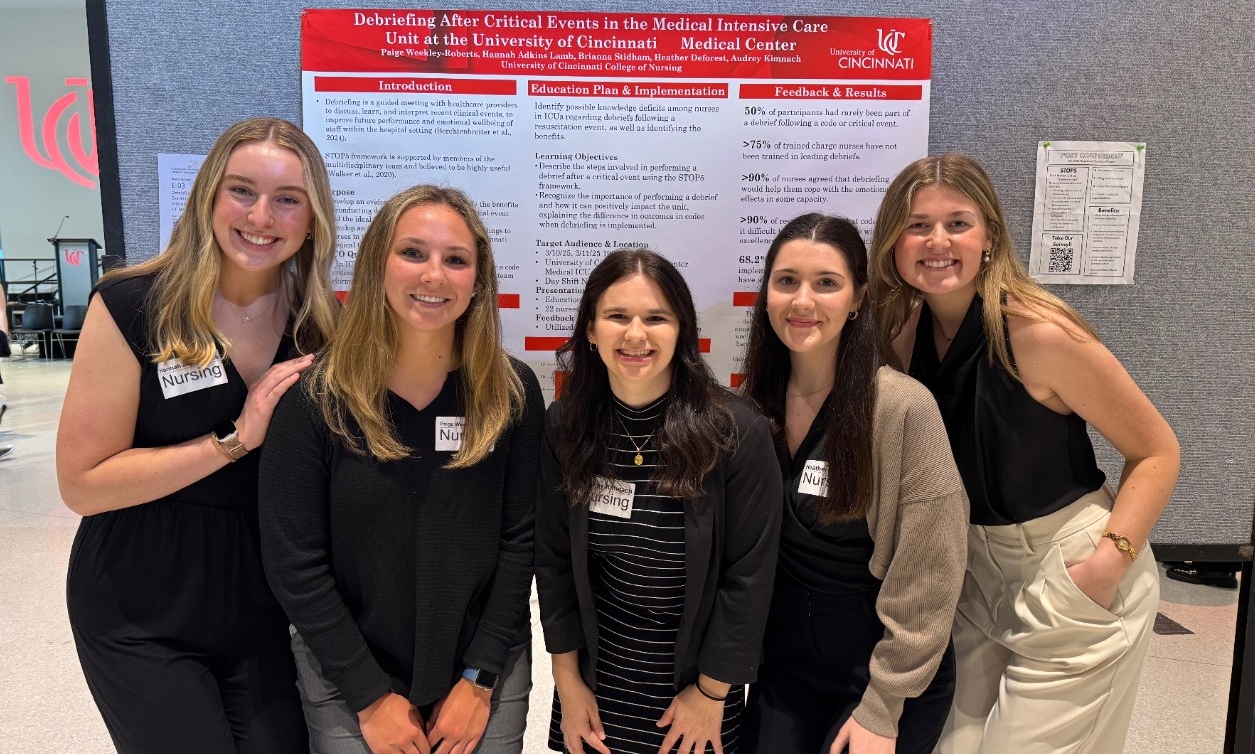
Pulse Check team members presenting at UC's Undergraduate Scholarly Showcase. Photo provided.
Audrey Kimnach, Bri Stidham, Hannah Adkins-Lamb, Heather Deforest and Paige Weekley focused their project on introducing a structured debriefing process for ICU nurses following codes or other critical events. Motivated by the lack of consistent emotional and safety-related reflection after emergencies, the team implemented the "Stop 5" method—an evidence-based, five-minute debrief designed for high-intensity settings. They adapted the framework to suit the ICU’s demanding pace, emphasizing its role in improving communication, supporting emotional well-being and enhancing patient safety.
Promoting ultrasound-guided IV access

Care Crew team members presenting at UC's Undergraduate Scholarly Showcase. Photo provided.
Alexander Daniels, Dominic Taylor, Ryan Lauck and Shane Hothem focused their project on promoting ultrasound guidance for peripheral IV insertion—an emerging best practice especially valuable for patients with difficult access, such as those in the Cardiovascular Intensive Care Unit (CVICU) at UC Medical Center. Drawing on their clinical experiences, the team created and delivered an educational session for nurses, highlighting how ultrasound guidance can improve patient comfort, reduce multiple IV attempts and streamline unit workflow.
Tags
Related Stories
Still the top ‘cat
October 20, 2026

The University of Cincinnati Bearcat mascot was voted Cincinnati’s favorite mascot in a Cincinnati Enquirer reader poll, earning 45.1% of the vote and topping other local favorites.
Got three minutes? Present your research for a chance to win $1,500
October 19, 2026
The University of Cincinnati’s Three Minute Thesis (3MT) Competition challenges graduate students to explain their research or scholarship to people outside their field in just three minutes using a single slide. Applications for the 2027 competition open Sunday, Nov. 1, 2026, giving graduate students a chance to sharpen a skill that can make a difference far beyond graduate school.
Portia Zaire brings cancer prevention research to UC Nursing
October 16, 2026
Dr. Zaire's doctoral and postdoctoral work centered on timely access to colorectal cancer screening in Black communities, as Black Americans have the highest colorectal cancer mortality rate and are often diagnosed at later stages, when outcomes are worse. Today she describes herself as a cancer health services researcher, focusing on how the health system delivers care at each point along the cancer continuum, from screening through diagnosis, treatment and survivorship.