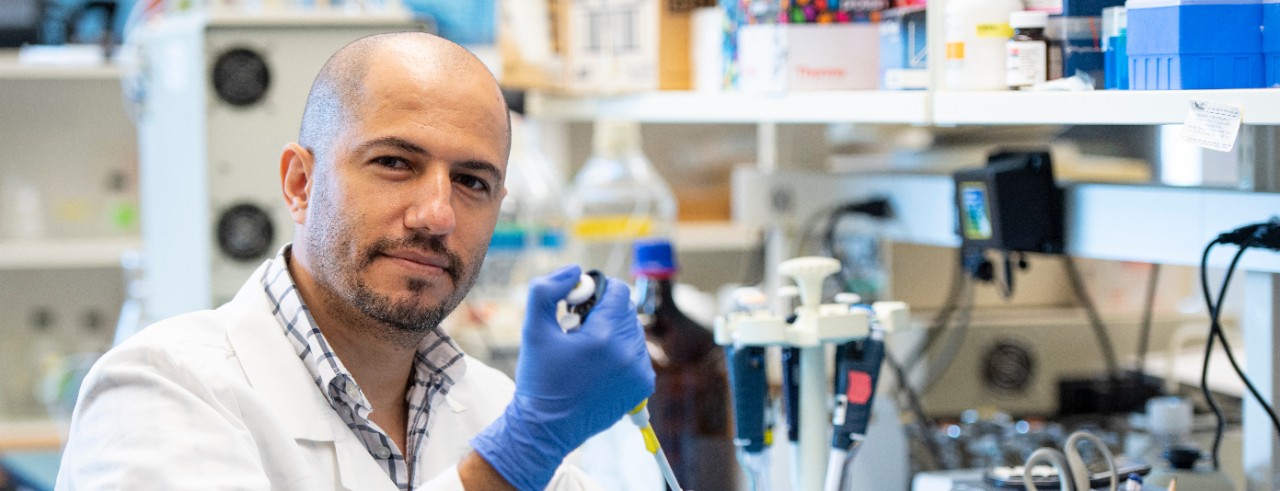
Researcher developing pancreatic cancer treatment that targets newly identified protein
MSN highlights Cancer Center trainee associate member

MSN highlighted the University of Cincinnati Cancer Center’s Ahmet Kaynak's research that examined the unique tumor microenvironment of pancreatic ductal adenocarcinoma cells, identified one of the key proteins that aids tumor treatment resistance and developed a new drug targeting this protein that reduced tumor size and increased survival in animal models.
The tumor microenvironment is the ecosystem that includes the tumor and surrounding immune cells, blood vessels and other tissue. Kaynak said PDAC’s microenvironment has unique characteristics that suppress the immune system’s ability to attack the cancer cells (causing immunosuppression), hinder drug delivery, and promote resistance to chemotherapy, radiotherapy and immunotherapy.
“There is an unmet need for the development of novel treatment approaches,” said Kaynak, PhD, a trainee associate member of the Cancer Center and postdoctoral fellow in the Hematology & Oncology Division of the Department of Internal Medicine in UC’s College of Medicine. “In this project, we asked the question of what the factors are that lead to immunosuppression in the tumor microenvironment.”
Kaynak and colleagues identified that a protein called Hsp70 contributes to tumor immunosuppression.
The team then developed a drug called SapC-DOPG that specifically targets cancer cells by binding to phosphatidylserine, a lipid on the cells’ surface. This work builds upon that of Kaynak’s mentor, Xiaoyang Qi, PhD, who developed a similar drug called SapC-DOPS that is currently in Phase 2 clinical trials as a lung cancer treatment.
SapC-DOPG was designed to target Hsp70 within PDAC cells. In animal models of PDAC, the drug was well tolerated and resulted in smaller tumor size and increased survival.
“We hope to transition to clinical settings and investigate whether SapC-DOPG can be used as a therapeutic agent in pancreatic cancer patients,” Kaynak said. “The safety of the analog SapC-DOPS has been proven in clinical trials with patients. We hope our novel drug can also be safely used in patients in the future.”
Read the original UC News story.
Featured photo at top of Kaynak in the lab. Photo/provided.
Related Stories
Three years, countless stories
May 15, 2026
UC's Klekamp Law celebrates its 193rd Hooding with stories from graduates reflecting on their paths through the college.
Driven by curiosity, guided by care
May 14, 2026
Max Wilson, a University of Cincinnati College of Allied Health Sciences health sciences major on the pre-physician assistant track, found his path expanding beyond the classroom and into hands-on research focused on human performance and patient care.
New cohort of nursing students get ready to join co-ops
May 14, 2026
A new chapter is beginning for more than 100 University of Cincinnati College of Nursing rising seniors as they embark on one of the most distinctive experiences in undergraduate nursing education: the UC Nursing Co-op Program. The incoming cohort will fan out across Cincinnati's premier healthcare institutions, stepping into some of the most dynamic and specialized clinical environments in the region. Placement sites include UC Medical Center (UCMC), West Chester Hospital, Cincinnati Children's Hospital Medical Center (CCHMC) Burnet, College Hill, and Liberty campus.