
UC gets $158M software donation to train students for geosciences jobs
Tech company donates licenses for geosciences research, training

The University of Cincinnati secured a $158 million donation of geosciences software from global energy technology company SLB.
The generous gift provides students and faculty with access to the same digital platforms used by leading energy companies worldwide.
“Subsurface energy sources, both conventional and unconventional, satisfy over 80% of total U.S. energy needs and mastering the subsurface is central to the nation’s energy future,” said UC Professor of Hydrogeology Reza Soltanian, who helped secure the donation.
“This is an impactful donation that will provide an opportunity for our students to get real-world experience while pursuing their degree at UC,” UC College of Arts and Sciences Dean James Mack said.
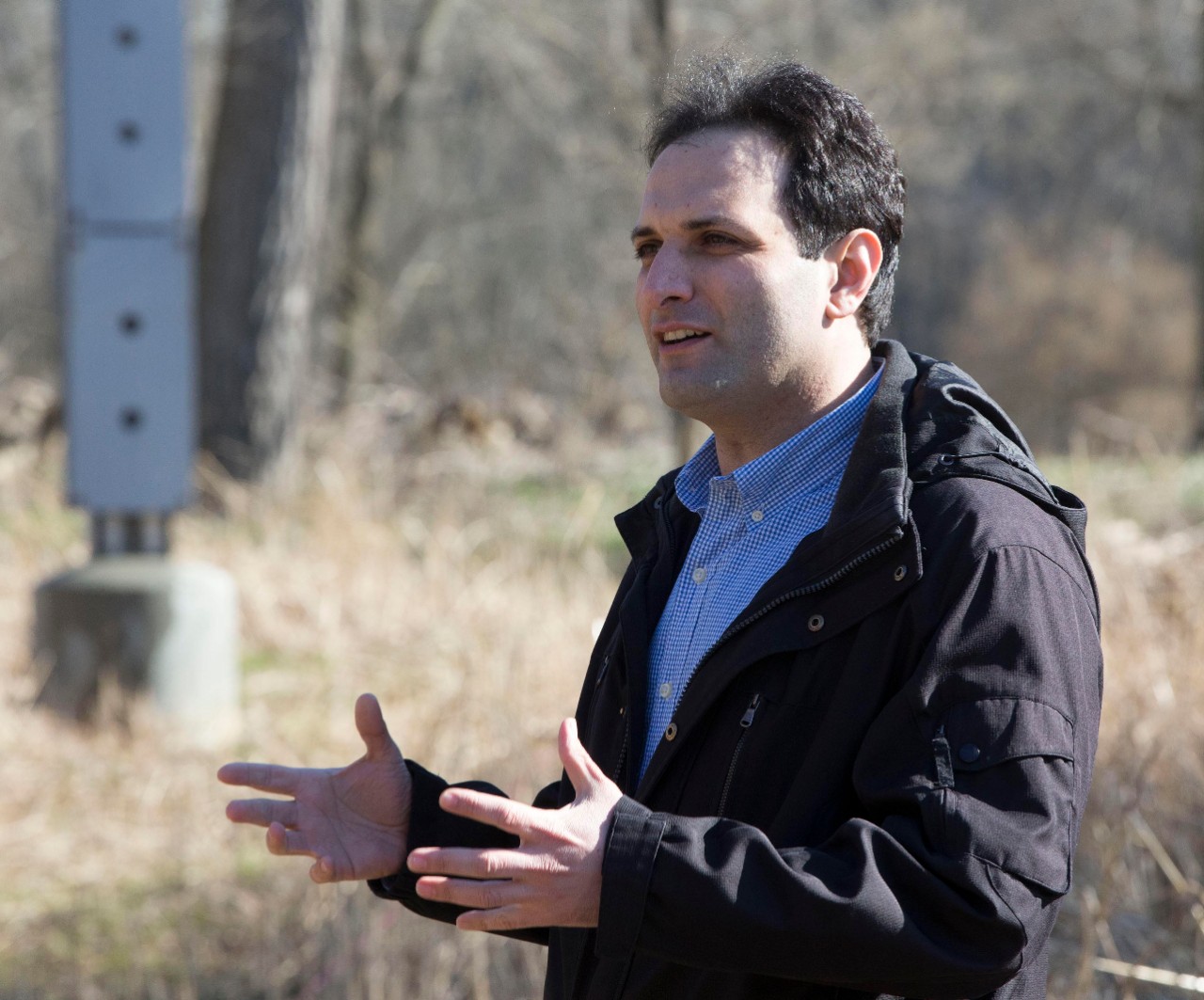
Professor Reza Soltanian helped UC secure software licenses from tech company SLB that will help students prepare for jobs in the geosciences. Photo/Joseph Fuqua II/UC
UC Geosciences Department Head Craig Dietsch said the software licenses will give UC grads a competitive edge as they launch their careers. Students will be able to develop powerful 3D models for subsurface groundwater flow and hydrogen storage. They also can model the layered crust of the Earth, he said.
“Students who have worked with these software packages will be highly sought after by employers in a number of fields, including environmental engineering,” Dietsch said.
Mack agreed, noting how important practical skills are for UC’s mission.
“Experiential learning is the hallmark of a University of Cincinnati education. Our faculty are committed to acquiring the resources to make this happen,” he said. “Access to this software will give our students a competitive advantage not just while they are studying at UC, but also well after the leave.”
Energy decisions today are data decisions.
Reza Soltanian, UC Department of Geosciences
Most geoscience research in the energy industry is multidisciplinary, Soltanian said.
“The oil and gas industry, and subsurface research more broadly, is highly integrated and multidisciplinary. The donated software platforms connect everything from basic geoscience visualization to geological modeling, engineering design and reservoir management,” he said.
“Energy decisions today are data decisions. This gift allows UC to integrate geoscience, engineering and advanced computing in one digital environment, preparing our students to drive the energy transition,” Soltanian added.
The software will be directly relevant to UC Digital Futures’ new Data Visualization Lab, where researchers will combine modeling and visualization.
Meanwhile, the university is creating a new Subsurface Energy Institute led by Soltanian at UC’s Digital Futures to serve as a hub for research into emerging priorities such as geothermal energy, hydrogen storage, lithium extraction and shale gas fields that are particularly relevant to Ohio’s economy.
The institute dovetails with UC’s plans for a related Energy Innovation Institute, UC Vice President for Research Patrick Limbach said.
“Oil and gas remain globally important, but the real story is the rapid rise of new energy frontiers,” Limbach said.
The new institute would help UC address state and national energy needs.
“It’s an opportunity for investment, invention and impact,” Limbach said “This is exactly the kind of forward-looking applied research that Digital Futures was designed to foster. This is yet another exciting milestone for UC.”
Featured image at top: Tech company SLB donated software licenses to UC that will help students prepare for jobs in the geosciences. Photo/Imaginima/iStockPhoto
The next groundbreaking discovery
UC is a powerhouse of discovery and impact as a Carnegie 1 research institution. From pioneering medical research to transformative engineering and social innovation, our faculty and students drive progress that reaches across the world.
Related Stories
Collaboration over consultation
October 16, 2026
New University of Cincinnati research published in the journal Health Expectations found stroke survivors participating in rehab research desire an approach that prioritizes shared decision-making, peer relationships and a focus on what they can accomplish rather than their deficits.
Cincinnati Spotlight features CCM's new Conservatory Series concerts
October 15, 2026

Cincinnati Public Radio features CCM's new Conservatory Series in its latest "Cincinnati Spotlight." The series launches on Wednesday, Oct. 21 with its inaugural "Grand Tradition" concert featuring a variety of CCM's distinguished faculty artists.
Medical devices exec touts UC co-op
October 15, 2026

UC College of Engineering and Applied Science alumnus Adam Hauke talks to Medium about the speed of innovation in developing new medical devices. Hauke is global director of product strategy & innovation at Gentherm Medical. He earned a doctorate and bachelor's degree in biomedical engineering from UC.