
UC anthropology co-op bridges culture and design research at Live Well Collaborative
A&S student Evan Kamp uses holistic thinking to shape health and consumer research

In the world of applied innovation, where academic theory meets real-world problem-solving, University of Cincinnati College of Arts and Sciences student Evan Kamp is carving out a distinctive path.
Kamp, an anthropology major participating in the A&S optional co-op program, is completing a full-time co-op at the Live Well Collaborative — a nonprofit, human-centered design firm that partners with sponsors such as Cincinnati Children’s Hospital Medical Center and Procter & Gamble. Since starting in January 2026, he has been bridging the gap between cultural analysis and human-centered design, demonstrating how an anthropology toolkit can thrive beyond traditional academia.
A perfect fit for applied anthropology
Kamp’s journey to Live Well began in the classroom. During his applied anthropology course at UC, research lead and educator, Jamie Maier visited to discuss the collaborative’s work.
“Throughout my college career, I haven’t necessarily wanted to pursue a typical route in anthropology,” Kamp said. Traditional paths like cultural archaeology didn’t appeal to him. Instead, he was drawn to applying anthropological thinking in business and practical settings.
Maier’s presentation on Live Well clicked.
“This is the opportunity I’ve been waiting for,” Kamp thought. He reached out after class, expressed his interest, and soon landed a co-op. His academic training in qualitative research, cultural analysis, and stakeholder understanding helped him feel prepared.
“As soon as I stepped into the role, it was very apparent,” he said, noting how those skills directly translated to synthesizing data and conducting interviews.
“Evan joined us as our first anthropology co-op,” Maier said. “His focus on individuals' cultural perspectives and lived experiences brings additional rigor and methodology to our research. His perspective is valuable for projects, for Live Well as an organization, and as a learning opportunity for other co-op students.”
Initially part-time, Kamp transitioned to full-time after just a week, while balancing online courses. The semester-based structure allows him to dive deep into projects while continuing his studies, and he’s already been invited back for a full-time summer role.
A week in the life: Projects, research and ideation
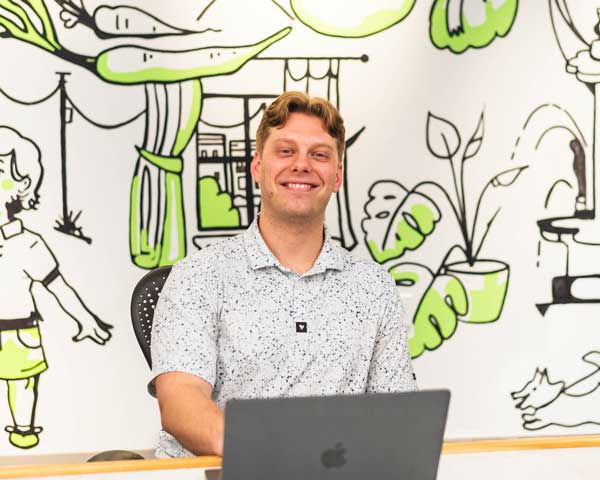
Evan Kamp inside the Live Well Collaboration. Photo/UC DAAP student Chloe Pampush
Kamp’s schedule is shaped by sponsor projects.
Mondays, Wednesdays and half of Fridays are dedicated to Procter & Gamble, where he is wrapping up one initiative and planning the next, focusing on recruitment for preliminary research. Tuesdays, Thursdays and the rest of Fridays shift to the Center for Clinical and Translational Science and Training at Cincinnati Children’s, where he is helping develop a Community Trust Toolkit aimed at increasing research participation among underrepresented communities.
A typical day includes background research, semi-structured interviews with community members and medical professionals, data synthesis, and ideation.
“We’ve moved into refining concepts and scheduling follow-up interviews,” Kamp said.
Digital tools help the team see the bigger picture. Platforms such as Miro support collaborative timelines and stakeholder maps. AI tools, like Google Gemini, help speed up theme identification in qualitative data.
“It allows us to get right to it,” he said, emphasizing that AI supports — but does not replace — the human insight at the core of his anthropology training.
Kamp also helps with Live Well’s educational workshops, which introduce design thinking to audiences ranging from health care providers to Live Well member organizations, including P&G, Boeing, and local nonprofits. Those sessions have sharpened his public speaking and professional communication skills.
Projects with impact: Anthropology in action
Kamp’s anthropological lens is especially visible in the Community Trust Toolkit project. Drawing on his medical anthropology coursework, he develops interview guides, synthesizes transcripts and conducts literature reviews — familiar academic skills now applied in a high-impact setting.
He approaches the work with a holistic mindset.
“Realizing that communities aren’t homogeneous — everyone is unique — has been really important,” he said. That perspective has helped guide broader concept development for the toolkit. One idea he is particularly proud of is a visual concept that illustrates the connection between researchers and community members.
Onsite experiences, such as attending Research Participant Advisory Committee meetings, have deepened that understanding.
“We hear from past participants and medical professionals,” Kamp said, adding that those conversations offer insights into lived experience that interviews alone can’t always capture.
Challenges, growth, and mentorship
Translating theory into practical tools can be challenging, especially within a complex medical system where trust-building often falls to individual providers.
“We need to do what we can do,” Kamp said. Instead of trying to fix the entire system, his team focuses on realistic road maps tied to CCTST’s seven-year grant.
Mentorship from Maier has been central to his growth.
“She’s taken me under her wing,” Kamp said. She has coached him in project management, recruitment and behind-the-scenes planning, while modeling multidisciplinary collaboration.
Regular interaction with high-level sponsors — through weekly calls, emails and co-creation sessions — has also accelerated his development.
“My professionalism in communication has improved drastically,” he said. He has learned how to maintain relationships that are both approachable and professional across a variety of settings.
A shift in perspective and what comes next
His co-op has reshaped Kamp’s view of what anthropology can do.
“It’s applicable in all realms — medical, business, e-commerce,” he said. What once felt like a “nebulous idea” has become lived experience.
That realization came full circle when he returned to the anthropology department to speak at a career day, just as Maier once visited his class. Kamp is also co-authoring a scholarly publication with CCTST sponsors based on the toolkit work — a rare opportunity for an undergraduate.
If another UC anthropology student asked whether they should pursue a similar co-op, Kamp wouldn’t hesitate.
“Absolutely. We need you,” he said. He stresses the importance of holistic thinking in design research and encourages peers to lean into human-centered innovation.
For Kamp, Live Well has been “challenging in the best way,” offering leadership experience, multidisciplinary exposure and a professional launchpad. As he looks ahead — including the possibility of a post-graduation fellowship — he sees his co-op as more than a job.
It is, he said, a way to apply anthropology where it matters most: in collaborative, impactful work that connects research, design and the communities they serve.
Featured image at top of Evan Kamp at Live Well. Photo/DAAP student Chloe Pampush.
Elevate Your Degree: A&S Optional Co-op
Why wait until graduation to start your career? Our optional co-op program gives A&S students a competitive edge by combining paid professional work with academic reflection. It’s more than just a job—it’s a way to apply what you’re learning in the real world while earning your degree.
Related Stories
College of Arts and Sciences sees rapid expansion in co-op programs
March 26, 2026
The co-op program at the University of Cincinnati’s College of Arts and Sciences is experiencing unprecedented growth, transforming how students gain real-world experience alongside their academic studies.
From co-op to CEO
November 13, 2023
Few understand the value of co-op quite like Jeremy Jarrett. Jarrett is president and CEO of Cincinnati-based tech consulting firm Kinetic Vision, a company that has integrated UC co-op students for over 30 years. Jarrett himself got his start at the company through co-op as UC aerospace student in the '90s.
UC offers experiential learning abroad in Central America
April 19, 2024
In the tropical paradise of Costa Rica, fourth year journalism and international affairs student Stephanie Rivera embarked on an unforgettable journey of self-discovery and cultural immersion. Leaving behind the familiar sights and sounds of Cincinnati, Rivera set out to study abroad for a transformative semester in this Central American country, rich with vibrant biodiversity and cultural heritage. The College of Arts & Sciences (A&S) at UC places great emphasis on encouraging study abroad and experiential learning opportunities for its students. Recognizing the transformative power of global experiences, the college supports a variety of study-abroad programs that enable students to enhance their academic pursuits while gaining valuable cultural and personal experiences.