
Aerospace engineering students win engine design competition
Undergraduate students earn first place in design challenge hosted by Air Force Research Laboratory

Every year, the Air Force Research Laboratory's Aerospace Propulsion Outreach Program develops an engineering challenge for college students nationwide. The 2026 challenge was to design a heat exchanger for a small gas turbine engine. The University of Cincinnati student team placed first out of 21 competing teams.
The core of the competition is modifying and innovating turbine engines, but the specific objective changes annually. This year, teams were tasked with designing a heat exchanger that takes hot bleed air from the compressor and uses it to heat outside air at a rate of 2,700 BTU/hr. The design challenge was given to students in September, giving them nearly two full semesters to work on their design.
"The goal of the competition is to apply real engineering principles to solve a problem that mirrors what engineers face in industry," said Alex Walicki, who graduated with his aerospace engineering degree in spring 2026.
Advised by Jongguen Lee, professor in the Department of Aerospace Engineering and Engineering Mechanics, the UC team was made up of 13 fifth-year aerospace engineering students, and the project served as their senior capstone. Along with a faculty adviser, teams were given a mentor from the Air Force Research Laboratory to guide them through the process.
Projects like APOP provide a realistic look at what it's like working in engineering. It was one of the most valuable experiences of my time in school.
Alex Walickim UC aerospace engineering graduate
Walicki shared that the team went through a full engineering design cycle over the course of the project, allowing them to expand their engineering knowledge past their coursework. They started by breaking down the project requirements to develop concepts for their initial design. The team had to make sure the engine met the required heat extraction, but in a way that didn't compromise engine performance. To ensure the work was done efficiently and effectively, the students decided to divide themselves into three sub teams for testing, design, and computational fluid dynamics and analysis.
"I was on the testing team, so I especially had the opportunity to work on something that I don't get the chance to in the classroom," Walicki said.
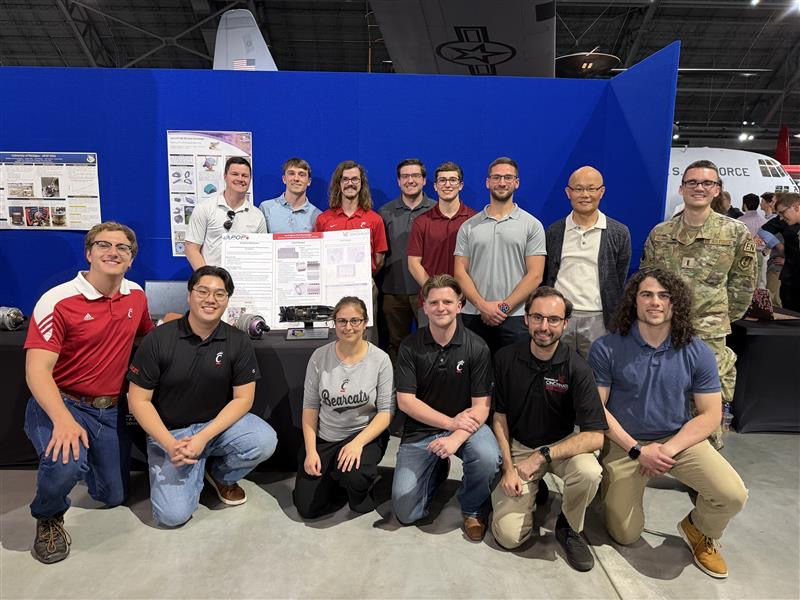
Students in the Air Force Research Lab's Aerospace Propulsion Outreach Program gathered to present their design. Photo/Provided
Ariana DeLuca, another student on the team, shared what each sub team spent their time working on. The testing team met at Professor Lee's lab at UC's Center Hill Research Facility to conduct baseline testing of both the engine and the heat exchanger design. The design team was in charge of getting quotes from manufacturers and sending designs out for production. The analysis team predicted engine performance, wrote scripts for cycle analysis using programming software MATLAB, and developed the computational fluid dynamics for the baseline engine.
"We also had one student who was in charge of team communications, which included scheduling mentor meetings, finding answers to our questions, and coordinating between sub teams," DeLuca said.
This approach proved so successful that they had enough people, and time, to develop three distinct designs to test and find the best one to bring to competition. Despite their success, the experience did not come without its challenges. Due to the government shutdown in the fall of 2025, teams were unable to access the Interface Control Document.
"The Interface Control Document gives us information about how the heat exchanger will be attached to the Air Force's testing setup," DeLuca said.
This critical document allows students to ensure what they are designing will be compatible with other components in the system. Completing a design without this information could be detrimental and lead to failed integration on competition day. Once they finally had access to the Interface Control Document over winter break, the team had to quickly design a new test stand to ensure their design would properly connect to the Air Force system.
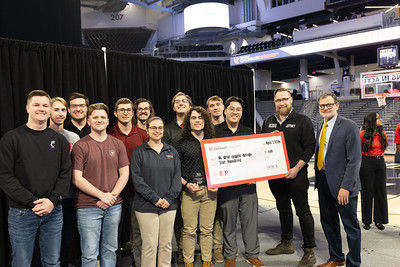
UC's team received the Lucius Q Cincinnatus Excellence in Engineering Award at the annual CEAS EXPO. Photo/Corrie Mayer/CEAS Marketing
Testing proved to be a challenge as well. Walicki shared that maintaining consistent conditions is difficult, and the engines are very temperamental.
"It's difficult to troubleshoot unexpected behavior during operation and ensure the engine will start and perform the same way each time," he said.
The 3D-printed components that make up the exchanger pose challenges as well. With this kind of fabrication, it can take multiple iterations to get tolerance and durability right.
After months of testing and multiple versions, the engine was ready for competition. Each team is provided a designated time to go to the AFRL testing facility and test their design. Of the three designs they developed, the team took the heat exchanger that worked best to testing day, giving themselves the best chance of success.
All engines were tested over the course of the week, and at the end of the week, teams met at the National Museum of the United States Air Force in Dayton, Ohio, to give a poster presentation of their design to various Air Force and industry professionals. The winners were announced on presentation day.
"The test day was an incredible experience," DeLuca said. "Seeing the engine start up, a blue flame shooting out the back, it was really cool."
Their design hit the heat exchange marker on the dot, a major accomplishment for the team and a crucial factor in winning first place. A successful test and first-ever win for UC was a testament to the work the students put in during their academic year. The project also received the Lucius Q Cincinnatus Excellence in Engineering Award at the annual CEAS EXPO.
"Projects like APOP provide a realistic look at what it's like working in propulsion and systems engineering. It was one of the most valuable experiences of my time in school," Walicki said.
Featured image at top: The University of Cincinnati earned first place in the annual Aerospace Propulsion Outreach Program competition. Photo/Provided
Related Stories
Engineering students showcase capstone projects at CEAS Expo
May 6, 2022
Graduating engineering undergraduates from the University of Cincinnati’s College of Engineering and Applied Science gathered for the inaugural CEAS Expo in April to showcase their senior capstone projects to more than 500 attendees, including faculty, staff, alumni and industry representatives. The event, organized by the college and CEAS Tribunal student government, was held in downtown Cincinnati at the Duke Energy Convention Center.
Engineering students present at third annual Expo
April 24, 2024
This spring, senior students at the University of Cincinnati's College of Engineering and Applied Science came together to present their final capstone projects at the third annual CEAS Expo. College faculty, staff, alumni and industry professionals attended the event to witness the innovation that is created at CEAS.