
From Classroom to Community: The Jones Center Expands Its Impact

The Nathaniel R. Jones Center for Race, Gender, and Social Justice at the Donald P. Klekamp College of Law is building on its legacy with a renewed focus on what happens when legal education moves beyond the classroom and into the community.
Under the leadership of Jennifer Dye, PhD, director, the center has expanded opportunities for students to explore social justice through their coursework, engage in hands-on legal work and take a more active role in developing programs that address issues affecting communities locally and beyond Cincinnati.
At the heart of that work is a simple idea: Students should have opportunities to see how the law works in the real world — and how they can use their legal education to make a difference.
Where the center is today
The Jones Center's work spans academics, experiential learning, scholarship, programming and community partnerships.
Academically, the center has expanded its joint-degree opportunities beyond its longstanding master's partnership in Women's, Gender and Sexuality Studies to include the Master of Public Administration. The center also created a social justice concentration open to all law students, providing additional pathways for students who want to incorporate social justice into their legal education.
The center's Social Justice Fellowship has also evolved. Fellows complete research projects while taking a more direct role in the center's programming. Beginning last academic year, fellows were given a budget and responsibility for developing and leading a Jones Center program — from identifying a topic and securing speakers to executing the event.
The result is programming shaped not only by the center's leadership, but by the interests and ideas of its students.
Recent programs have explored issues including access to reproductive care and Native American and Indigenous rights, giving fellows opportunities to investigate subjects that matter to them and share what they learn with their peers.
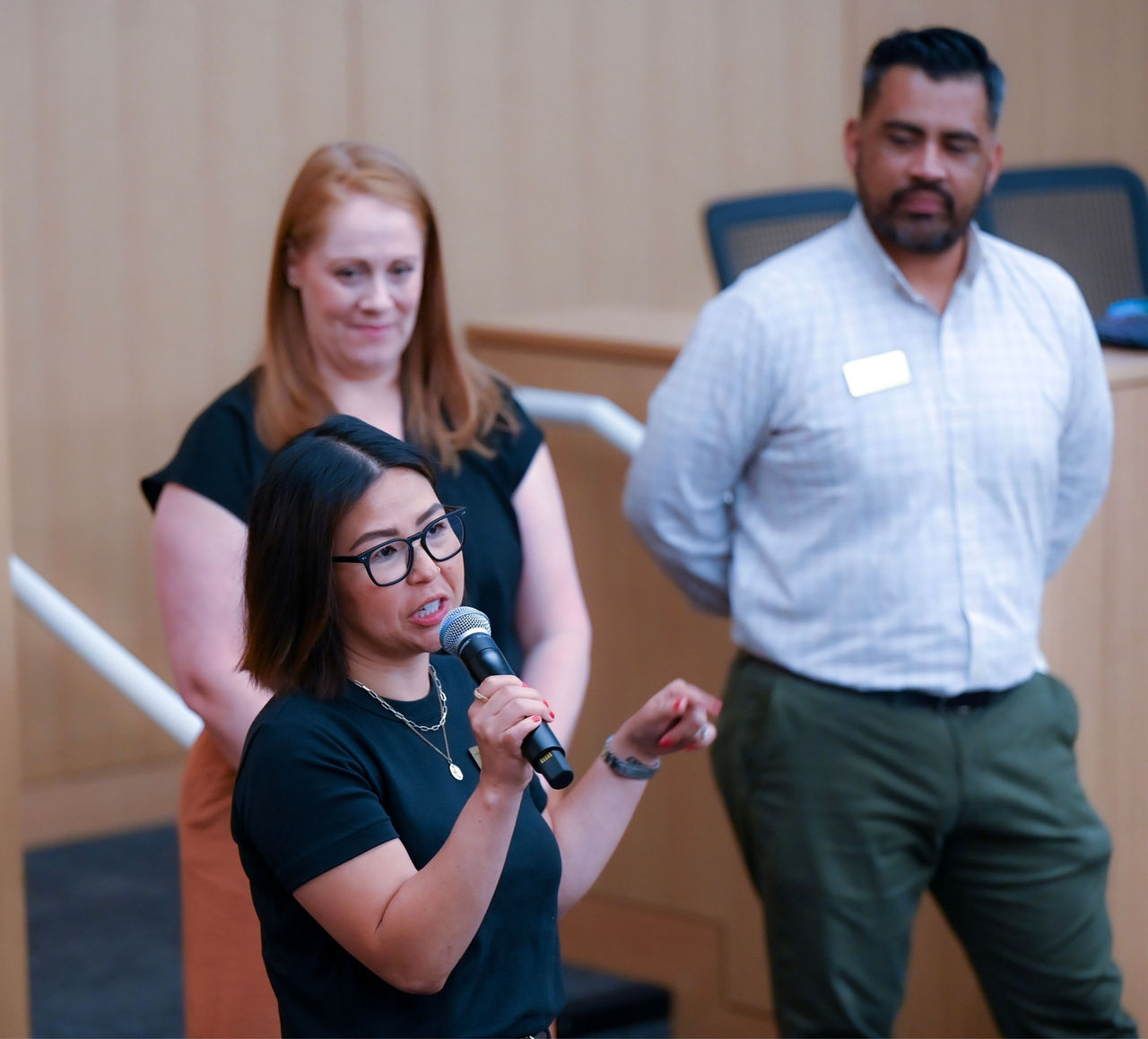
Jenn Dye, PhD, shares a message at Jones Center events
From classroom to real-world impact
Perhaps the center's greatest impact on students comes through opportunities to apply their legal education to actual legal and social justice challenges.
Students have contributed to amicus briefs, conducted legal research for civil rights attorneys and worked on projects connected to ongoing litigation and advocacy efforts. In one example, students provided research support to Minnesota civil rights attorneys and the Minnesota ACLU related to claims arising from an ICE and DHS enforcement surge.
Other student projects have explored the legal implications of emerging issues, including the use of generative artificial intelligence in domestic violence situations and the intersection of race, intellectual property and the rights of African American musicians.
The work gives students the opportunity to produce work that exists beyond a classroom exercise.
“Classroom learning and hypotheticals are integral in learning and foundational in preparing our students for real world experience — these are all enriched when students get the opportunity to work with real clients and cases, with actual judges and practicing attorneys; it provides such an invaluable learning experience and real world impact," said Dye.
For students, that distinction matters. Their work can help inform actual legal advocacy while giving them practical skills they will carry into their careers.
“These experiential and applied opportunities allow students to have real world impact on work that is rooted in the community,” said Dye.
The center's work also gives students an opportunity to explore questions at the intersection of race, gender and social justice as those issues emerge in the world around them. Their research can begin with something they have noticed or an issue about which they are passionate, then develop into a deeper examination of how the law responds — or fails to respond—to that challenge.
Classroom learning and hypotheticals are integral in learning and foundational in preparing our students for real world experience
Jennifer Dye, PhD
Deepening roots in the Cincinnati community
The center is also taking a more intentional approach to its community partnerships.
The Jones Center has long had relationships throughout Cincinnati's legal and nonprofit communities. Today, there is a growing emphasis on formalizing those relationships so collaboration can become more sustained and intentional rather than dependent on individual connections.
One example is the center's relationship with the National Underground Railroad Freedom Center, where the hope is to formalize the relationship in a way that encourages greater collaboration on programs and events.
The relationship is already producing results. Two Jones Center fellows are working with the Freedom Center on a voting rights program designed to bring together community members and members of the law school community. This event, “The Vote, The Map, and The Law: What’s at Stake in Ohio’s Election” will be held on September 24, 2026 at the Freedom Center. Registration is open now.
Another major development is a forthcoming collaborative clinic with the Ohio Justice and Policy Center. The clinic, expected to launch in spring pending final university approvals, will give law students an opportunity to work with the organization's Human Rights in Prison program. Students will review requests involving potential civil and human rights violations affecting incarcerated people, including issues such as access to medical care and religious accommodations.
For Dye, developing these deeper partnerships is part of the center's larger role in the community.
"The Jones Center historically has had good name recognition in the Cincinnati legal community," she said. "We welcome collaboration if you want to give law students experience or connect on a community program."
The goal now is to build on that foundation with partnerships that are lasting, intentional and mutually beneficial.
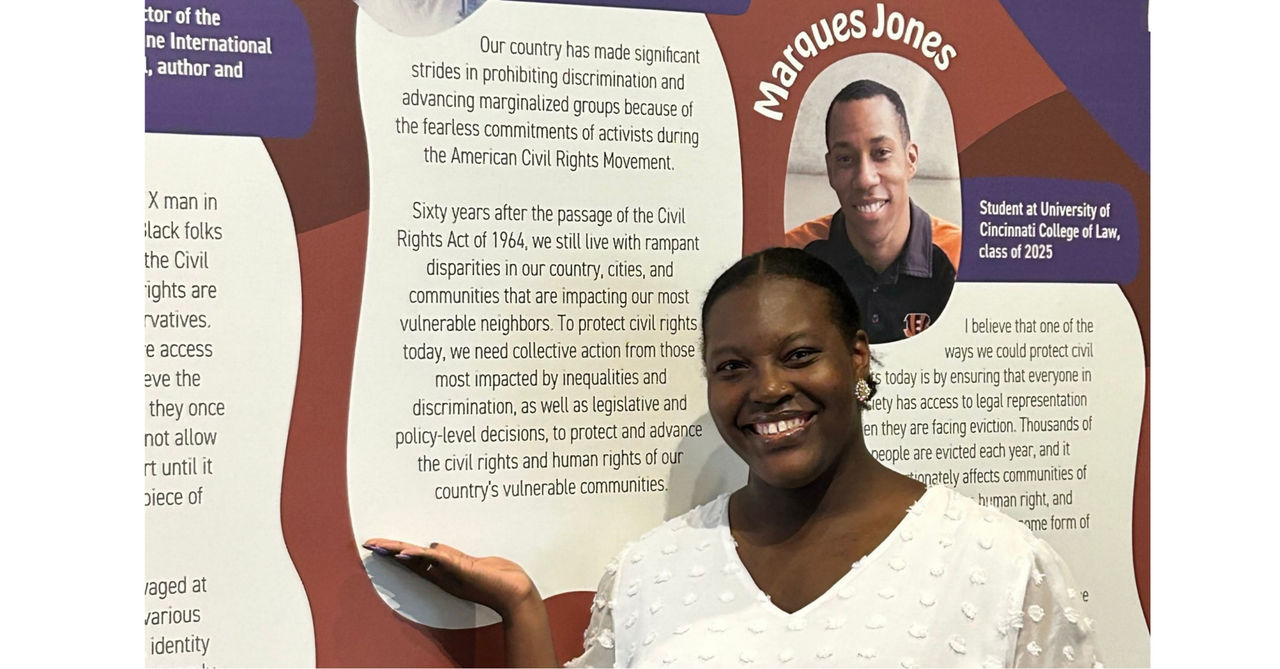
Joele Newman '26 visits the collaborative project between the Jones Center fellows and the Freedom Center.
Looking ahead
The next chapter for the Jones Center will build on these foundations.
Launching and strengthening the collaborative clinic with the Ohio Justice and Policy Center will be a priority, as will continuing to develop the center's relationship with the Freedom Center and other community organizations. Dye also sees an opportunity to elevate the center's Morelli programming and increase its visibility alongside the College of Law's signature events and speakers.
But sustaining and expanding the center's work will require investment.
A major priority is ensuring long-term support for the Social Justice Fellowship. The College of Law currently provides funding for the fellows, but the center is working toward an endowed model that would provide sustainable support while potentially increasing the fellowship award to $7,500 per student.
With nine fellows, the long-term fundraising goal represents a significant investment in the future of the program — and in students who are preparing to become lawyers and leaders in the communities they serve.
We welcome collaboration if you want to give law students experience or connect on a community program.
Jennifer Dye, PhD
Staying connected—and investing in what's next
That future also includes a renewed focus on the Jones Center's alumni.
Dye has begun reconnecting with former fellows and other Jones Center alumni to learn where they are now, what they are doing and how they would like to remain connected to the center. The goal is to create meaningful opportunities for alumni to engage with current students. Alumni might host virtual office hours, allow students to shadow them at work, participate in panels or serve as speakers and mentors. Those connections can help students see the many ways a Jones Center experience can translate into a career.
And, over time, those relationships can create another kind of connection: one that inspires alumni to invest in the center's future. By strengthening the relationship between alumni, students, faculty and community partners, the Jones Center can create a network that extends well beyond the walls of the College of Law.
The work underway today is laying that foundation.
Students are gaining practical experience. Community partners are gaining new opportunities to collaborate. Alumni are being invited back into the life of the center. And the Jones Center is continuing to create spaces where questions of race, gender and social justice are not simply studied — but explored through the practice of law and put into action.
Photos taken by Joey Yerace, UC Klekamp Law Marketing Dept.
Tags
Related Stories
Taking justice international
May 11, 2026
UC Klekamp College of Law’s LLM Program collaborates with the Ohio Innocence Project to impact global policy.
Innocence Network Midwest Regional Summit to unite advocates in Cincinnati
October 13, 2025
Cincinnati Law will host the Innocence Network Midwest Regional Summit to discuss updates in the field.
Law360: UC Law professor weighs in on National Labor Relations Board case
February 11, 2025

UC Law professor Anne Lofaso spoke with Law360 about the constitutionality of the National Labor Relations Board.