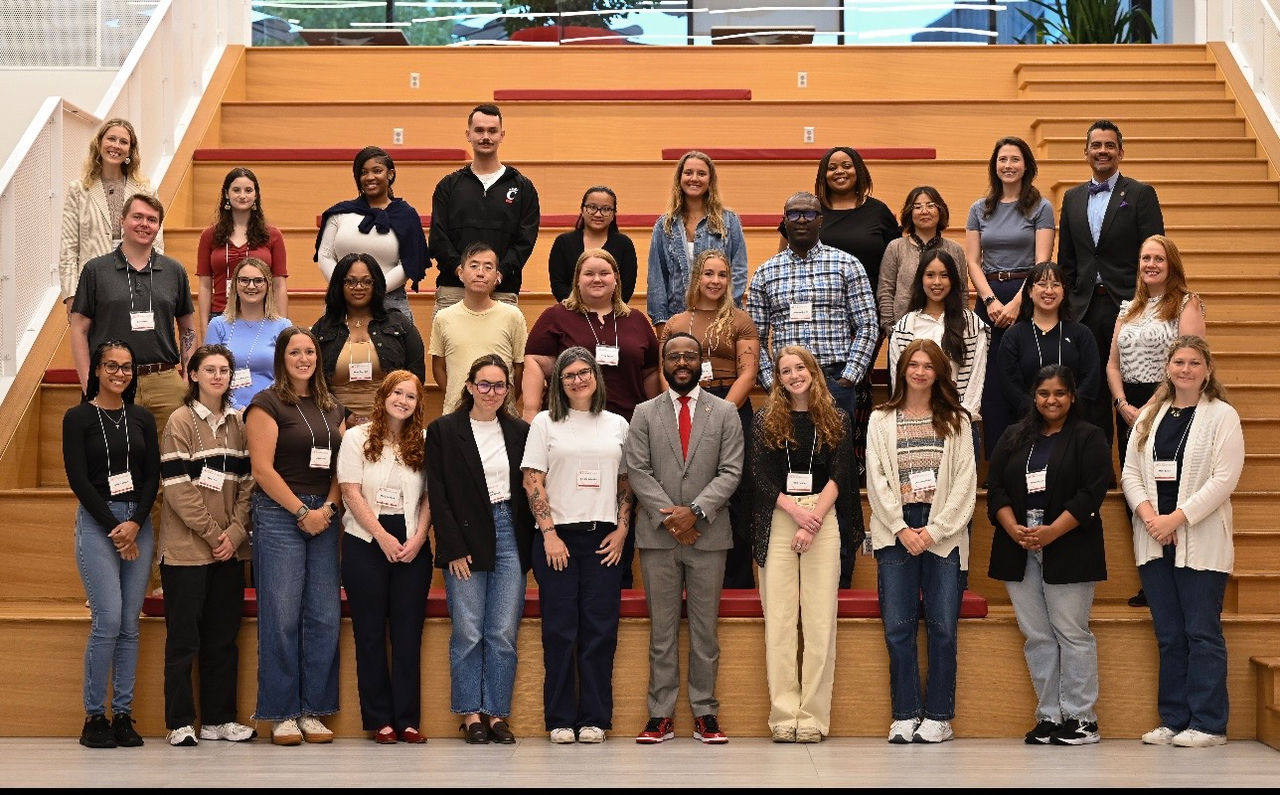
GENESIS: From Finding Community to Becoming Leaders

When Gabrielle Long arrived at the University of Cincinnati College of Law as a first-year student, she was nervous.
The transition to law school can be intimidating for any student. For students who are the first in their families to attend law school, however, the experience can come with an added layer of uncertainty: What should I expect? Who can I ask? How do I navigate a profession whose rules and expectations aren't always written down?
Long found an answer to those questions through GENESIS.
“I remember looking at her and saying, ‘Are you OK?’” said Cassandra B. Jeter-Bailey, senior assistant dean for Admissions, Financial Aid & Strategic Marketing Initiatives, who helps lead the GENESIS program. “And then I told her, ‘Let’s take a deep breath together.’”
They did. Then Jeter-Bailey hugged her and offered a simple reassurance: “You’re fine. You’re here. You made it. You belong.”
Three years later, Long has grown into a confident law student and admissions ambassador, sharing her own experience with prospective students. Her transformation reflects the impact GENESIS strives to have on every participant: helping students find community, build confidence, expand their networks, seize opportunities, and grow into leaders.
Now entering its third year, GENESIS is beginning to demonstrate the long-term impact of that approach. With its three-year curriculum now fully implemented, the College can see how the program helps students progress from newcomers to engaged leaders and future professionals.
“In the beginning, our goal was to help students feel prepared for law school and confident that they belonged here,” Jeter-Bailey said. “Three years later, we're seeing those same students emerge as leaders, mentors, and future legal professionals. That's the impact we hoped to create.”
Building a foundation for law school—and beyond
GENESIS is designed around the idea that succeeding in law school involves more than mastering the material in the classroom.
For many students, particularly those who are first in their families to attend law school or who may not have longstanding connections to the legal profession, there can be an unwritten set of expectations to navigate. GENESIS seeks to make that “hidden curriculum” more visible while giving students a community where they can ask questions, build relationships and gain early exposure to the legal profession.
“I found two of my best friends through GENESIS,” said Gabrielle Long ‘27. “It felt good knowing there are people at law school who have faced adversity and are doing law school first in their family too—especially being double first generation. I believe the biggest focus of GENESIS is the community you create before orientation starts. There is programming to help you navigate the different obstacles of law school that other law students can normally lean on their family to help with.”
Commented Dr. Jenn Dye, director of the Nathaniel R. Jones Center for Race, Gender, and Social Justice, and a member of the GENESIS leadership team, “Programs like GENESIS are integral to helping students transition to the study of law by demystifying law school. By increasing students’ familiarity and comfort with the culture of law school, the hope is that they can be fully engaged in the classroom and beyond. GENESIS also helps students build and leverage their social capital and mentorship relationships. This is particularly important for students who may not have existing connections in the legal field.”
The program now follows a deliberate progression.
During their first year, students focus on building foundations: developing community, demystifying law school, learning professional expectations and gaining early exposure to alumni and judges.
In the second year, the focus shifts toward expansion and strategy—growing professional networks, deepening mentorship relationships and preparing for internships and postgraduate opportunities.
By the third year, students focus on transition and mobility, including refining their professional identities, preparing to enter the legal profession and learning how to sustain and expand their networks.
“Law school represents a challenge unlike anything else,” said Dyann Margolis, associate dean for academic success and bar programs and a member of the GENESIS leadership team. “The GENESIS program ensures that students have the support they need before formal orientation even starts that will follow them through all three years of law school. I love getting to be a small part of that support system and watching students grow from 1Ls into graduates who will make a difference as they enter the profession.”
Along the way, students from different GENESIS cohorts come together through “vibe checks,” creating opportunities to reconnect, share experiences and offer one another advice.
The result is a program that increasingly functions as an internal network, connecting students across cohorts and creating relationships that continue throughout their law school experience.
“This isn't a program that ends when the summer does,” Jeter-Bailey said. “We want students to begin with a strong network of peers, mentors, and supporters they can rely on throughout their law school journey.”
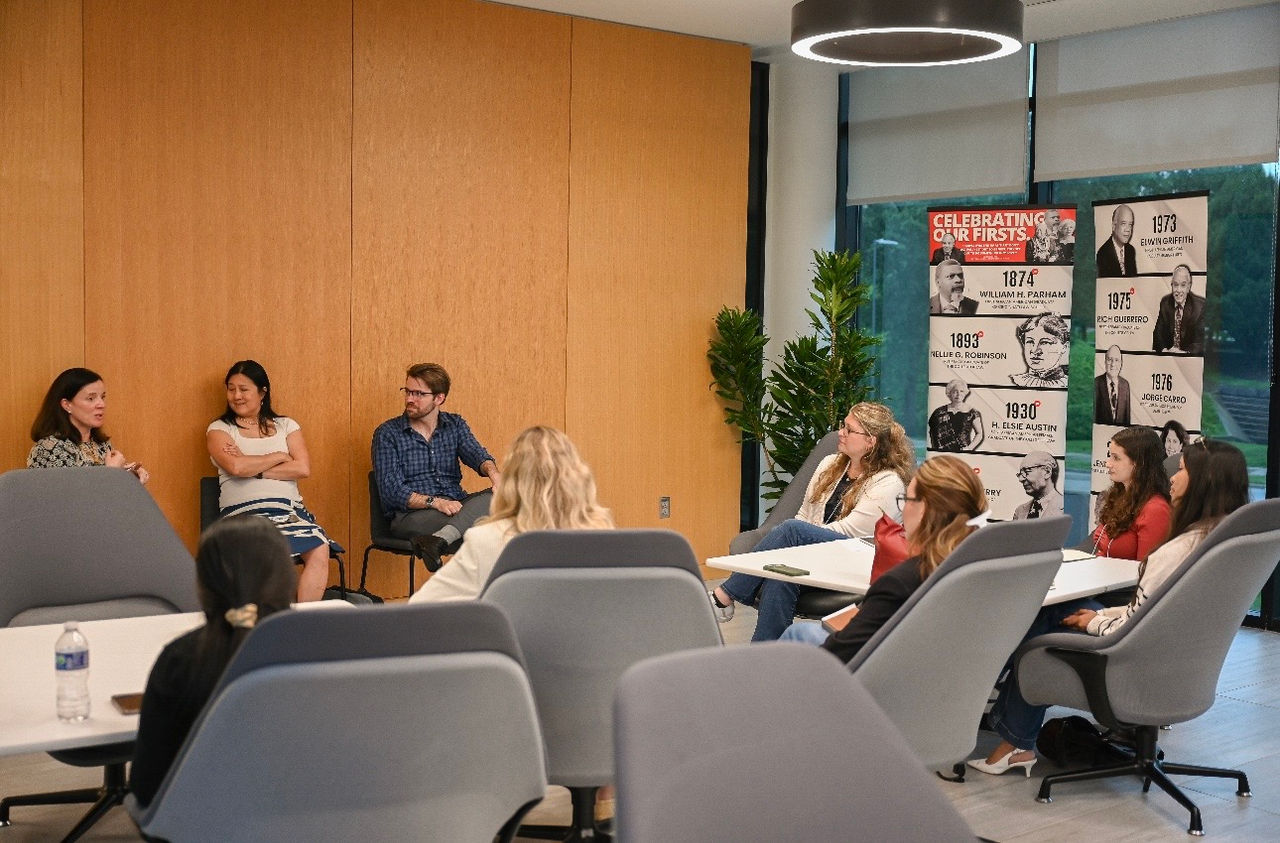
GENESIS program participants meet.during their Orientation week.
From confidence to leadership
One of the program's most notable outcomes was unexpected. GENESIS students are increasingly stepping into leadership roles across the College.
This year's Student Bar Association executive board includes three GENESIS participants among its four top positions. GENESIS students also hold leadership positions in student organizations throughout the College.
For Jeter-Bailey, the connection is clear.
As students gain confidence in their ability to navigate law school, they become more willing to engage in the campus community, pursue leadership opportunities, and invest in their own professional development. What begins as a program focused on community often evolves into a platform for leadership.
“I think when students come in, there can be areas of uncertainty, particularly for first-generation students,” Jeter-Bailey said. “As they work through and demystify some of the myths and misperceptions about law school, they gain confidence in their ability to succeed. That confidence often translates into greater involvement, leadership, and a willingness to invest in their own professional development.”
“Coming into law school as a first-generation college graduate and first-generation law student, I was nervous about starting a new chapter in a new city,” said Robby Belt ’27, GENESIS participant and SBA president. “GENESIS quickly gave me a community, introduced me to some of my closest friends, and helped me build confidence in myself. After a challenging 1L Fall, the support and encouragement I received from GENESIS faculty reminded me of what I was capable of and helped me continue moving forward. Now, as president of the Student Bar Association, I can confidently say that GENESIS helped prepare me to step into leadership. The opportunities to connect with judges, attorneys, faculty, and fellow students helped me find my voice, become more comfortable putting myself out there, and develop the skills I rely on as a leader today. GENESIS gave me a community that believed in me and, in turn, helped me learn to believe in myself.”
“Our inaugural GENESIS cohort members are true pioneers in student leadership. More than half have already stepped up to serve in registered student organizations, the SBA executive cabinet, journals, and competition teams. The current 2L Cohort is not far behind, with many of its members taking on significant leadership roles as well. Together, these students are sharpening their leadership, writing, and presentation skills while making a lasting impact on the Klekamp Law community,” said Rudy Trejo, assistant dean for student affairs and community engagement.
The program's leadership impact is now becoming an intentional area for future development. Jeter-Bailey envisions eventually building a more formal leadership component into the second- and third-year program experience, including opportunities for students to learn from GENESIS participants who have already stepped into leadership roles.
The confidence students develop through GENESIS extends beyond the College itself. Just as importantly, the program helps students envision their place within the legal profession.
Now, as President of the Student Bar Association, I can confidently say that GENESIS helped prepare me to step into leadership
Robby Belt '27
Seeing yourself in the profession
Some of the program’s most meaningful experiences take place outside the classroom.
“In my role working largely with first-year law students, I’ve repeatedly witnessed how difficult it is for incoming students to navigate the new challenges they encounter in law school—challenges that are made more difficult when you feel like you are alone,” said Kate Selander, director for academic success and bar programs and a GENESIS leadership team member. “I’m reminded of a study demonstrating that a person will perceive a hill as markedly less steep if that person is with, or even just thinking about, a friend.
“By facilitating meaningful connections not only between GENESIS students but also with the Cincinnati legal community at large, our students begin building lasting camaraderie before orientation even begins. Our hope is that this sense of community will help GENESIS students feel supported and see that they are more than capable of scaling the metaphorical hill of law school.”
During their first year, students visit a courtroom where they have the opportunity to meet judges, some of whom share their experiences as first-generation students, engage in candid conversations about the legal profession, and experience the courtroom from a perspective they may never have imagined before beginning law school.
One of the program's signature experiences is a visit with Judge Marilyn Zayas of the First District Court of Appeals. Students tour her courtroom, meet with judges, and have the opportunity to sit at the bench, wear a judicial robe, and take photographs. But the most meaningful part may be less tangible: each student receives an individual moment of encouragement from the judge.
For students who may have entered law school wondering whether they belonged in the profession, the experience is about more than visiting a courtroom. It offers a tangible reminder that they, too, have a place in the legal profession and can envision themselves occupying those spaces one day.
“I enjoy participating in GENESIS because it allows a space for first-generation law students to gather regardless of where they came from. Before 1L there were some students I had very little in common with, but one thing we shared was that we were both new to the legal field and eager to put our best foot forward toward our careers,” said Ariel Barrientos ’27, GENESIS participant. “Personally, it was very helpful to attend GENESIS as a 1L and be introduced to Judge Marilyn Zayas. As a Latina legal professional and judge of the First District Court of Appeals, it was very empowering to hear her story and feel representation from an esteemed member of the legal community.”
The program similarly seeks out alumni and legal professionals who can relate to students' experiences. The goal is to bring in people who can identify with students in some meaningful way—whether through being first-generation, from varied backgrounds or having experienced isolation or imposter syndrome themselves.
That shared experience can be transformative. Students are not simply hearing from successful lawyers and judges; they are hearing from professionals who can say, “I've been where you are,” reinforcing that they, too, belong in the legal profession.
Ultimately we're talking about developing future lawyers and future leaders.
Cassandra Jeter-Bailey, senior assistant dean for Admissions, Financial Aid + Strategic Marketing Initiatives
A community that gives back
Perhaps the clearest indication that GENESIS is becoming more than a program is what happens when students advance through it.
Upper-level students are increasingly looking for ways to support those coming behind them. This year, GENESIS launched an ambassador model, with second- and third-year students helping shape programming, leading cohort “vibe checks” and creating experiences for new students.. One student independently reached out to Jeter-Bailey to ask how he could return and give back to incoming GENESIS students.
“I think it's important to give back to GENESIS because I believe giving back is necessary for the advancement of others,” said Barrientos.
“My favorite part of GENESIS is when we meet with the younger GENESIS cohorts and tell them how we navigated through our first year and giving advice on what we would do differently and what worked out,” said Long. “I feel honored to be a part of the inaugural cohort and hope it lasts for many more years.”
The same idea extends beyond current students. Jeter-Bailey envisions a future GENESIS alumni network in which graduates return as speakers, mentors, and advocates for future cohorts. Having shared the GENESIS experience themselves, they can offer a uniquely meaningful form of support.
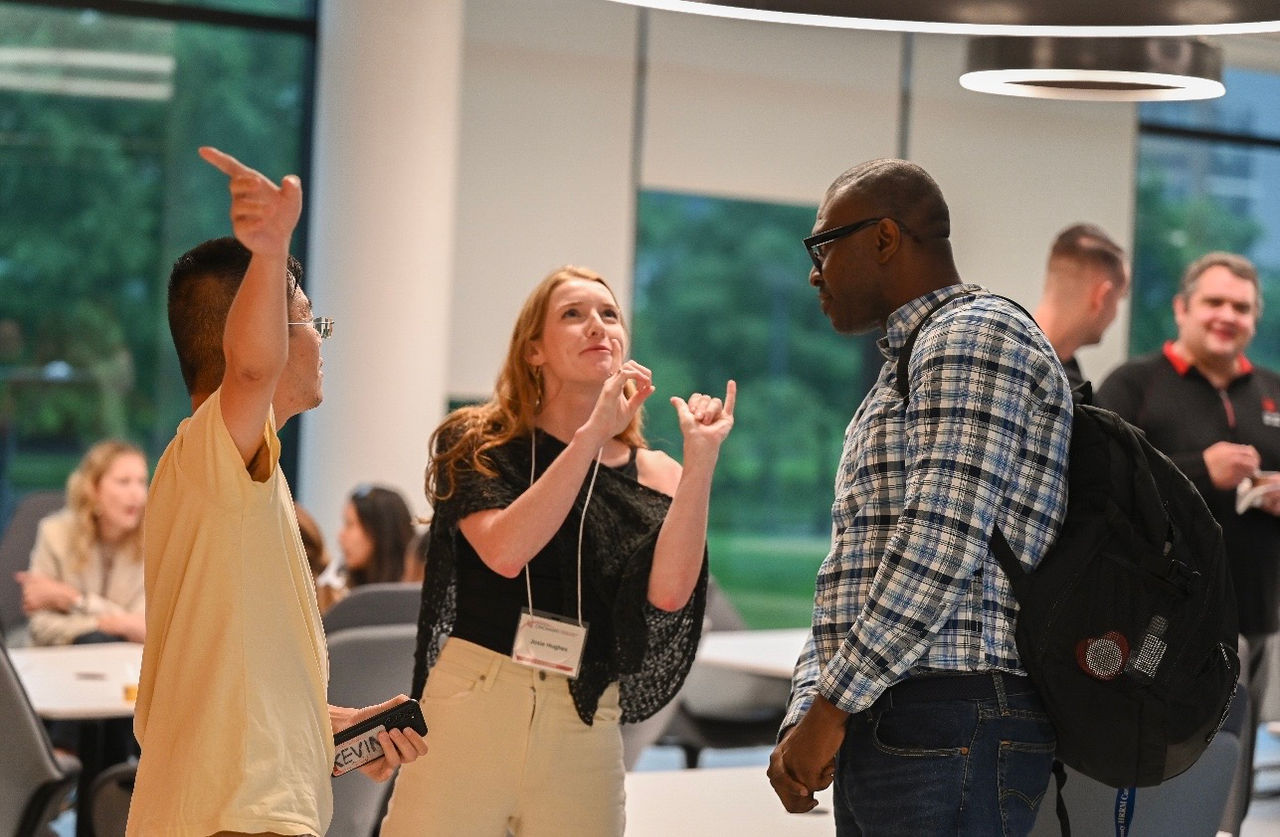
Program participants relax and have fun at reception.
The next chapter
With the program's three-year curriculum now fully realized, the program team’s next focus is assessing its impact and charting a path for the future.
For Jeter-Bailey, success is not measured solely by growth in numbers. Equally important is preserving the close-knit community that has become a hallmark of the program. While current funding supports a cohort of approximately 30 students, the long-term goal is a fully funded, sustainable model that maintains its personal approach while expanding access to more students.
Future growth could include a more formal leadership component, expanded alumni engagement and additional resources to meet students' practical needs.
“Ultimately we're talking about developing future lawyers and future leaders,” Jeter-Bailey said. “We want our students to enter the profession with confidence, empathy, the ability to think broadly, and a commitment to serving others beyond themselves.””
For GENESIS, that may be the most important outcome of all: creating a culture in which community gets passed on one student at a time.

GENESIS participant speaks with a UC Klekamp Law connection.
I feel honored to be a part of the inaugural cohort and hope it lasts for many more years.
Gabrielle Long '27
Photos: provided by Joey Yerace, UC Klekamp Law Marketing Department.
Lead photo: The 2026 GENESIS cohort, along with the leadership team, stand on college's the social stairs.
Tags
Related Stories
Taking justice international
May 11, 2026
UC Klekamp College of Law’s LLM Program collaborates with the Ohio Innocence Project to impact global policy.
Innocence Network Midwest Regional Summit to unite advocates in Cincinnati
October 13, 2025
Cincinnati Law will host the Innocence Network Midwest Regional Summit to discuss updates in the field.
Law360: UC Law professor weighs in on National Labor Relations Board case
February 11, 2025

UC Law professor Anne Lofaso spoke with Law360 about the constitutionality of the National Labor Relations Board.