
When grief doesn't end: Nursing PhD students bring a classroom theory to Ohio families

Two UC College of Nursing doctoral students helped families, self-advocates and providers at the 2026 Synergy Conference put a name to a kind of grief many had felt for years.
Most of us think of grief as something with an ending. A loss happens, it hurts, and over time the hurt fades.
For many parents of children with developmental disabilities, it doesn't work that way. The sadness can quiet down for months or years and then come back. It might return on the first day of kindergarten, at a cousin's wedding, at a high school graduation, or on the day a young adult ages out of school services.
Nurses and researchers have a name for this: chronic sorrow. Last October, two University of Cincinnati College of Nursing PhD students helped bring that name to a room of families, people with disabilities and the professionals who support them.
Christiana Williams and Ummy Msenga presented "Beyond the Diagnosis: Understanding Chronic Sorrow in Families of Children with Disabilities" with Cleopatra Kum, PhD, RN, an assistant professor at the college. Their audience was the Synergy Conference, a three-day statewide gathering that draws more than 1,000 people from Ohio's developmental disability community, from people with lived experience and their families to direct support staff, educators, agency leaders and policymakers. It was the first conference presentation for both students, and the first time Kum had brought students along to present.
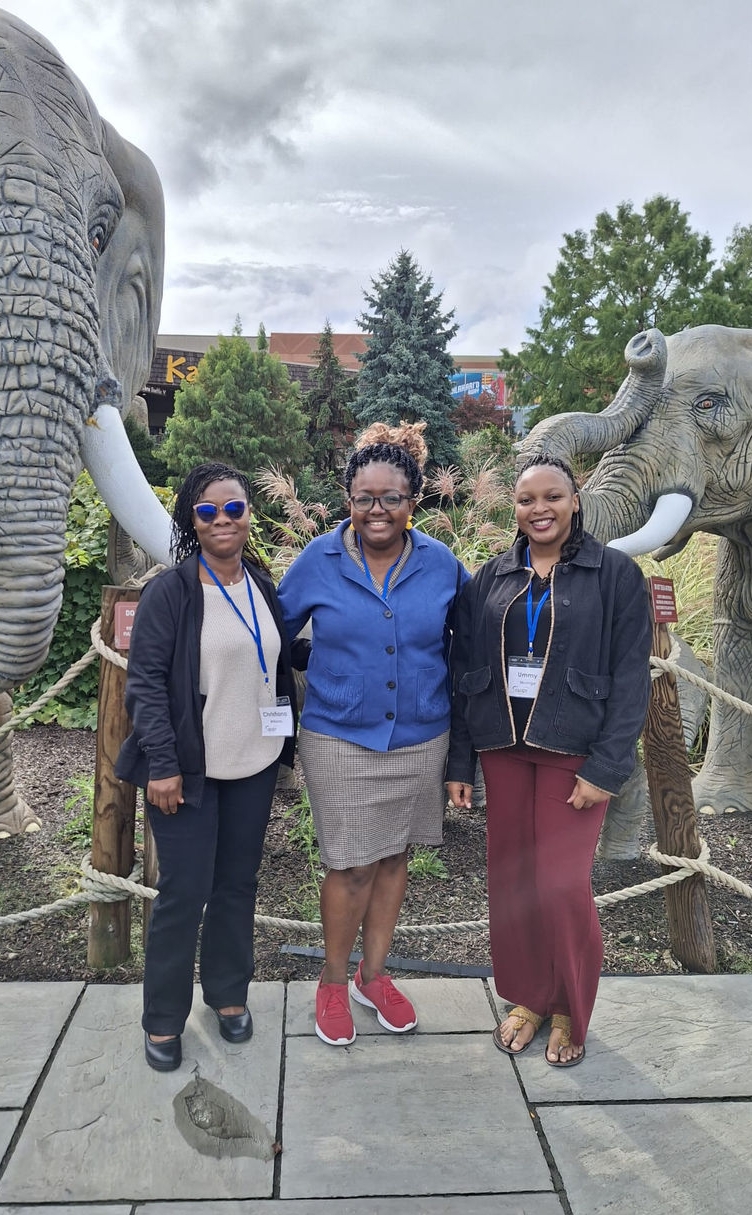
Williams, Dr. Kum and Msenga at Kalahari Resort, where the Synergy Conference was held
The idea started in a classroom. Last spring, during their first year in the PhD program, Williams and Msenga took Theory Construction, Analysis and Evaluation, a doctoral course Kum teaches with PhD Program Director Kimberly Johnson, PhD, RN. The course asks students to take nursing theories apart: where they came from, how they were built and tested, and whether they hold up in real care.
Much of the course centers on middle-range theories, the more focused frameworks nurses use to explain and guide everyday care. Students are also pushed to look past nursing's own borders.
"We encourage the students to not only look at nursing theories but look at theories from other disciplines that can be borrowed and used in nursing," Kum explains. "For example, chronic sorrow was a term that was coined outside nursing."
Then the timing lined up.
"We studied the theory of chronic sorrow, and coincidentally, I was invited to present on it at the Synergy Conference," Kum said. "So, I invited the students to come along."
Rather than lecture, they walked the audience through the story of Maya and Leo, a fictional mother and son, and stopped along the way to ask people where they thought sorrow might return in a family's life.
Giving the feeling a name
The term "chronic sorrow" goes back to 1962, when Simon Olshansky used it to describe what he saw in parents of children with developmental disabilities. Nurse researchers Georgene Eakes, Mary Lermann Burke and Margaret Hainsworth later developed it into a nursing theory in 1998.
The theory describes recurring sadness as a normal response to an ongoing gap between the life a family imagined and the life they are living. It is not a mental health diagnosis, and it does not mean a parent has failed to accept their child. The feelings can sit right alongside love, pride and hope.
That idea landed with at least one mother in the room. She found the presenters after the session to thank them.
"She said, thank you so much for giving it a name," Kum says. "Every time there would be a graduation or a major event, she had experienced this kind of sorrow. She never had a name for it."
Without a word for it, the mother told them, she had not been sure the feeling was allowed. Her child is alive, so why was she grieving?
The audience also broadened the discussion beyond parents and families. Several people with disabilities shared their own experiences of grief, including the sorrow of feeling responsible for the pain their families experience.
"They brought up the sorrow that comes with being the person causing all this grief to your family," Kum recalls. "That was another point that we hadn't considered."
Hearing these perspectives gave Msenga a deeper understanding of how chronic sorrow affects people differently.
"Hearing their experiences helped me understand that grief can be ongoing and recurring and that each person experiences it differently," Msenga says. "It reminded me how important it is to listen with empathy, acknowledge their feelings and offer support without making assumptions."
The discussion also gave providers practical tools for supporting families, including language that encourages open conversations and questions to ask during major life transitions.
The impact extended beyond the conference. After the session, the superintendent of the Auglaize County Board of Developmental Disabilities invited the team to share the material with the organization's staff.
What a PhD in Nursing can look like
Grief and feelings are not what most people picture when they hear "PhD in nursing." But this is what theory work can look like in practice: an idea taken apart in a seminar room ends up changing what a provider says to a worried parent.
Williams and Msenga are now in their second year of the program, connecting their research to people outside the university. Williams is a pediatric nurse who cared for children and families in Ghana before starting her PhD; her research looks at how social and environmental factors, including air quality, affect children's development and sleep. Msenga is a psychiatric and mental health nurse and an assistant lecturer at Hubert Kairuki Memorial University in Tanzania; she studies mental health stigma and access to care.
The work has already opened the door to further outreach. After the Synergy Ohio Conference, the superintendent of the Auglaize County Board of Developmental Disabilities invited the team to share the session with the organization's staff.
The team closed by returning to the question of when grief ends. Their answer, on the final slide: "For many families, it does not end. It changes, recedes and returns. Our role is to make sure families do not have to carry it alone."
Our PhD in nursing program prepare students to advance nursing science and practice through impactful research, knowledge generation and the development of future nurse educators and scientists.
Feature image: Christiana Williams and Ummy Msenga standing in front of their presentation at the Synergy Conference. / Photo provided.
Related Stories
Inspired by care, driven to give back
October 28, 2026
From the nurses who eased his fears as a child to the mentors who helped him find his footing at UC, Sam Pascarella is learning how to support others as he prepares for a career in nursing.
Still the top ‘cat
October 20, 2026

The University of Cincinnati Bearcat mascot was voted Cincinnati’s favorite mascot in a Cincinnati Enquirer reader poll, earning 45.1% of the vote and topping other local favorites.
UC launches Bearcats Affordability Grant
January 7, 2026
The University of Cincinnati is making college more attainable for students across Ohio with the creation of the Bearcats Affordability Grant. The new grant will provide a pathway to tuition-free college for students of families who make less than $75,000 per year. Beginning in fall 2026, the Bearcats Affordability Grant will cover the remaining cost of tuition for Ohio residents who are Pell eligible.