
New DAAP certificate explores how AI can amplify human creativity
Exploring practical AI applications in creative fields

As artificial intelligence continues to reshape professional work, the University of Cincinnati's College of Design, Architecture, Art, and Planning (DAAP) is partnering with Disruption Now to offer a new AI certificate.
The DAAP-backed certificate combines artificial intelligence with design systems thinking, teaching participants how to direct AI tools, integrate them into workplace projects and responsibly apply the technology across professional disciplines. It's designed to help professionals use AI effectively while maintaining the human judgment and creative thinking that distinguish their work.
Open to individuals and teams across any department, the program requires no design or technical background. Through practical AI training and design-focused instruction, participants will develop skills they can apply to their everyday work.
What you'll learn
Participants will develop practical fluency in directing AI tools through prompting and meta-prompting while learning how to approach different AI models and evaluate their results. The curriculum includes a multi-model toolkit spanning Claude, Google and ChatGPT, with an emphasis on applying those tools to real workplace projects.
Beyond learning to use individual platforms, the certificate emphasizes how to operationalize AI by developing repeatable processes that can be incorporated into everyday workflows. Participants will also explore authorship, provenance and ethical practices for responsible AI use.
The program's focus on design systems thinking and critical thinking is intended to help participants move beyond simply accepting what AI produces. Instead, they will learn to apply their own expertise, judgment and creative perspectives to guide the technology toward meaningful results.
Rob Richardson, founder and CEO of Disruption Now, believes that distinction will become increasingly important as AI becomes embedded across nearly every professional discipline.
Through Disruption Now's AI enablement and product development services, Richardson helps individuals and teams integrate AI into their workflows, moving beyond basic chatbot use to develop new ways of working.
Claudia Rebola, Senior Associate Dean for Strategic Initiatives and Graduate Programs at DAAP, sees an opportunity to advance the human element of artificial intelligence through the partnership and wants DAAP's creative disciplines to play a role in shaping how the technology is used.
It is our responsibility to ensure that technology supports the creative process rather than replaces it.
Claudia Rebola Senior Associate Dean for Strategic Initiatives and Graduate Programs
"Our creative disciplines are built on human perspective, curiosity and the ability to approach problems in new ways," Rebola said. "AI can help expand those possibilities, but it is our responsibility to ensure that technology supports the creative process rather than replaces it."
For creative professionals, Richardson sees an opportunity to expand what they can produce. AI can help someone develop a website, create a video or bring an idea to life without requiring extensive technical skills or large teams. However, he believes creative expertise remains essential to producing distinctive work.
“Creative people now have an opportunity to leverage technology and express their unique creative perspective on the world in a way that wasn't previously possible,” Richardson said. “Now, if you can organize your thoughts and you know how to use AI, you can bring so many more creative assets into the world and contribute more, and I don't think using AI diminishes that.”
How it works
The certificate is delivered through one-week cohorts of 15 participants, with three stackable modules totaling 12 contact hours. Cohorts will be offered several times throughout the academic calendar, allowing participants to complete the training in a condensed format.
The program provides an opportunity to demonstrate the concepts and skills they developed throughout the training. The certificate emphasizes evidence-based mastery, requiring participants to submit their work rather than complete a self-reported quiz.
That hands-on approach also connects to the program's focus on artistic intelligence and the importance of documenting the thinking and decisions behind a finished product. Richardson believes demonstrating the human contribution to AI-assisted work will become increasingly relevant as questions surrounding authorship and ownership continue to develop.
Rebola said the opportunity to put those concepts into practice is an important part of the certificate's structure.
"We wanted this certificate to go beyond simply introducing people to AI tools," Rebola said. "Participants need opportunities to experiment, apply what they learn and demonstrate how these technologies can become part of their professional work."
Although documenting the creative process cannot guarantee copyright or patent protection, it can help establish the human decisions and contributions involved in producing a finished work.
If you know how to leverage AI and your competitors don't, you'll be able to do what they can do at a much higher rate to make yourself stand out.
Rob Richardson Founder and CEO, Disruption Now
“Whether we like it or not, part of our value in this world is our ability to produce an output in a certain amount of time,” Richardson said. “If you know how to leverage AI and your competitors don't, you'll be able to do what they can do at a much higher rate to make yourself stand out.”
Who it's for
The certificate is open to individuals and teams across professional departments, including creative fields, operations and strategy. No design or technical background is required, making the program accessible to professionals looking to develop AI skills regardless of their industry or experience.
Businesses can also use the program to upskill current employees or prepare new hires for AI-integrated work.
DAAP brings its expertise in design and design thinking to the partnership, complementing Disruption Now's experience in AI implementation and product development. As AI continues to evolve, DAAP wants its students and creative professionals to play a role in keeping humans at the forefront of the technology.
"Artificial intelligence is becoming increasingly integrated into our creative disciplines, and it is important that we prepare people to understand and work with these technologies," Rebola said. "We want to make sure the human remains in charge of the judgment, decision-making and authorship that define creative work."
The program is initially focused on working professionals, though Richardson said there may be opportunities to expand it to students in the future.
Ultimately, the goal is not to encourage people to hand over their thinking to artificial intelligence, but to learn how to use it as a tool to expand their capabilities. As AI becomes increasingly integrated into professional work, the ability to direct the technology while maintaining creative judgment and individual expertise could become an important distinction.
“We still don't want to give away our critical thinking, which is why I think we have to hold on to our process, force ourselves into the old ways with critical thinking and use AI simply as an amplifier,” Richardson said. “I see this certificate as a way to amplify creativity, not to reduce it.”
The next groundbreaking discovery
UC is a powerhouse of discovery and impact as a Carnegie 1 research institution. From pioneering medical research to transformative engineering and social innovation, our faculty and students drive progress that reaches across the world.
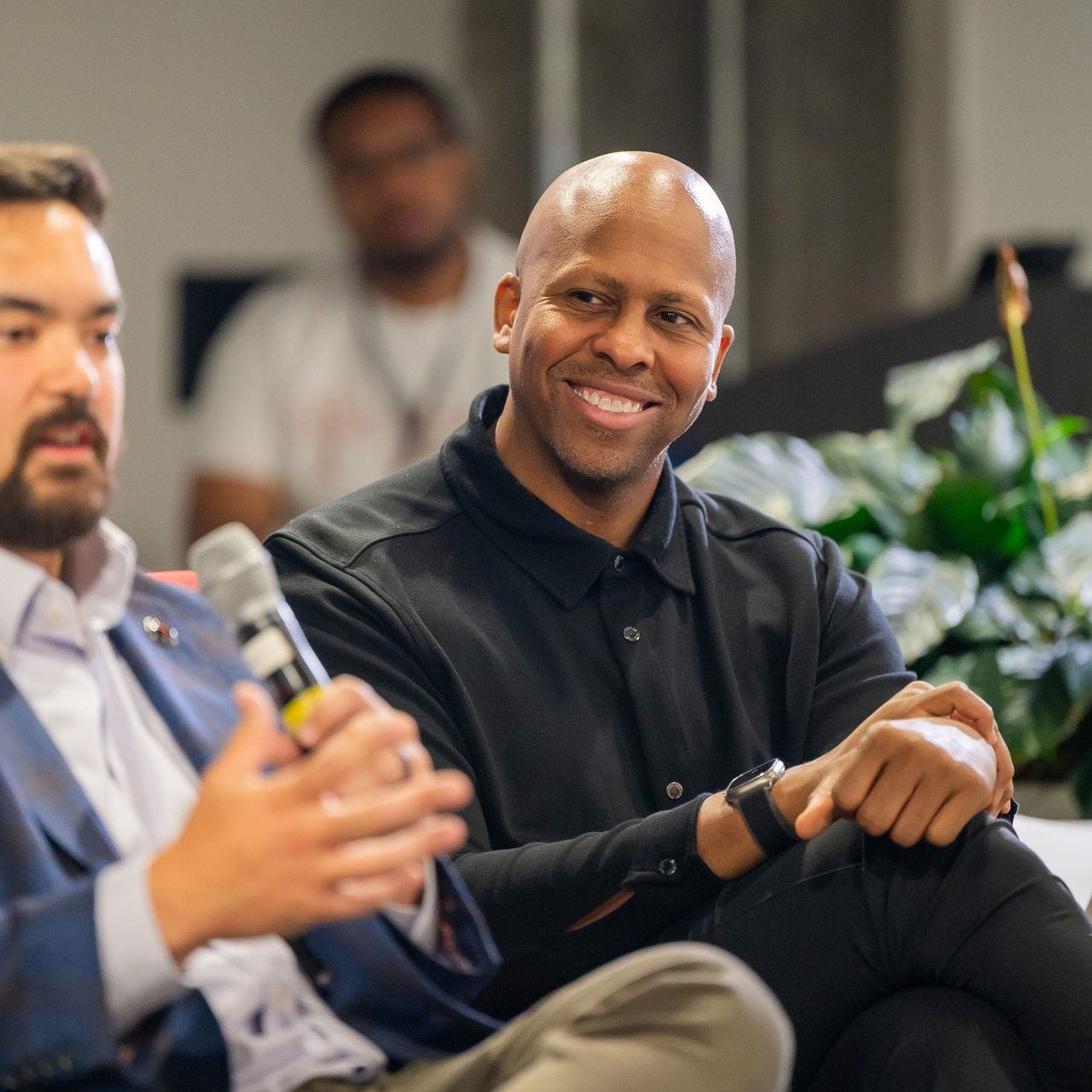
Featured image at top of Rob Richardson speaking at the MidwestCon event. Photos/provided.
Additional Contacts
Related Stories
Humanizing AI
March 27, 2026
Professor Yingying Sun uses AI tools, including custom ChatGPT applications, to teach Industrial Design students at UC how to develop judgment, cross-disciplinary understanding, and creative problem-solving skills.
How the University of Cincinnati co-op program is shaping the future of work at SXSW
March 17, 2026
The University of Cincinnati served as a 2026 Workplace Track sponsor at the annual South by Southwest (SXSW) Innovation Conference March 12-18 in Austin, Texas, showcasing how co-op is redesigning the future of work.
AI as a creative partner
March 27, 2026
University of Cincinnati architecture professor Ming Tang discusses how AI enhances design, research, and student creativity in the XRLab and the classroom.