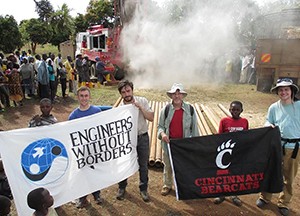
UC Engineers Without Borders Chapter Wins Penetron Contest

The University of Cincinnati
College of Engineering and Applied Science
student chapter of
Engineers Without Borders (EWB UC)
was a clear favorite among voters in the
Penetron Internationals Fall 2017 EWB-USA Grant Award Contest
, winning by a margin of more than 400 votes. The contests other two finalists were chapters from the University of Wisconsin Madison and the Oregon Institute of Technology.
EWB UC will receive a $5,000 grant towards its project. The group has been traveling to Burere, Tanzania, working to provide a solar-powered pump system that will draw clean drinking water from a well for a community of approximately 6,000 people.
Burere is in dire need of clean drinking water. The town currently relies on Lake Victoria as its main source of water due to its reliability throughout the rainy and dry seasons. However, disease-causing viruses such as Schistosomiasis are found in the lake and are very prevalent in Burere. Although the community has an existing well, which is the only clean source of water in Burere, much of the population can't use it because of its remote location. The well's pump is also hand-powered, which is time-consuming and leads to long wait times to draw water during the dry season. By implementing a pump and tank system to the well and increasing accessibility, EWB UC can assist the community in promoting safe drinking and water-collection habits. Reducing the incidence of disease is expected to result in a healthier overall community and will increase both productivity and the quality of life for its residents.

EWB UC members Paige and Kaitlin doing some assessment work in Burere.
With this grant, EWB UC will implement phase one of its water-system design to start providing clean water to the community. This phase includes overseeing contractor installation of the solar panels and electric pump in the borehole well, installing the storage tank at the well site and connecting it to the pump. This phase will allow the water-collection system to be expanded, if necessary.
"We would like to thank everyone who voted and shared to help us win first place in Penetron's grant competition," the UC chapter said after winning Friday. "We cannot express enough how much your support and efforts are appreciated. Thanks to Penetron, and with the help of all of you, we are one giant step closer to helping the people of Burere get access to clean drinking water."
About Engineers Without Borders
Engineers Without Borders USA (EWB-USA) is a nonprofit humanitarian organization that supports community-driven development programs worldwide, through partnerships that design and implement sustainable engineering projects. EWB-USA's vision is a world in which the communities they serve have the capacity to meet their basic human needs sustainably. Today, more than 2 billion people lack access to the most basic necessities clean drinking water, adequate sanitation, reliable passage to local markets and more. EWB-USA's projects create transformative experiences that enrich global perspectives and promote responsible leaders.
Related Stories
UC climbs to No. 3 in the nation for co-ops and internships in 2027 U.S. News rankings
September 22, 2026
In U.S. News & World Report’s 2027 Best Colleges rankings, the University of Cincinnati rises to No. 3 in the nation for co-ops and internships — No. 1 among public institutions — and posts gains in undergraduate business, computer science and psychology.
Engineering graduate student developing intelligent AI systems
September 21, 2026
Artificial Intelligence is on the rise, and researchers are working harder than ever to understand, develop, and improve it. Aneesh Deshmukh, computer science M.S. student at the University of Cincinnati, is working on AI systems modeled after human brain functionality. Deshmukh's goal is to help these robots understand their surroundings and take this knowledge to navigate unfamiliar environments in the future. For this work, he has been named Graduate Student Engineer of the Month by the College of Engineering and Applied Science.
President Pinto’s 2nd glow party brings first-year Bearcats together
September 20, 2026
UC President Neville Pinto and team hosted the second annual Bright Beginnings glow party for first-year students