UC HEALTH LINE: 'Scientific' Skin Care Can Reduce Damage from Aging, Environment

Its like having a personal trainer for your skin, explains John Kitzmiller MD, chief of plastic surgery and associate professor of surgery. You quantify the problem, define goals, make a plan and then establish a routine.
That routine should ideally include a combination of exfoliating chemical peels, which remove dead skin cells and stimulate new growth, and daily facial products that clean and moisturize the skin.
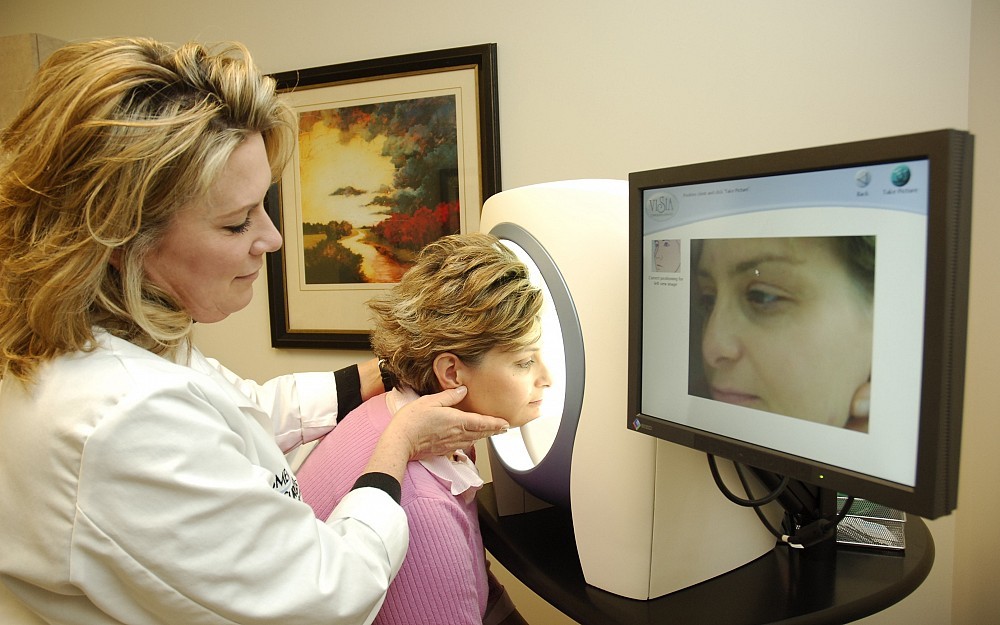
Dr. Kitzmiller and his team use a complexion analysis system to identify problem areas of the skinsuch as sun spots, ultraviolet damage, fine lines or wrinklesthat need correction. Using sophisticated photography and measurement calculations, the system can calculate information about skin tone, texture and bacteria in the skin to guide treatment.
By creating a skin-care plan based on scientific measurements, were able to accurately pinpoint and treat specific problem areas, says Dr. Kitzmiller. After two months of treatment, we can revisit the plan to see if were getting effects we want. If not, we can tweak treatment based on the updated measurements.
He says surface chemical peels are an effective alternative for people who want to reduce damage from early aging without a large time investment.
Surface chemical peelsalso called micropeelsuse a light acid to gently remove dead cells and refine texture on the top layer of human skin. Once the damaged cells are removed, new smooth skin can emerge.
People notice when their top layer of skin is exfoliated, because it looks and feels smoother, says Dr. Kitzmiller. The key is creating a skin-care plan that fits into your daily life.
Micropeels can be used on all skin types and take only about 15 minutes. Usually they are done in a series of four to six treatments every two weeks. Once initial treatment is complete, the peels are typically done every two months.
The treatment can also help minimize acne, says Dr. Kitzmiller, when used in conjunction with topical medications like Retin-A cream (tretinoin).
The important thing, says Dr. Kitzmiller, is that you find a balance that works for you.
Regardless of your skin-care regimen, Dr. Kitzmiller says that everyone should watch for skin changes that may indicate cancer.
According the American Cancer Society, more than 1 million people will be diagnosed with squamous or basal cell skin cancer in 2006. He recommends that everyoneespecially those with fair skinuse SPF 15 sunscreen when out in the sun to prevent dangerous overexposure.
Dr. Kitzmiller is one of nearly 140 UC experts answering health-related questions from consumers on NetWellness, a collaborative health-information Web site staffed by
Tags
Related Stories
Cancer Center plays key role in lab research, clinical trials for new pancreatic cancer drug
September 1, 2026

WLWT and WCPO highlighted the contributions of University of Cincinnati Cancer Center researchers that helped lead to the recent FDA approval of daraxonrasib, a new treatment for pancreatic cancer.
Cancer Center physician receives $150,000 New Investigator Research Grant to study treatment-resistant leukemia
September 1, 2026
The University of Cincinnati Cancer Center’s Sarah Skuli, MD, PhD, received a two‑year, $150,000 Leukemia Research Foundation New Investigator Grant to study TP53‑mutated leukemia, a treatment‑resistant subtype with very poor outcomes.
Heavy social media use linked to depression
August 31, 2026

U.S. News and World Report, Yahoo! News, MSN, USA Today and other national media highlight a new study by the University of Cincinnati and Northwestern University that found a correlation between heavy social media use and depression in adults.