Workshops Help Families Address Concerns on Aging

Aging is a natural process that everyone goes through. And in the next 25 years, one out of every five Americans (72 million people) will be 65 years or older.
Aging brings physical and emotional changes, but whats normal and whats not? What challenges could you face? What resources are available to you?
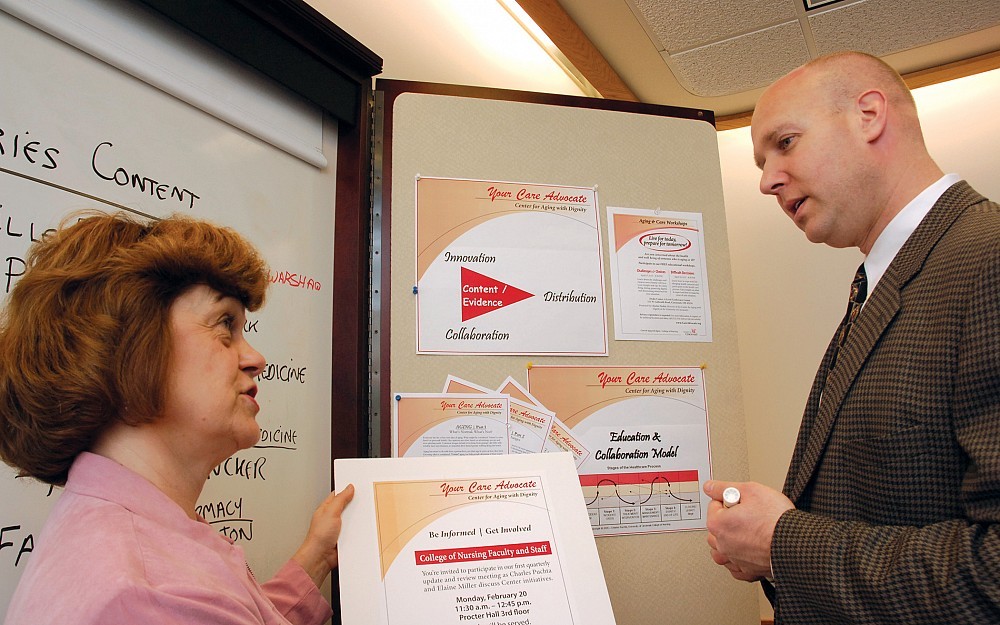
The University of Cincinnati College of Nursing is helping people who are aging or chronically ill, as well as their families, answer these and other questions through its Center for Aging with Dignity.
The center is kicking off a free aging and care workshop series in April to help people anticipate, understand and address the struggles they are likely to face as loved ones age or become ill.
The health-care system is complex and fragmented, says Charles Puchta, director of the center. A variety of organizations are offering programs and services that address specific issues, such as diseases, acute medical care and adult day services, but many basic concerns are not adequately addressed.
Were focusing on how to help people make sense of their situation so they are better able to take the appropriate action and make informed decisions, says Puchta, a certified senior advisor (CSA). Everything we do is designed to complement existing services and organizations.
The workshops, called Live for Today, Prepare for Tomorrow, are a two-part series. The first workshop, Challenges and Choices, provides insight and tips for daily living, driving, preserving dignity and determining whats best for your situation.
The second workshop, Difficult Decisions, is designed to help people cope with life-changing health concerns and participate in the health-care process.
In addition to workshops for the public, the center is offering a professional development series that provides continuing education units for nurses and social workers.
According to Puchta, people often find themselves overwhelmed and uninformed when thrust into the role of providing or receiving care. Thats why its important for health-care professionals to know and understand techniques and interventions that can help them support the needs of their patients and clients, he says.
For more information on the workshops (details below) or the center, contact Charles Puchta at (513) 558-2428, e-mail charles.puchta@uc.eduor visit www.careadvocate.org.
General public workshops
Session 1Challenges and Choices
April 3, 6:158:30 p.m., Mercy Anderson (Health Plex)
April 17, 6:15¬8:30 p.m., Drake Center (conference center, A-level)
Session 2Difficult Decisions
April 10, 6:158:30 p.m., Mercy Anderson (Health Plex)
April 24, 6:158:30 p.m., Drake Center (conference center, A-level)
Health-care professional workshops (two-part series)
April 3 and 10, noon1 p.m., Mercy Anderson (Health Plex)
April 17 and 24, noon1 p.m., Drake Center (conference center, A-level)
Tags
Related Stories
On-site training in Speech & Hearing Clinic sets UC’s programs apart
August 27, 2026
At the University of Cincinnati’s Speech & Hearing Clinic, Doctor of Audiology and Speech-Language Pathology graduate students gain real-world experience while providing free speech and hearing services to the community.
UC, NKU renew longstanding partnership supporting Army ROTC cadets
August 26, 2026
The University of Cincinnati Army ROTC and Northern Kentucky University (NKU) have renewed a longstanding partnership that supports students preparing to become Army officers and leaders in their communities. The universities formalized the renewed agreement during a signing event Aug. 11 at NKU.
Funding expands UC research into weight gain side effects of bipolar medication
August 26, 2026
University of Cincinnati researchers have been approved for funding by the Patient-Centered Outcomes Research Institute (PCORI) to expand the implementation of healthy lifestyle interventions and metformin prescription to help manage weight gain in overweight or obese youth taking second-generation antipsychotic medications.