Appetite-Inducing Hormone Receptor Found Active in Breast Cancer

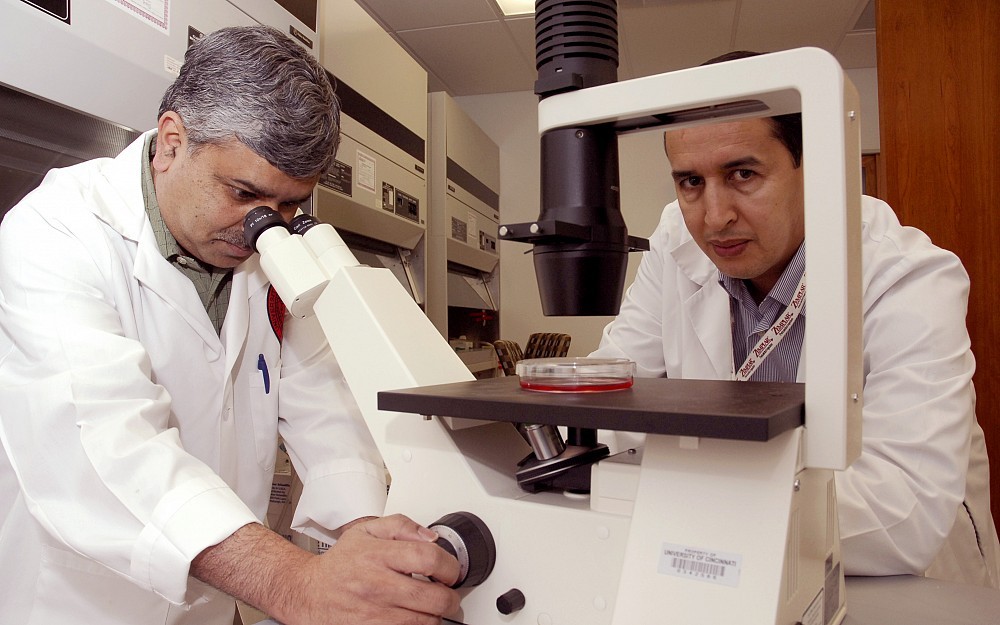
The UC research team, led by Hassane Amlal, PhD, and Sulaiman Sheriff, PhD, report their laboratory findings on the hormone, neuropeptide Y, and its receptor in the April edition of the journal Cancer Research.
Earlier studies have shown that neuropeptide Ys receptor, known as Y1, is overproduced in human ovarian, prostate and breast cancers. This study, however, is the first to demonstrate that the Y1 receptor is actually working in breast cancer cells and can be turned on by excessive estrogena known cause of about 60 to 70 percent of breast cancers, they say.
The high incidence and activity of the Y1 receptor in human breast tumor cells suggests that it may play an important role in breast cancer, explains Dr. Sheriff, a UC research assistant professor in the department of surgery.
Pilot data suggests that about 40 percent of all breast cancer patients have increased levels of the Y1 receptor, he says.
We knew this receptor was overproduced in breast cancer tissue, adds Dr. Amlal, a research assistant professor in the department of internal medicine, but now the real question is what does it do in breast cancer cells, and how can we use it as a target to fight cancer.
The UC researchers were able to slow the growth of breast cancer cells with abnormally high levels of the Y1 receptor by treating them with neuropeptide Y hormone produced by chemical synthesis.
This finding gives us a promising new investigational target in the fight against breast cancer, the authors report. If we can find a way to selectively activate the Y1 receptor, we can limit breast cancer growth in the body.
Further studies of the Y1 receptors role, they explain, may ultimately lead to more targeted drug therapy for many breast cancer patients.
According to the American Cancer Society, more than 214,000 women and men will be diagnosed with breast cancer in 2006. About 19 percent will die from the disease.
This study was sponsored by UC and the National Institutes of Health. The research team also included Somia Faroqui, and Ambikaipakan Balasubramaniam, PhD.
Tags
Related Stories
Heavy social media use linked to depression
August 31, 2026

U.S. News and World Report, Yahoo! News, MSN, USA Today and other national media highlight a new study by the University of Cincinnati and Northwestern University that found a correlation between heavy social media use and depression in adults.
On-site training in Speech & Hearing Clinic sets UC’s programs apart
August 27, 2026
At the University of Cincinnati’s Speech & Hearing Clinic, Doctor of Audiology and Speech-Language Pathology graduate students gain real-world experience while providing free speech and hearing services to the community.
Funding expands UC research into weight gain side effects of bipolar medication
August 26, 2026
University of Cincinnati researchers have been approved for funding by the Patient-Centered Outcomes Research Institute (PCORI) to expand the implementation of healthy lifestyle interventions and metformin prescription to help manage weight gain in overweight or obese youth taking second-generation antipsychotic medications.