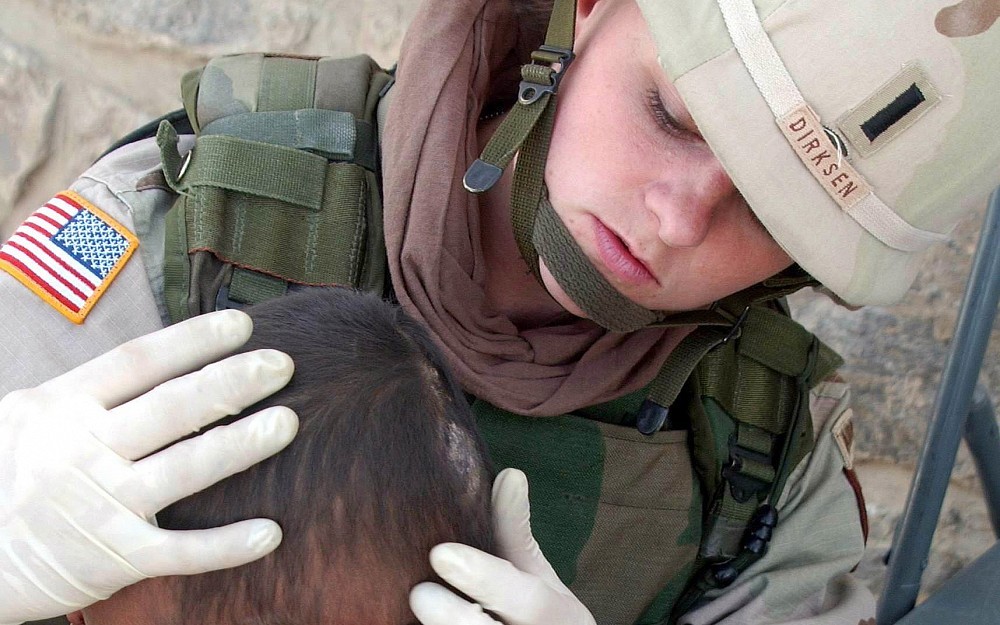
Public Gets Rare Chance to Visit an Army Combat Surgery Team

The FST is a 20-person team, including surgeons, anesthetists and nurses who provide immediate medical care for soldiers on the battlefield, assessing and treating their injuries before they are transported to field hospitals for long-term care.
Being forward on a battlefield means being close to where the combat troops are, says Eric Bentley, MD, lieutenant colonel and commander of the 933rd FST. He is also trauma director for
The 933rd FST recently returned from
Its rare for the public to have a chance to visit an FST unit, says Dr. Bentley. We want to give people an opportunity to experience firsthand how their tax dollars are helping save the lives of soldiers.
We also hope health-care professionals in the area will visit the unit, see how their skills are needed and consider military medicine as a career option, Dr. Bentley says. Dr. Bentley himself joined the Army reserves several years ago in his mid-40s because he knew his skills as a general surgeon would benefit the country, and he felt the need to help.
Andrea Lindell, DNSc, dean of the UC College of Nursing, says, Nurses are a vital part of any health-care team and must be adaptable to diverse situations. Were honored the Army is sharing their expertise and experiences saving lives with the people in our community.
There are 24 FST units in the Army reserves and 12 on active duty. Units are generally tents equipped with operating tables and lights, IVs, surgical instruments and two portable refrigerators for blood (they have 30 units on hand). They are equipped to provide care to critically wounded soldiers for 72 hours before another unit moves forward to allow units to restock their supplies.
FST units are set up in three areas, a receiving (triage) area where wounded soldiers injuries are assessed, an operative area and a postoperative (recovery) area. The units have to keep up with the movement of the forces and are designed to be able pack up and move in two hours.
FST units are a fairly new concept. Most people dont realize that were right there to take care of injured soldiers, says Dr. Bentley. Its pretty intensive, but were able to provide high-quality care to wounded soldiers faster and more effectively, increasing their chance of survival.
Tags
Related Stories
Cancer Center plays key role in lab research, clinical trials for new pancreatic cancer drug
September 1, 2026

WLWT and WCPO highlighted the contributions of University of Cincinnati Cancer Center researchers that helped lead to the recent FDA approval of daraxonrasib, a new treatment for pancreatic cancer.
Cancer Center physician receives $150,000 New Investigator Research Grant to study treatment-resistant leukemia
September 1, 2026
The University of Cincinnati Cancer Center’s Sarah Skuli, MD, PhD, received a two‑year, $150,000 Leukemia Research Foundation New Investigator Grant to study TP53‑mutated leukemia, a treatment‑resistant subtype with very poor outcomes.
Heavy social media use linked to depression
August 31, 2026

U.S. News and World Report, Yahoo! News, MSN, USA Today and other national media highlight a new study by the University of Cincinnati and Northwestern University that found a correlation between heavy social media use and depression in adults.