Cincinnati Surgeon Leads First Test of Mobile Robotic Surgery

CINCINNATI--A team of military, telecommunications and surgical experts led by University of Cincinnati (UC) faculty are using an unmanned aircraft and sophisticated communication tools to take the next step toward making telesurgery a reality.
Telesurgery is a new approach to surgical care in which a surgeon performs operations using a surgical robot and advanced computer technology on a patient located miles away.
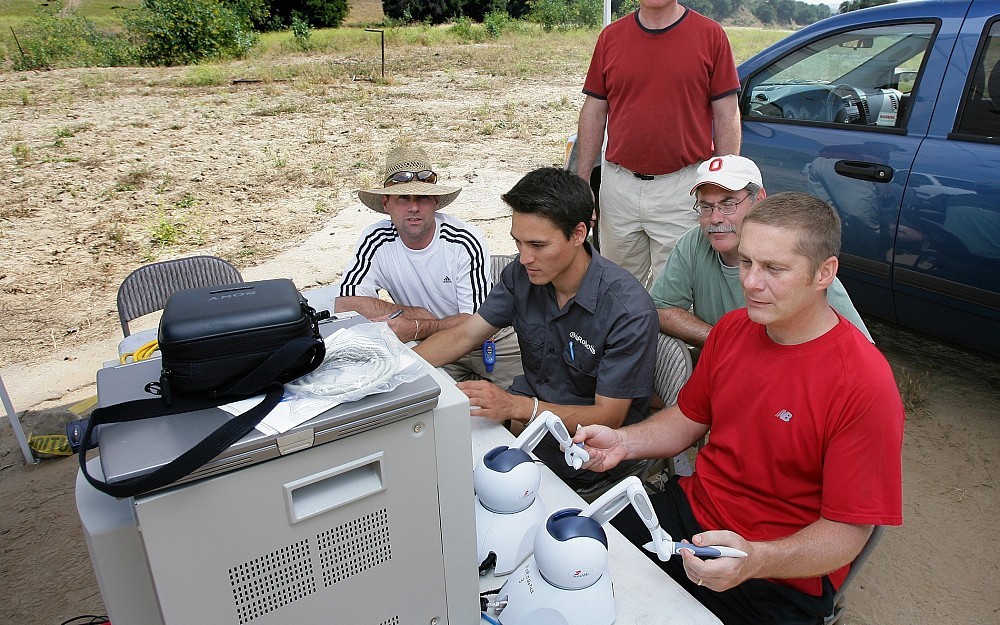
Timothy Broderick, MD, assistant professor of surgery at UC and medical director for its Center for Surgical Innovation (CSI), is leading the first test of a prototype communications platform for mobile telesurgery: the High Altitude Platforms for Mobile Robotic Telesurgery (HAPsMRT).
This two-phase telesurgery experiment takes place between
The HAPsMRT modeldeveloped in collaboration with the U.S. Armys Telemedicine and Advanced Technology Research Center and the
Current telesurgery tools rely on satellite communication and streaming video delivered via high-speed Internet. In remote locations, explains Dr. Broderick, satellite signals are not always dependable and can result in delays that make surgery difficult.
Reliable, high-speed communication signals are critical for telesurgery to work in day-to-day patient care, explains Dr. Broderick. Our ultimate goal is to eliminate the communications lag to enable the surgeon to safely operate on a remote patient in real time.
HAPsMRT utilizes low-latency communication transmissions, so the communication signals travel over a shorter distance and with fewer delays.
In phase one of the mission, a simulated patient and robot will be located five miles north of Dr. Broderick at the AeroVironment Flying Field. Dr. Broderick will sit behind the surgical robot control console and operate on the simulated patient using streaming video fed into the console from the UAV.
In phase two of the experiment, Dr. Broderick will travel to the
Throughout the mission, the research team will evaluate the UAVs communications capabilitiesincluding speed and quality of video streaming, information time lapses and suturing precisionto see how they are affected by an extreme environment.
We need to find better ways of delivering emergency and specialized surgical care to patients when they are hundreds of miles away from the nearest hospital, explains Dr. Broderick. When its perfected, telesurgery could quickly become the medical norm for remote places, including battlefields, extremely rural townseven space.
Founded in June 2003, the CSI is an interdisciplinary collaboration between the departments of surgery and biomedical engineering at UC and leading government and industry partners.
One of only a handful of centers of its kind across the nation and the only one in the
The 3,700-square-foot facility includes an eight-bench teaching lab with advanced audiovisual and telecommunications capabilitiessuch as international videoconferencing and direct linkages to the operating rooms at
In March 2005, Dr. Broderick and his UC team led the nations first live telesurgery, using the da Vinci surgical robot, from

The two-phase telesurgery HAPsMRT experiment took place between Simi Valley, California a desolate and arid area surrounded by hills and plains and Seattle, Washington.

In the HAPsMRT mission, UC used an unmanned aerial vehicle (UAV) developed by AeroVironment as a communication platform for telesurgery.
Tags
Related Stories
On-site training in Speech & Hearing Clinic sets UC’s programs apart
August 27, 2026
At the University of Cincinnati’s Speech & Hearing Clinic, Doctor of Audiology and Speech-Language Pathology graduate students gain real-world experience while providing free speech and hearing services to the community.
Funding expands UC research into weight gain side effects of bipolar medication
August 26, 2026
University of Cincinnati researchers have been approved for funding by the Patient-Centered Outcomes Research Institute (PCORI) to expand the implementation of healthy lifestyle interventions and metformin prescription to help manage weight gain in overweight or obese youth taking second-generation antipsychotic medications.
One in four NFL players had CTE at death
August 25, 2026

Forbes cites research on concussions and football helmets by the University of Cincinnati in a report that found one in four NFL players had brain damage at death.