UC Surgeons Perform Tristate s First Rectal Microsurgery

CINCINNATIUniversity of Cincinnati (UC) colorectal surgeons have become the first in the Tristate to perform a transanal endoscopic microsurgical (TEM) procedure, a minimally invasive method for removing rectal cancers that eliminates the need for external incisions.
Surgeons say the procedure is a safe alternative to open surgery for removing very early rectal cancers and polyps, the precancerous masses that form on the lining of the colon or rectum.
TEM is a great alternative for certain patients, including those who might not be able to tolerate a big operation, explains Bradley Davis, MD, an assistant professor of surgery at UC and a colorectal surgeon at Christ Hospital. The recovery time is minimal, and functional resultsnamely bowel function and controlare often better, so patients can return to their normal activities faster.
The technique, known as endoluminal surgery is a minimally invasive method for operating inside the rectum using a fiber-optic light source, a camera and specialized instruments. Inserted through the anus, the instruments eliminate the need for an external incision and leave no visible scarring.
TEM allows surgeons to reach tumors deeper in the rectum, says Davis. Its very accurate, and cancer recurrence rates are typically as low as those achieved using other established methods.
Traditional radical rectal surgery often involves removing a large part of the rectum, which results in less room to store solid waste. This results in a decreased ability to hold feces and can even result in incontinence. Endoluminal surgery allows certain patients to avoid a temporaryand sometimes permanentcolostomy bag, a pouch connected to the bowel and worn outside the body to the collect waste that would normally pass through the digestive system.
The important thing, stresses Davis, is that the patient is diagnosed and evaluated properly. TEM is only appropriate for polyp and very early cancer removal. More advanced cancers require a more aggressive treatment to completely eradicate the disease.
Before surgery, the patient is given spinal anesthesia and positioned on the side, back or stomach, depending where the tumor is located. Guided by a video monitor, the surgeon navigates a rectoscopea thin, flexible instrument equipped with a three-dimensional camera and light source at its tipup through the anal canal to the tumor.
The bowel is inflated with gas to improve tumor visualization. Then, the surgeon detaches the tumor and a small section of surrounding tissue using a specialized electronic scalpel that simultaneously seals affected blood vessels. Once the tumor is removed through the anus, the rectal wall is cleansed and sutured.
The TEM procedure takes about an hour, and patients are typically released from the hospital the next day.
Patients have valid concerns about quality-of-life issues that result from radical rectal surgery, says Davis. TEM maximizes surgical effectiveness while minimizing the negative side effects, such as incontinence, that can cause both discomfort and embarrassment during recovery.
Davis and his colleagues at UC are specially trained to research, diagnose and treat diseases of the colon and rectum. Together, they perform more than 100 laparoscopic colon and rectal procedures annually.

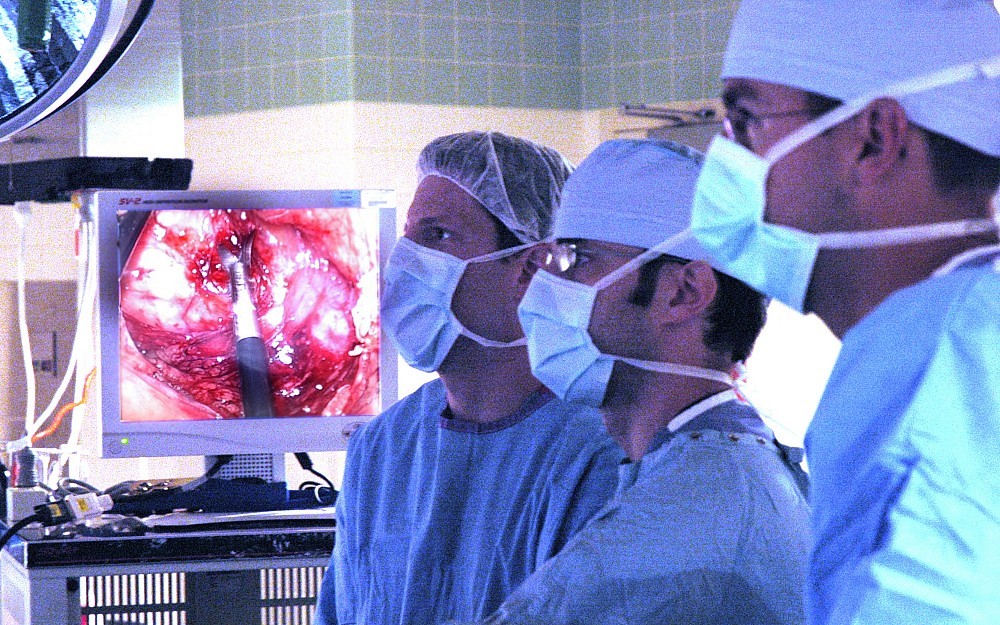
Bradley Davis, MD, (left) and his colleagues at UC are specially trained to research, diagnose and treat diseases of the colon and rectum.

Bradley Davis, MD, and his team perform about 100 laparoscopic colon and rectal procedures annually.

Bradley Davis, MD, is a colorectal surgeon and assistant professor of surgery at UC.
Tags
Related Stories
On-site training in Speech & Hearing Clinic sets UC’s programs apart
August 27, 2026
At the University of Cincinnati’s Speech & Hearing Clinic, Doctor of Audiology and Speech-Language Pathology graduate students gain real-world experience while providing free speech and hearing services to the community.
Funding expands UC research into weight gain side effects of bipolar medication
August 26, 2026
University of Cincinnati researchers have been approved for funding by the Patient-Centered Outcomes Research Institute (PCORI) to expand the implementation of healthy lifestyle interventions and metformin prescription to help manage weight gain in overweight or obese youth taking second-generation antipsychotic medications.
One in four NFL players had CTE at death
August 25, 2026

Forbes cites research on concussions and football helmets by the University of Cincinnati in a report that found one in four NFL players had brain damage at death.