Art Course Improves Medical Student's Diagnostic Skills

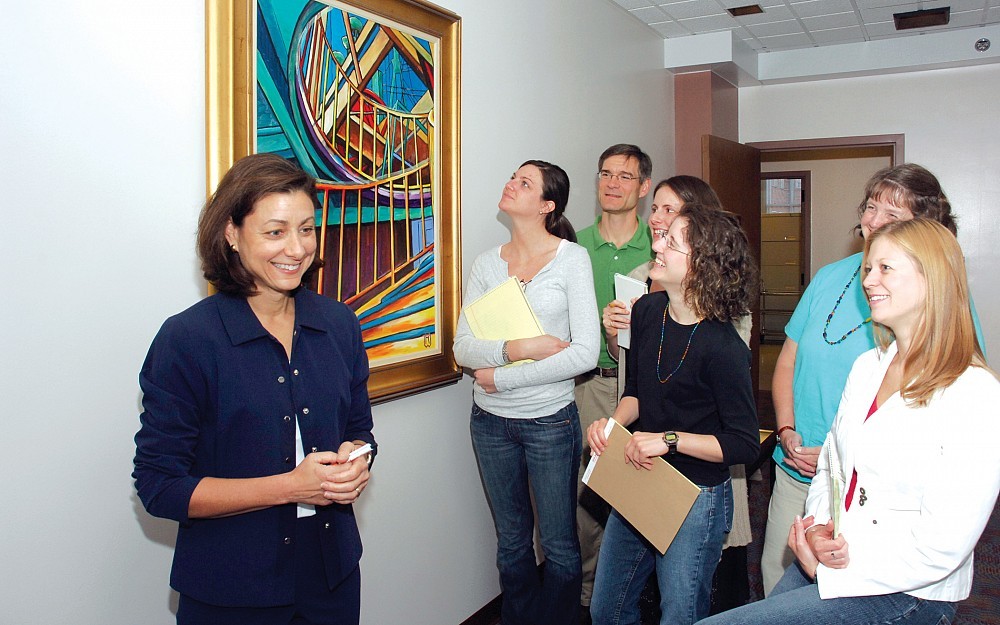
Called the Art of Observation, the course is run by Barbara Tobias, MD, and Nancy Elder, MD, both associate professors of family medicine, with the help of Amber Lucero-Criswell of the
Using paintings and sculptures at the art museum, says Tobias, Were attempting to teach students to think about conclusions made on the basis of their observations. For example, what is it about this person that makes us think they are sad, and what are the observers personal frames of references and biases?
A greater awareness of the difference between our objective and subjective views allows us to be more careful about the judgments we make about patients, and people in general, Tobias says. Its very easy for a doctor to seize upon an obvious diagnosis, and overlook other complicating conditions.
The field trips to the art museum are not just a reprieve from the welter of medical facts that students are expected to absorb.
Taking this class has been one of the high points in my medical school career, says participant Robin Petroze.
I learned that one of the keys to being a good doctor is noticing your patients, and being aware of yourself, Petroze says. Noticing the little things in a patients appearance and demeanor, the subtle hue of skin, the turn of a smile or the uncomfortable wringing of the hands is important.
Whats more, she says, I learned to acknowledge my own prejudices and frame of reference in dealing with patients. I appreciated that in many ways, medicine is more an art than a science.
And I think it helps us grow in ourselves, in our view of the world, and in our interactions with those around us, Petroze says. You just have to make a conscious effort.
Student Katie Davidson adds, We were trained to look at all the parts of what were seeing, whether it was a painting or a person, so we're less likely to miss important details that may help in a diagnosis.
The ability to interact with people, to help with healingnot just curingis equally important, she says.
The course, introduced in 2001, is offered as an elective to second-year medical students. The small class meets at the art museum once a month for eight months.
Students also practice their powers of observation by shadowing Elder or Tobias for half a day each month as they see patients. During each session, the students journal their observations and later discuss their interpretations and reflections of the patient-doctor interaction in a group.
Shadowing allows second-year students to practice their interviewing and physical exam skills, gaining more confidence before actually going into rotations of different medical specialties during their third year, Elder says.
Katie Davidson says that the art of observation also contributed to what she was learning in other classes, and the chance to shadow her mentors demonstrates in a practical way how knowledge is only part of medicine.
Seeing a patient who has a disease we had just studied, she says, reinforced concepts associated with its diagnosis and treatment a hundred times more strongly than just reading about it.
Davidson concludes, Every aspect of this classthe time in the museum, the time spent shadowing, the excellent preceptors and the discussions with other classmatesmade learning and practicing medicine more exciting and enjoyable.
A survey of third- and fourth-year students who had previously taken the course, Elder says, found that All participants surveyed echoed one resounding theme: this course helps medical students become more aware of how the art of observation enhances the art of medicine.
Tags
Related Stories
Cancer Center physician receives $150,000 New Investigator Research Grant to study treatment-resistant leukemia
September 1, 2026
The University of Cincinnati Cancer Center’s Sarah Skuli, MD, PhD, received a two‑year, $150,000 Leukemia Research Foundation New Investigator Grant to study TP53‑mutated leukemia, a treatment‑resistant subtype with very poor outcomes.
Heavy social media use linked to depression
August 31, 2026

U.S. News and World Report, Yahoo! News, MSN, USA Today and other national media highlight a new study by the University of Cincinnati and Northwestern University that found a correlation between heavy social media use and depression in adults.
On-site training in Speech & Hearing Clinic sets UC’s programs apart
August 27, 2026
At the University of Cincinnati’s Speech & Hearing Clinic, Doctor of Audiology and Speech-Language Pathology graduate students gain real-world experience while providing free speech and hearing services to the community.