UC HEALTH LINE: Dizziness, Fatigue May Be Sign of Balance Disorder

CINCINNATIJust
about everything you do in your daily lifewhether its walking,
driving a car or brushing your teethrequires balance.
For
most people balance is so instinctive they dont think about ituntil
dizziness or disorientation signals that something has gone wrong.
And when that happens, UCs
Maintaining balance depends on three complex processes, says Julie Honaker, director of audiology in the UC Department of OtolaryngologyHead and Neck Surgery: the sensory systems ability to accurately determine the bodys position relative to the environment (standing up, for example), the brains ability to process that information, and the coordinating movement of the muscles and joints.
The bodys balance sensors include the eyes, the sense of touch, and the inner earwhere calcium carbonate otolith particles and fluid inside three paired canals stimulate hair cells to generate senses of forward, backward and vertical motion in the head.
The
Already one of the best equipped of its kind, UCs
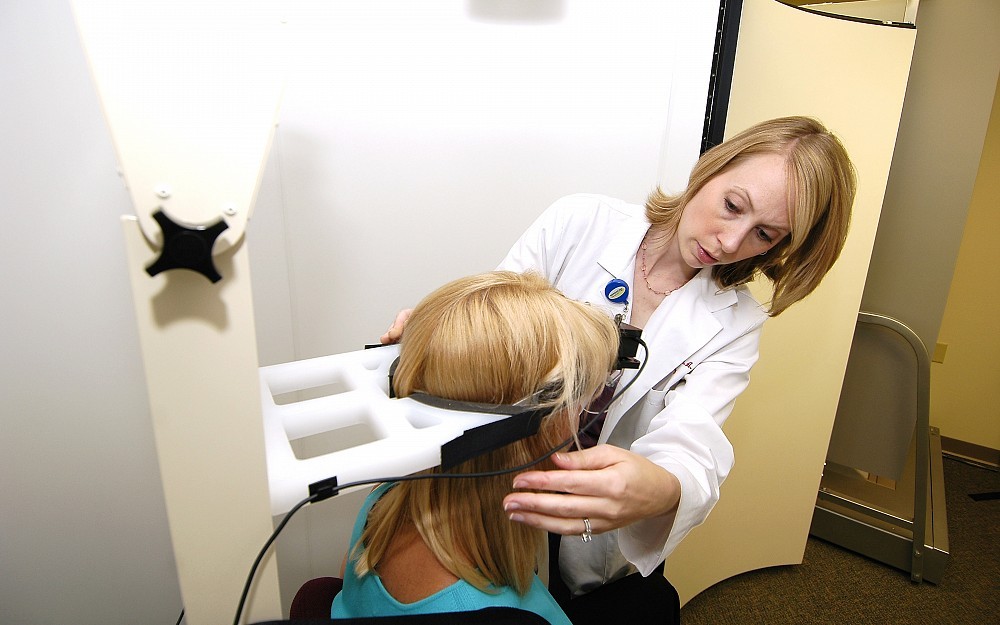
· A rotational chair: UC is one of the first comprehensive balance centers in the area to offer this test. Patients are seated in a chair that rotates at different speeds to measure their eye movements. The chair features multiple testing options that focus on different aspects of balance function.
· Platform posturography: This series of tests measures how well patients can maintain their balance while the walls and floor of the booth in which they are standing are gradually moved.
· VEMP (vestibular evoked myogenetic potential): This technique measures responses from the saccule, one of the otolith organs in the inner ear, to sound stimulation, including high-intensity acoustic stimuli, clicks and low-frequency tones.
So many conditions can cause dizziness and disorientation, says Honaker. Were like detectives when we evaluate and test people for balance disorders, because of all the conditions that must be ruled out as the cause. Thats why were really excited to add this equipment to our centerit gives us more in-depth options for whats causing a patients balance issues.
People can develop balance problems because of inner ear conditions, head injury, stroke or other neurological issues, she explains.
Balance disorders can really disrupt a persons life, adds Ravi Samy, MD, assistant professor of otolaryngology. They can cause fatigue, shorten the attention span, disrupt sleep patterns and increase the risk of falling, making it difficult to do everyday tasks.
Balance problems also increase with age, and Honaker, currently studying the risk and fear of falling in the elderly, hopes to establish a program for at-risk patients.
Were an aging population, so its important to offer safety and counseling tips to help those at risk of falling, she says. Im hoping to develop a multidisciplinary approach, which would include primary care, geriatric and neurology physicians among others.
For more information on balance disorders, visit www.netwellness.org, a collaborative health-information Web site staffed by Ohio physicians, nurses and allied health professionals, or call (513) 475-8453 to schedule an appointment at the Balance Center.

Ravi Samy, MD, assistant professor of otolaryngology

Julie Honaker, director of audiology in the UC Department of Otolaryngology Head and Neck Surgery

The UC Balance Center recently added a rotational chair which features multiple testing options that focus on different aspects of balance function.

Julie Honaker, director of audiology, Department of Otolaryngology Head and Neck Surgery, stands in front of the Balance Center's new rotational chair.
Tags
Related Stories
Cancer Center plays key role in lab research, clinical trials for new pancreatic cancer drug
September 1, 2026

WLWT and WCPO highlighted the contributions of University of Cincinnati Cancer Center researchers that helped lead to the recent FDA approval of daraxonrasib, a new treatment for pancreatic cancer.
Cancer Center physician receives $150,000 New Investigator Research Grant to study treatment-resistant leukemia
September 1, 2026
The University of Cincinnati Cancer Center’s Sarah Skuli, MD, PhD, received a two‑year, $150,000 Leukemia Research Foundation New Investigator Grant to study TP53‑mutated leukemia, a treatment‑resistant subtype with very poor outcomes.
Heavy social media use linked to depression
August 31, 2026

U.S. News and World Report, Yahoo! News, MSN, USA Today and other national media highlight a new study by the University of Cincinnati and Northwestern University that found a correlation between heavy social media use and depression in adults.