Exercise May Be Best Medicine for Breast Cancer Survivors

Beverly Reigle, PhD, is leading a pilot study to determine whether a regular exercise programstarted just one day after breast cancer surgerycan improve the functional abilities and quality of life of breast cancer survivors.
The assault a womans body takes from breast cancerboth from the actual disease and the treatmentaffects what she can do physically and mentally, says Reigle, assistant professor of nursing at UC and principal investigator of the study. These women have active livestheyre mothers, grandmothers and professionals in the workforce. Life cant and shouldnt stop for breast cancer.
Researchers are recruiting about 25 study participants aged 45 or older who have had breast cancer surgery (mastectomy or lumpectomy and lymph node evaluation) and chosen not to undergo immediate reconstruction.
Prior to surgery, a physical therapist measures the womans range of motion, upper body strength and arm circumference. This data is used to benchmark strength, flexibility and stamina after treatment. Arm circumference is also used to monitor for lymphedema, a condition in which the lymphatic channels that carry fluid to and from tissue become clogged and swollen.
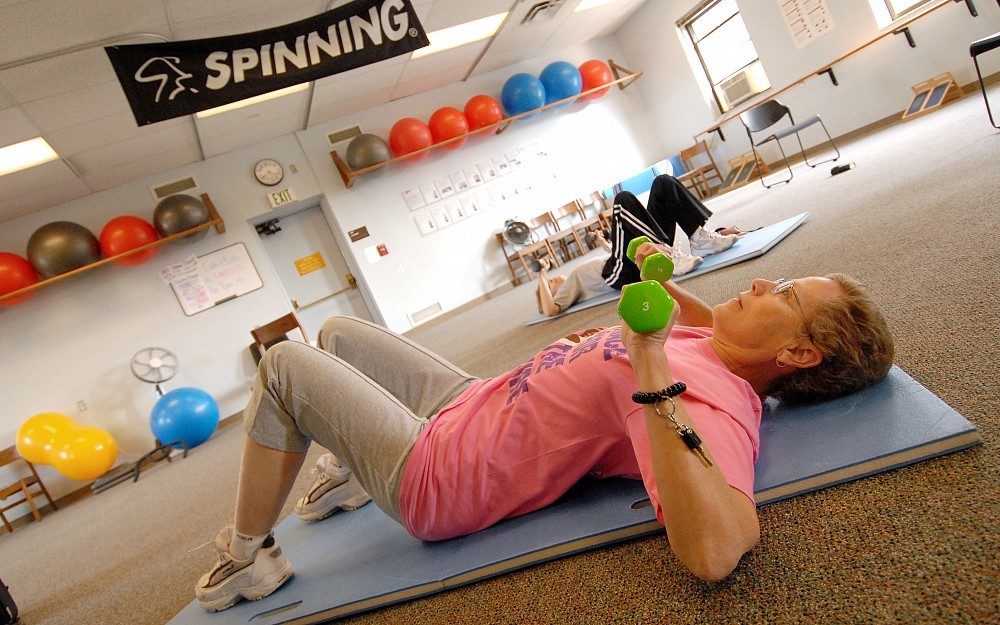
Women are divided at random into two groups. One day after surgery, supervised by a physician therapist, the experimental group starts an 18-week exercise program that includes light lower- and upper-body weight training. A physical therapist meets one-on-one with the patient for the first six weeks, and then the women transition into the
The control group receives an instructional pamphlet and verbal encouragement to do the exercises.
The problem is that there is no consensus in the medical community on rehabilitation guidelines for breast cancer survivors, so women dont know what activities they can safely do after surgery, explains Elizabeth Shaughnessy, MD, PhD, associate professor of surgery at UC and study collaborator.
This study intervenes at the point of impairmentsurgeryto help promote continued physical strength, endurance and flexibility, she adds. A low-impact exercise regimen started immediately following surgery may prove beneficial without compromising medical recovery.
For more information on this trial, contact Reigle at (513) 558-5276. To learn more about breast cancer clinical trials at UCs

A ftness instructor works with a breast cancer survivor on an exercise routine.
Tags
Related Stories
Cancer Center plays key role in lab research, clinical trials for new pancreatic cancer drug
September 1, 2026

WLWT and WCPO highlighted the contributions of University of Cincinnati Cancer Center researchers that helped lead to the recent FDA approval of daraxonrasib, a new treatment for pancreatic cancer.
Cancer Center physician receives $150,000 New Investigator Research Grant to study treatment-resistant leukemia
September 1, 2026
The University of Cincinnati Cancer Center’s Sarah Skuli, MD, PhD, received a two‑year, $150,000 Leukemia Research Foundation New Investigator Grant to study TP53‑mutated leukemia, a treatment‑resistant subtype with very poor outcomes.
Heavy social media use linked to depression
August 31, 2026

U.S. News and World Report, Yahoo! News, MSN, USA Today and other national media highlight a new study by the University of Cincinnati and Northwestern University that found a correlation between heavy social media use and depression in adults.