Program Offers Quick, No-Cost Imaging Exams to Kids with Disabilities

The MRI project, led by Kenneth Weiss, MD, associate professor of radiology and psychiatry at UCs
MRI is a procedure that uses a magnetic field and radio-wave energy pulses to create pictures of organs and body structures. The test is used to detect, diagnose and plan treatment for a variety of disorders, including those involving the brain and spine.
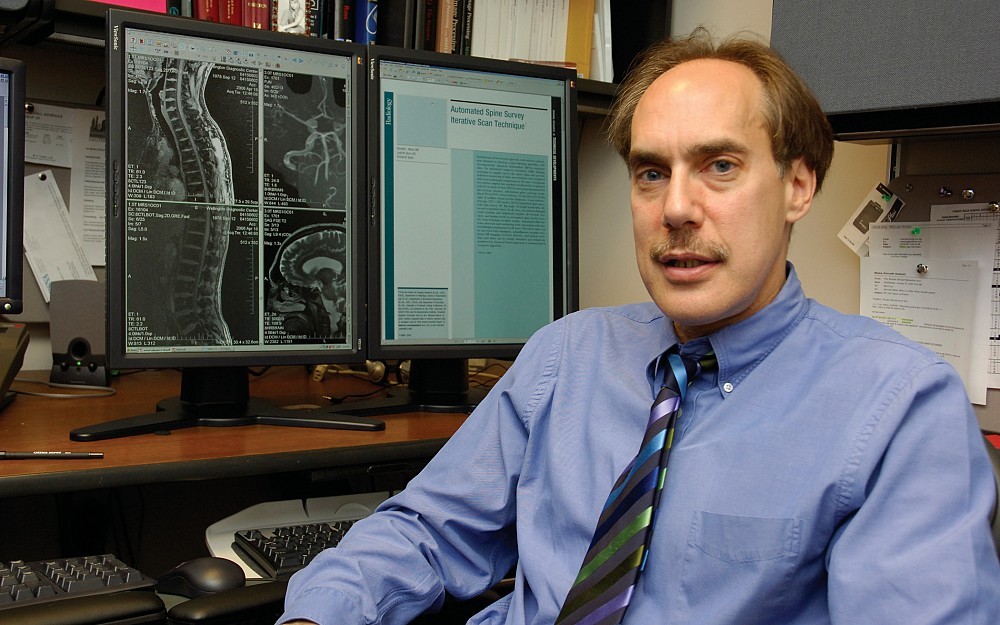
Weiss and his team have developed and are currently refining a noninvasive computer-automated MRI techniqueknown as the automated spine survey iterative scan technique (ASSIST)that allows physicians to obtain rapid, high-quality MRI scans.
Spine and brain imaging in kids is challenging because the patient usually cant hold still for the duration of time it takes to do a comprehensive scan, explains Weiss. This is especially true in children with neurological disabilities.
Weiss believes his technique, which is currently being refined in adults, could also improve the detection and diagnosis of brain and spine injuries in childrenultimately leading to better care.
Brain and spine abnormalities are a leading cause of death, disability and reduced quality of life in children, he says. We hope that by providing physicians with a technique that is scientifically valid but lower in cost, MRI can become a sensible neurological screening and diagnosis tool in day-to-day patient care.
The UC-developed technique uses computer automated software to obtain and help analyze brain and spine MRI studies. With Weisss techniquewhich is patent pendinga total neuroaxis MRI survey can take less than ten minutes. Traditional total brain and spine MRI exams can take more than 90 minutes to complete.
Weiss stresses that the neuroaxis screening exam is not as comprehensive as a standard MRI, but it may prove sufficient to answer pressing clinical questions. Further testing is needed before the technique can be applied in daily patient care.
For cases that involve fidgeting or claustrophobic children, the rapid image sequencing may actually yield more information than a longerbut motion-degradedexam, he says.
This allows physicians to get numerous high-quality images in a very short timeframe, adds Weiss.
ASSIST also has the potential to reduce costs associated with diagnostic MRI by cutting the time it takes to acquire scans and increasing the number of patients who have access to the services, he says.
We want to provide the very best possible care and promote the neurological well-being of childrennot just in
Physicians and nonprofit organizations that provide care to
The project is being conducted in collaboration with Cincinnati Childrens

Kenneth Weiss, MD, is an associate professor of radiology and psychiatry at UC.
Related Stories
On-site training in Speech & Hearing Clinic sets UC’s programs apart
August 27, 2026
At the University of Cincinnati’s Speech & Hearing Clinic, Doctor of Audiology and Speech-Language Pathology graduate students gain real-world experience while providing free speech and hearing services to the community.
Designing with cancer patients' needs in focus
August 27, 2026
Kristina Shin is designing garments that prioritize the comfort, function and confidence of breast cancer patients, addressing a need often overlooked by traditional fashion.
UC, NKU renew longstanding partnership supporting Army ROTC cadets
August 26, 2026
The University of Cincinnati Army ROTC and Northern Kentucky University (NKU) have renewed a longstanding partnership that supports students preparing to become Army officers and leaders in their communities. The universities formalized the renewed agreement during a signing event Aug. 11 at NKU.