Early Exposure to Indoor Fungus Molecules May Protect Infants Against Future Allergies

CINCINNATIMaybe being a fussy housekeeper isnt such a good thing after all.
Environmental health scientists at the University of Cincinnati (UC) say they have confirmed what other scientists have only suspected: early-life exposure to certain indoor fungal components (molecules) can help build stronger immune systems, and may protect against future allergies.
The UC team found that infants who were exposed to high levels of indoor fungal componentsknown as fungal glucanswere nearly three times less likely to wheeze compared with infants exposed to low levels.
Fungal glucans are tiny molecules that scientists believe cause respiratory symptoms in adults. Crawling infants are often exposed to these molecules when they disturb dust on carpet or floors in their homes.
Study lead author and environmental health scientist Yulia Iossifova says exposure to high levels of these molecules may also protect against allergy development in high-risk infants.
The immune systems protective effects only appear to occur when there are high levels of microbial exposure, she explains. Cleaner environments do not have enough microbial components to trigger the immune system response.
The UC team reports their findings in the May 2007 edition of the scientific journal Allergy. This epidemiological study is the first to suggest that early-life exposure to high levels of indoor fungal glucans can have a positive impact on the human immune system.
Fungi are a diverse group of microorganisms, so species differ in their glucan content and allergenic proteins. Some fungi also contain mycotoxins that can contribute to disease, adds Tiina Reponen, PhD, professor of environmental health and corresponding author of the study. Exposure to indoor molds during infancy may be associated with respiratory symptoms, such as persistent coughing and wheezing.
The UC-led team analyzed the effects of microbial exposures to both fungal glucans and endotoxins (natural compounds secreted from disease-causing agents like bacteria) in 574 infants, enrolled in the Cincinnati Childhood Allergy and Air Pollution Study (CCAAPS), who were identified as being at greater risk for future allergies because at least one parent had known allergies.
The CCAAPS, funded by the National Institute of Environmental Health Sciences, is a five-year study at UC examining the effects of environmental particulates on childhood respiratory health and allergy development.
UC researchers collected dust samples from each infants primary activity room and analyzed them for indoor allergens, fungal glucans and bacterial endotoxins. They also gathered information about the home, including the presence of any visible mold and water damage. Environmental and food allergy development was monitored through annual skin prick tests.
Scientists say early-life exposure to common microbial componentslike bacterial endotoxins and fungal glucanscan stimulate the bodys immune system to produce infection- and allergy-fighting substances. Because of this, Iossifova says, people should avoid overusing antibacterial sprays and soaps to clean their bodies and homes.
Certain microbes can have helpful affects in the body, she explains, but antibacterial disinfectants cant discriminate between helpful and harmful microbesthey destroy them all.
This eliminates the natural competition among bacteria and fungi, so the surviving microbes are often the infectious ones that can develop resistance to drugs designed to eliminate them.
Iossifova says further research is needed to determine how early microbial exposures affect the development of certain allergic conditionsincluding asthma, dermatitis and hay feverlater in life.
Collaborators in this study include UC colleagues David Bernstein, MD, Linda Levin, PhD, Hapinder Kalra, MD, Paloma Campo, MD, James Lockey, MD, Manuel Villareal, MD, and Grace LeMasters, PhD, principal investigator of CCAAPS. Gurjit Hershey, MD, of Cincinnati Childrens Hospital Medical Center also contributed to the study.

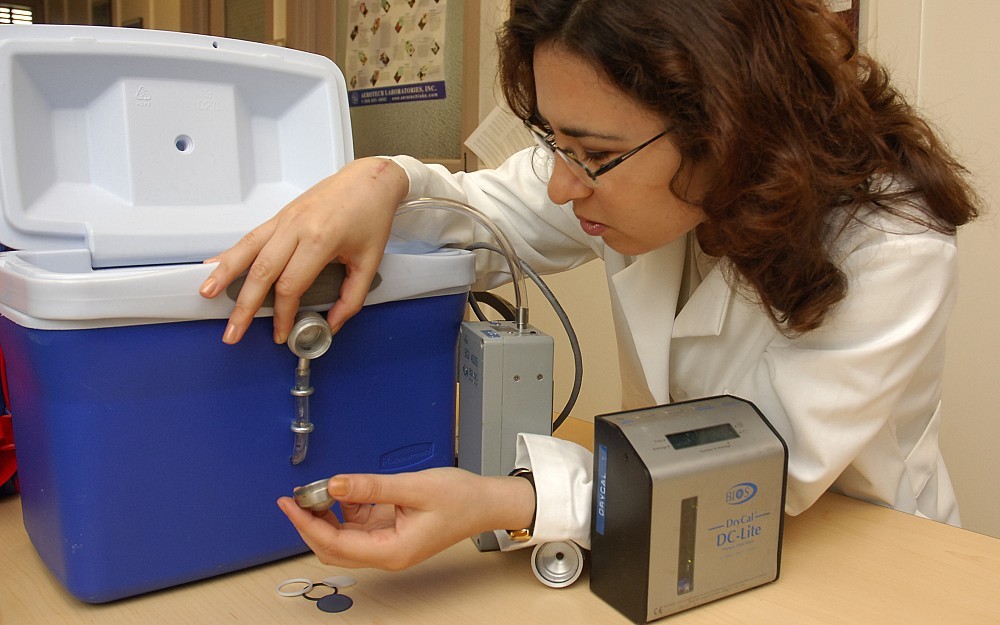
Tiina Reponen, PhD, professor of environmental health, and student Yulia Iossifova examine air sampling equipment prior to collecting fungal spores.

Environmental health scientist Yulia Iossifova calibrates an air sampling device used to collect fungal spores.
Tags
Related Stories
Cancer Center plays key role in lab research, clinical trials for new pancreatic cancer drug
September 1, 2026

WLWT and WCPO highlighted the contributions of University of Cincinnati Cancer Center researchers that helped lead to the recent FDA approval of daraxonrasib, a new treatment for pancreatic cancer.
Cancer Center physician receives $150,000 New Investigator Research Grant to study treatment-resistant leukemia
September 1, 2026
The University of Cincinnati Cancer Center’s Sarah Skuli, MD, PhD, received a two‑year, $150,000 Leukemia Research Foundation New Investigator Grant to study TP53‑mutated leukemia, a treatment‑resistant subtype with very poor outcomes.
Heavy social media use linked to depression
August 31, 2026

U.S. News and World Report, Yahoo! News, MSN, USA Today and other national media highlight a new study by the University of Cincinnati and Northwestern University that found a correlation between heavy social media use and depression in adults.