Lead- Scrubbing Drug May Also Improve Muscle Function in Lead-Exposed Children

CINCINNATIUniversity of Cincinnati (UC) environmental health researchers say a therapy commonly used to remove dangerously high levels of lead from the body may also improve muscle functions associated with postural balance and movement in lead-exposed children.
Led by Amit Bhattacharya, PhD, the UC team found that children treated with succimer (SUX-sim-er) chelation therapy showed a 19 percent improvement in their ability to perform moving taskssuch as crossing an obstacle or walkingthan those who did not receive treatment.
Chelation (ke-LAY-shun) is a technique, nicknamed scrubbing, in which a drug is administered to seek out and bind to poisonous heavy metals, such as lead or mercury, in the bloodstream. The compound resulting from this binding is then excreted in the urine, essentially cleaning out the dangerous metals.
Succimer (Chermet) is an oral chelating drug approved by the Food and Drug Administration to treat children with extremely elevated blood lead levels (44 to 69 micrograms per deciliter).
The UC team has found that succimer chelation therapy improved static balance by 6 percent.
Lead exposure is a very serious issue, says Bhattacharya, professor of environmental health and lead author of the study, and its important to identify early signs of neuromotor (muscle-function) exposure effectssuch as impaired postural balance or locomotionbefore permanent damage occurs. Our research may help develop control strategies for minimizing exposure to lead at an earlier stage.
The team reports its findings in the May 2007 edition of the journal Neurotoxicology. This is the first study to report that succimer chelation therapy can produce beneficial effects on postural balance and movement in lead-exposed children.
Previous research has shown that succimer chelation therapy can reduce lead levels in the blood, but few scientists have investigated whether it can improve neuromotor abilities in this at-risk population.
Bhattacharya and his team wanted to know if succimer chelation therapy could eliminate or minimize lead-associated muscle-function impairments in children exposed to high levels of lead early in life.
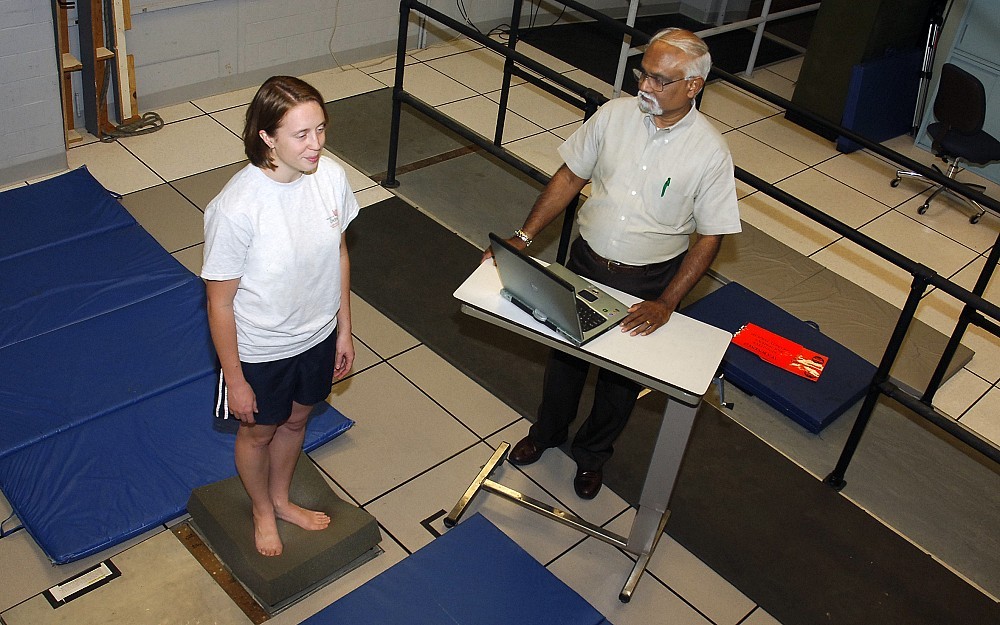
The team identified about 160 Cincinnati children with elevated blood lead levels enrolled in the local arm of a randomized, placebo-controlled clinical trial conducted nationally by the Centers for Disease Control and Prevention and the National Institute of Environmental Health Sciences (NIEHS). Postural balance and gait tests were performed only after each childthen 5 years oldhad completed the succimer or placebo therapy.
Tests were designed to eliminate or challenge factors that help maintain postural balance, such as eyesight and visual context.
Our statistical analysis revealed that subjects who received succimer therapy showed a significant improvement in balance and movement compared to the non-therapy group, says Bhattacharya. This new datacombined with our previous researchleads us to believe that succimer therapy may also result in reduced injuries among this at-risk population.
In the October 2006 issue of the Journal of Adolescent Health, Bhattacharyas team reported that teenagers who experienced high blood lead levels during childhood appear to suffer more accidental injuries than those who had lower lead exposure.
He says further research is needed to determine if succimer therapy can minimize long-term negative effects of lead on balance and movement.
According to the most recent U.S. National Health and Nutrition Examination Survey, more than 434,000 children between the ages of 1 and 5 have elevated blood lead levels. Lead is known to be associated with decreased intellectual capabilities and balance disorders among infants, children and teens.
Collaborators in this NIEHS-sponsored study include UC colleagues Rakesh Shukla, PhD, Edward Auyang, PhD, Kim Dietrich, PhD, and Robert Bornschein, PhD.

Amit Bhattacharya, PhD, is a professor of environmental health.
Tags
Related Stories
Cancer Center plays key role in lab research, clinical trials for new pancreatic cancer drug
September 1, 2026

WLWT and WCPO highlighted the contributions of University of Cincinnati Cancer Center researchers that helped lead to the recent FDA approval of daraxonrasib, a new treatment for pancreatic cancer.
Cancer Center physician receives $150,000 New Investigator Research Grant to study treatment-resistant leukemia
September 1, 2026
The University of Cincinnati Cancer Center’s Sarah Skuli, MD, PhD, received a two‑year, $150,000 Leukemia Research Foundation New Investigator Grant to study TP53‑mutated leukemia, a treatment‑resistant subtype with very poor outcomes.
Heavy social media use linked to depression
August 31, 2026

U.S. News and World Report, Yahoo! News, MSN, USA Today and other national media highlight a new study by the University of Cincinnati and Northwestern University that found a correlation between heavy social media use and depression in adults.