UC HEALTH LINE: Pulmonary Hypertension Becoming a Common, Fatal Disease

CINCINNATIIf you cant walk down the hall without stopping to catch your breath, or if routine exercise makes you feel like youve just finished a marathon, it may be more than simply being out of shape, according to a UC expert.
Jean
Pulmonary arterial hypertension is a serious disease, life-threatening even, said Elwing. Symptoms should not be ignored.
Pulmonary arterial hypertension is a blood vessel disorder of the lungs in which pressure in the pulmonary artery, the blood vessel that leads from the heart to the lungs, rises above normal levels.
Although once thought to be a rare disease affecting mostly younger women,
It can occur for genetic reasons or spontaneously, she added. Pulmonary arterial hypertension can also be associated with several other systemic diseases.
It often goes unrecognized and is often undertreated,
Theres no easy way to prevent the development of this illness, Elwing said. Recognition is the key.
Elwing said people should seek immediate evaluation if they experience the following:
- Shortness of breath with minimal exertion
- Fatigue
- Decreased exercise tolerance
- Chest pain
- Dizzy spells
- Fainting
She said echocardiograms are generally used to check for the illness, but heart catheterization is needed for confirmation.
But if pulmonary hypertension is a possibility, Elwing said, the effort is worth it.
The average life expectancy for someone with untreated pulmonary arterial hypertension who is diagnosed in the later stages of the disease is only about two and a half to three years, she said. But if its found in the early stages and treated, people can live a semi-normal life. We want people to be aware of the symptoms and ask their physician for help.
For more information on pulmonary hypertension, visit http://www.netwellness.org/healthtopics/pulhypertension/overview.cfm. NetWellness is a commercial-free, consumer-health Web site that UC produces in collaboration with Case Western Reserve and

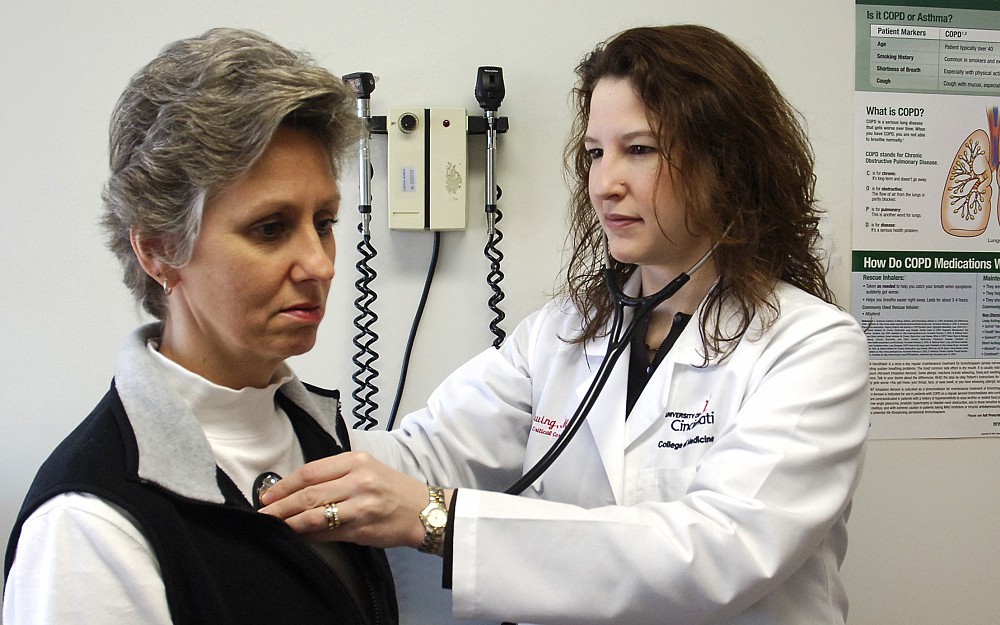
Jean Elwing, MD, pulmonologist in the division of pulmonary, critical care and sleep medicine
Tags
Related Stories
Cancer Center plays key role in lab research, clinical trials for new pancreatic cancer drug
September 1, 2026

WLWT and WCPO highlighted the contributions of University of Cincinnati Cancer Center researchers that helped lead to the recent FDA approval of daraxonrasib, a new treatment for pancreatic cancer.
Cancer Center physician receives $150,000 New Investigator Research Grant to study treatment-resistant leukemia
September 1, 2026
The University of Cincinnati Cancer Center’s Sarah Skuli, MD, PhD, received a two‑year, $150,000 Leukemia Research Foundation New Investigator Grant to study TP53‑mutated leukemia, a treatment‑resistant subtype with very poor outcomes.
Heavy social media use linked to depression
August 31, 2026

U.S. News and World Report, Yahoo! News, MSN, USA Today and other national media highlight a new study by the University of Cincinnati and Northwestern University that found a correlation between heavy social media use and depression in adults.