UC HEALTH LINE: Speech Offering Clues to 'Sleepiness'

Poor memory, short attention span and impaired motor coordination are often the most noticeable effects of sleep deprivation, but changes in speech clarityalthough not obvious to the average listenermay also be a sign of serious lack of sleep.
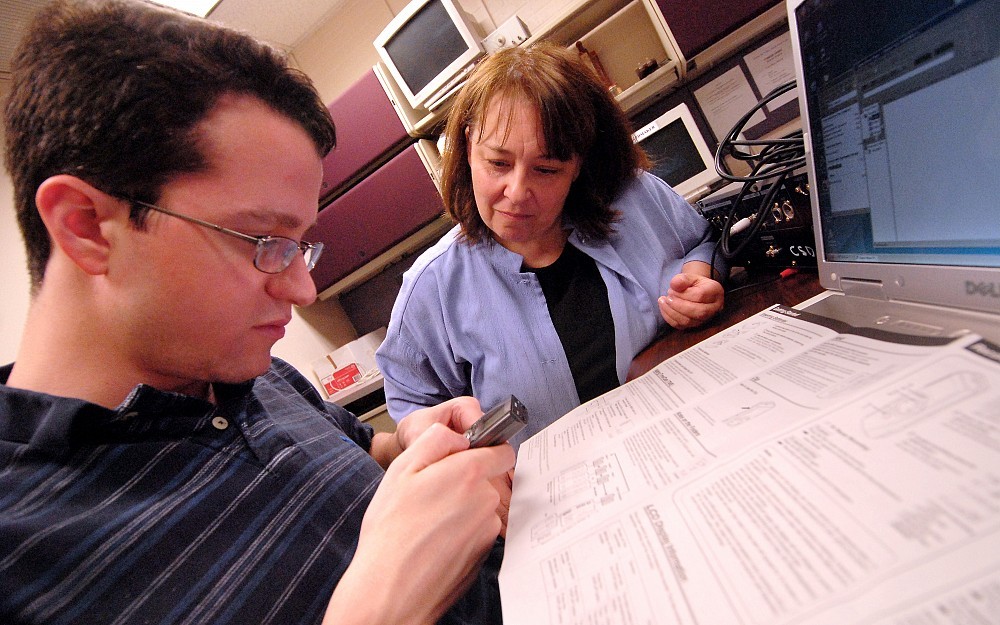
UC speech researcher Suzanne Boyce, PhD, hopes that by identifying speech changes in sleep-deprived individuals, new, noninvasive steps can be taken to help the number of fields interested in this topic.
The National Heart, Lung, and Blood Institute of the National Institutes of Health (NIH) has awarded Boyce a $467,000, two-year grant to demonstrate speech changes in the sleep deprived.
Shell study speech recordings taken through a partnership between the NIHs National Institute on Deafness and Other Communication Disorders and Walter Reed Army Institute of Research.
Boyce, associate professor in the communication sciences and disorders department in UCs
People who are sleep deprived probably dont try quite as hard to pronounce each sound, and/or take as big a breath as they need before speaking, says Boyce. The result will be that speakers fail to put as much emphasis on consonant sounds as their more awake counterparts. And vowels are sometimes slurred.
Recognizing many of these changes, however, can be extremely difficult for the typical listener, says Boyce.
Speech may be the most robust function in sleep-deprived individuals, Boyce adds. Its not so obviously impaired until a person is extremely deprived of sleep. But beyond that, listeners are very good at understanding what someone is trying to say, so noticing speech changes is rare.
Because studying speech patterns can be as noninvasive as making a simple recording, Boyce says, the sounds we makeor dont makemay prove invaluable to the number of professions that rely on their workers being wide awake and alert at all times.
And finding noninvasive tools for measuring sleepiness, Boyce says, could also help home health care workers when testing patients for sleep apnea, and even forensic analysts trying to determine causes of accidents.
Related Stories
Cancer Center plays key role in lab research, clinical trials for new pancreatic cancer drug
September 1, 2026

WLWT and WCPO highlighted the contributions of University of Cincinnati Cancer Center researchers that helped lead to the recent FDA approval of daraxonrasib, a new treatment for pancreatic cancer.
Cancer Center physician receives $150,000 New Investigator Research Grant to study treatment-resistant leukemia
September 1, 2026
The University of Cincinnati Cancer Center’s Sarah Skuli, MD, PhD, received a two‑year, $150,000 Leukemia Research Foundation New Investigator Grant to study TP53‑mutated leukemia, a treatment‑resistant subtype with very poor outcomes.
Heavy social media use linked to depression
August 31, 2026

U.S. News and World Report, Yahoo! News, MSN, USA Today and other national media highlight a new study by the University of Cincinnati and Northwestern University that found a correlation between heavy social media use and depression in adults.