Cell Receptor May Lead to New Biomarker for Pancreatic Cancer

CincinnatiA research team led by University of Cincinnati (UC) scientists has identified a potential biological target for pancreatic cancer, a finding they say could help scientists better understandand eventually treatthe disease that kills more than 33,000 people each year.
In laboratory studies led by Andrew Lowy, MD, and Susan Waltz, PhD, the
The RON receptor has been found to be active in several cancersincluding breast cancerbut its role in pancreatic cancer was unknown. This is one of the first studies, published in the July 1, 2007, issue of the journal Cancer Research, to report a link between the RON receptor and pancreatic cancer.
Receptor tyrosine kinases are proteins on the cell surface used to activate specific body functionsfor example cell growth and migration.
A normal pancreas has very low levels of RON, but our study showed that as tumors progress, so does the level of RON expression in the pancreas cellsand those overexpressed levels were maintained in metastases, the areas that the tumors spread to, explains Waltz, associate professor and director of the oncology research program in UCs surgery department.
The team found that the RON receptor was active in 93 percent of what is known as pancreatic intraepithelial neoplasia, an early form of pancreatic duct cancer. In addition, the receptor was present in 79 percent of primary pancreatic cancers and 83 percent of metastatic cancers.
UC researchers believe the RON receptors signaling pathways could be a key factor contributing to pancreatic cancer progression. Waltz says if the receptor could be blocked, it would give drug developers a new target for RON-directed therapies that are more effective in treating this deadly disease.
When cells became invasive, Waltz said, we saw higher levels of RON expression that correlated with the aggressive nature of this disease and cancer metastasis. Clearly, this signaling pathway is associated with pancreatic cancer and merits further investigation.
A relatively rare but difficult disease to treat, pancreatic cancer will affect about 37,000 Americans in 2007. According to the National Cancer Institute, overall survival for the disease is only about 4 percentoften because the disease spreads before it can be clinically detected.
In the December 2006 issue of Cancer Research, Waltz reported that the RON receptor can also be involved in breast cancer. Based on those earlier findings, she and Lowy wanted to know if the receptor was also expressed in pancreatic canceran aggressive, highly metastatic cancerand whether it played a role in disease development.
For the UC study, researchers used the protein HGFL
Our findings suggest that combining antibodies that block the RON receptor and the standard chemotherapy drugs might stop progression of pancreatic cancer more effectively, says Waltz. RON could be a promising molecular target for future cancer drug development.
Waltz stresses, however, that additional preclinical research is needed before RON receptor blockers become available for human testing.
UC collaborators in this study include Waltz, Ryan Thomas, MD, Kenya Toney, Cecilia Fenoglio-Preiser, MD, Monica Revelo-Penafiel, MD and Lowy, who completed this work at UC but is now with the
This research was supported with grants from the National Institutes of Health, National Pancreas Foundation and UC cancer center pilot grants program.

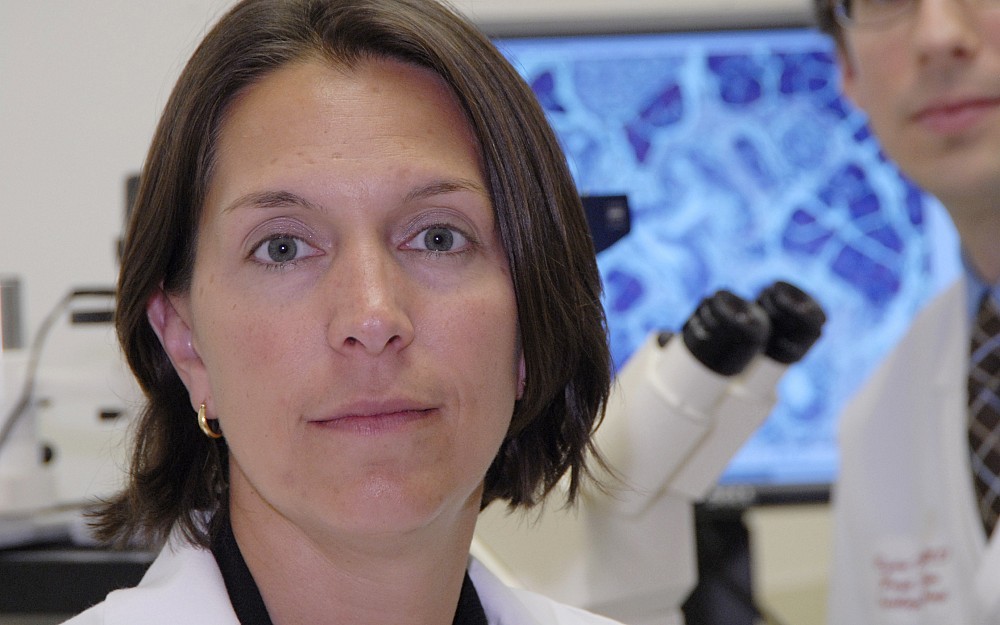
Susan Waltz, PhD, and Ryan Thomas, MD, are researching the role of the RON receptor in pancreatic cancer.

Susan Waltz, PhD, is a professor of cancer and cell biology.
Tags
Related Stories
Cancer Center plays key role in lab research, clinical trials for new pancreatic cancer drug
September 1, 2026

WLWT and WCPO highlighted the contributions of University of Cincinnati Cancer Center researchers that helped lead to the recent FDA approval of daraxonrasib, a new treatment for pancreatic cancer.
Cancer Center physician receives $150,000 New Investigator Research Grant to study treatment-resistant leukemia
September 1, 2026
The University of Cincinnati Cancer Center’s Sarah Skuli, MD, PhD, received a two‑year, $150,000 Leukemia Research Foundation New Investigator Grant to study TP53‑mutated leukemia, a treatment‑resistant subtype with very poor outcomes.
Heavy social media use linked to depression
August 31, 2026

U.S. News and World Report, Yahoo! News, MSN, USA Today and other national media highlight a new study by the University of Cincinnati and Northwestern University that found a correlation between heavy social media use and depression in adults.