Facial Transplantation May Be a Safer Option, Study Shows

CINCINNATIResearchers in
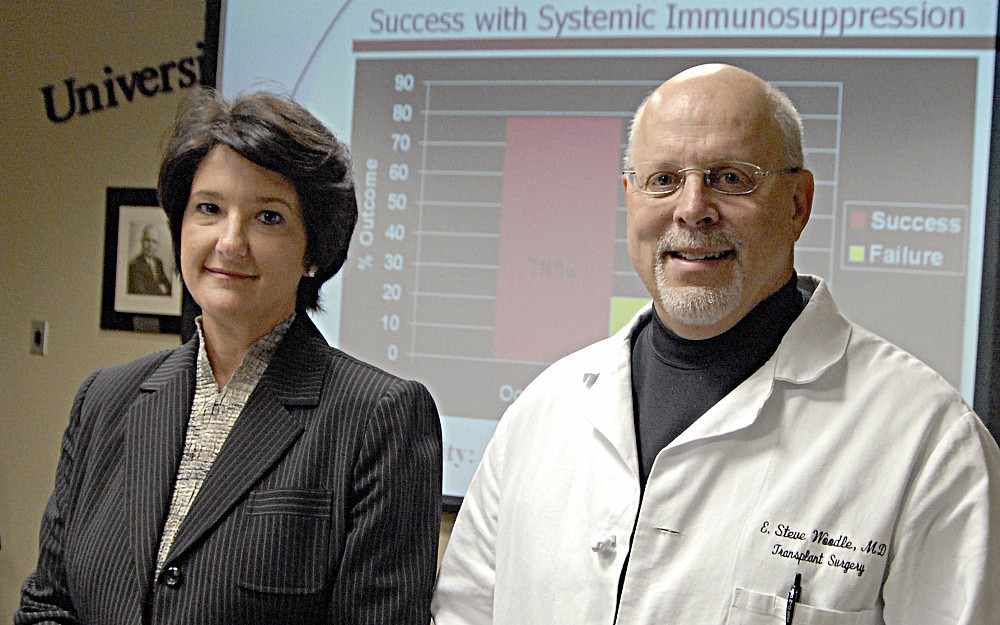
Previous data on the immunosuppression risks involved in facial transplantation were misleading, according to Rita Alloway, PharmD, and Steve Woodle, MD, of the University of Cincinnati (UC), and a
The first recorded facial transplant was performed in
There have been only two similar attempts since.
In 2004, the British Royal College of Surgeons published a controversial report predicting a high incidence of immunological complications for facial transplants. This data became a benchmark for facial transplant teams and review boards and greatly influenced the facial transplantation debate.
According to Woodle, however, the report did not provide the best risk assessment.
In estimating the risks of immunosuppression for face transplant recipients, the biggest problem is comparing apples to oranges, Woodle says. What we have tried to do is to address the apples and oranges problem by a comprehensive and up-to-date consideration of the issue.
Both the health status of solid organ transplant recipients and the tissue composition of the solid organs reported in the earlier studies are very different from that of face transplant recipients and their facial tissues, he says.
In the current study, the
They found the outcomes to be very different from those in the 2004 study.
Based on kidney and hand transplantation cases, in which the same drug regimen was used, researchers found that acute, or immediate, rejection may occur in 10 to 70 percent of patients. In of all these cases, however, rejection was reversible by adjusting the immunosuppression medications.
They also found that fewer than 10 percent of patients would experience chronic rejection over five years.
In considering the most recent and relevant data, we came to the conclusion that the expectations for face transplant recipients should be significantly better than those previously published, Woodle says.
Coauthor Barker says that the lack of comparable apples-to-apples risk data in the field has led to debate over the ethics of face transplantation, which was the inspiration for Cincinnati-Louisville study.
This risk-benefit equation is at the center of controversy over facial transplantation, he says. Physicians and scientists question whether the risks of life-long immunosuppression for patients justify the benefits of this new treatment.
Surveys from transplant professionals have shown that doctors underestimate what people will do for a cure, Alloway says. Often, living disfigured is worse than risk associated with this sort of operation and the immunosuppressive risks that accompany it.
Researchers hope this study will provide a solid foundation for future work with facial transplantation.
Were trying to meld the fields of transplantation and immunosuppression to produce maximum expertise on the subject, Alloway continued. Were hoping to decrease toxicity and create a more manageable risk spectrum for surgeons and patients.
Other coauthors on the study were
Allen Furr, PhD, Joseph Banis, Jr., MD, Rachael Ashcroft, and Dalidor Vasilic
, MD, from the University of Louisville as well as and Moshe Kon, MD, PhD, from the University of Utrecht, Netherlands.
Tags
Related Stories
Cancer Center physician receives $150,000 New Investigator Research Grant to study treatment-resistant leukemia
September 1, 2026
The University of Cincinnati Cancer Center’s Sarah Skuli, MD, PhD, received a two‑year, $150,000 Leukemia Research Foundation New Investigator Grant to study TP53‑mutated leukemia, a treatment‑resistant subtype with very poor outcomes.
Heavy social media use linked to depression
August 31, 2026

U.S. News and World Report, Yahoo! News, MSN, USA Today and other national media highlight a new study by the University of Cincinnati and Northwestern University that found a correlation between heavy social media use and depression in adults.
On-site training in Speech & Hearing Clinic sets UC’s programs apart
August 27, 2026
At the University of Cincinnati’s Speech & Hearing Clinic, Doctor of Audiology and Speech-Language Pathology graduate students gain real-world experience while providing free speech and hearing services to the community.