Engineering, Medicine Awarded $9 Million to Improve Bedside Care

The award funds the Point-of-
Stroke is the third leading cause of death and a leading cause of disability in the
Finding ways to identify or rule out neurologic emergencies quicklywherever treatment is being deliveredis critical for preventing further injury.
Its said that time is brain during a neurologic emergency, says principal investigator Fred Beyette, PhD, so point-of-care information is critical for preventing brain damage, dysfunction and death.
From Invention to Intervention
Beyette, associate professor of electrical and computer engineering, and co-principal investigator Joseph Clark, PD, are no strangers to the work required to conceptualize and develop point-of-care technologies.
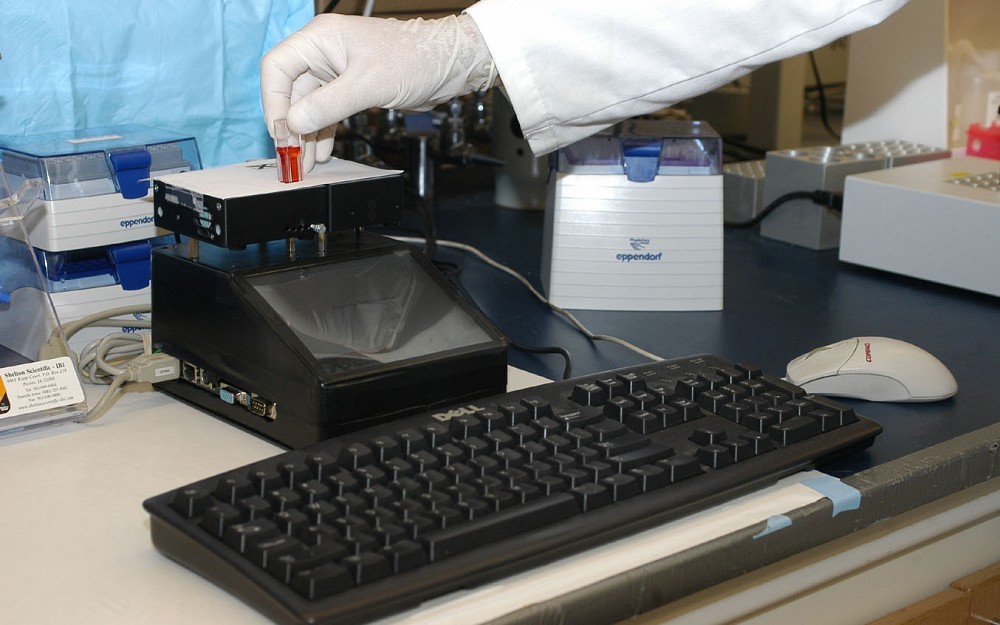
The two are developing an instrument that can rapidly analyze spinal fluid. A laboratory procedure that with current technology can take hours is reduced to three minutes with the duos innovation.
The devicenow about the size of a shoeboxcan quickly detect the presence of red blood cells in spinal fluid. But more important, the technology can detect bilirubin, a chemical found when red blood cells begin to break down.
Finding bilirubin in a spinal tap is a good indicator that the blood has been in the spinal fluid for some time, says Clark, a professor in the department of neurology. If the blood in the tap is purely hemoglobin, its possible that the blood were seeing was introduced into the fluid during the process of tapping. But if bilirubin is present, we know the blood has begun to break down, and we can infer that it has been in the fluid for a while and is coming from another sourcepossibly a subarachnoid hemorrhage.
Subarachnoid hemorrhage is a form of bleeding stroke that occurs when an artery bursts near the membrane that surrounds the brain. Blood then contaminates protective fluid around the brain.
Because a secondary stroke is so common in subarachnoid hemorrhage patients, says
Its technology like this, says Beyette, that UCs new point-of-care center will support and see through to development and testing phases.
Theres a critical need for developing improved and rapid diagnostic information, Beyette says. The center will be structured to take ideas from conception to development of a prototype ready for clinical testing. We want to facilitate the creation of size-appropriate technologies that offer fast results to health care providers.
Faculty from the departments of emergency medicine and neurosurgery will join Beyette and Clark and their engineering and neurology colleagues to lead several cores within the point-of-care center. The Office of Entrepreneurial Affairs and staff from UCs intellectual property office will add expertise in technology commercialization.
The team will soon issue a national call for proposals.
For more information, contact Beyette at (513) 556-4588 or e-mail fred.beyette@uc.edu.

Joe Clark, PhD, professor of neurology.

Joe Clark, PhD, professor of neurology

Joe Clark, PHD (right), studies cerebral vasospasm--also known as "secondary stroke."
Tags
Related Stories
Cancer Center plays key role in lab research, clinical trials for new pancreatic cancer drug
September 1, 2026

WLWT and WCPO highlighted the contributions of University of Cincinnati Cancer Center researchers that helped lead to the recent FDA approval of daraxonrasib, a new treatment for pancreatic cancer.
Cancer Center physician receives $150,000 New Investigator Research Grant to study treatment-resistant leukemia
September 1, 2026
The University of Cincinnati Cancer Center’s Sarah Skuli, MD, PhD, received a two‑year, $150,000 Leukemia Research Foundation New Investigator Grant to study TP53‑mutated leukemia, a treatment‑resistant subtype with very poor outcomes.
Heavy social media use linked to depression
August 31, 2026

U.S. News and World Report, Yahoo! News, MSN, USA Today and other national media highlight a new study by the University of Cincinnati and Northwestern University that found a correlation between heavy social media use and depression in adults.