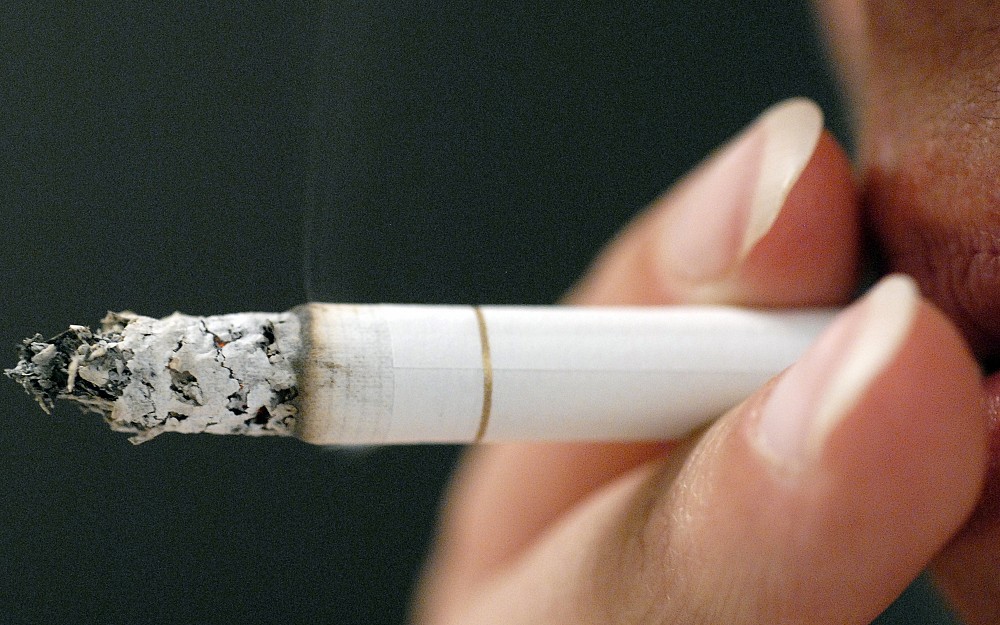
UC HEALTH LINE: Quitters Win Through Smoking Cessation Clinic at UC, University Hospital

Nearly 100
"We know that about 70 percent of Americans who smoke want to quit, but only about 15 percent succeed in doing so on their own, says Jane Pruemer, PharmD, a UC professor of pharmacy and oncology pharmacist who runs the clinic.
Since the programs inception in August 2004, 534 patients have registered for Win by Quitting and attended at least one visit. For those who completed at least three visits, about 72 percent quit smoking initially and about 56 percent report kicking the habit for good.
Patients work with Pruemer,
According to the Centers for Disease Control and Prevention, smoking is the single most common cause of preventable death and disease in the
UC experts say the problem is magnified in Greater Cincinnati. The region has a higher-than-average percentage of adult smokers (30 percent) compared to the rest of
"Anyone who is serious about kicking the habit and improving their overall health should take advantage of this free program sooner rather than later, says Mehta, a medical oncologist who specializes in lung cancer and provides medical oversight for the Win by Quitting program.
Win by Quitting participants have access to no-cost prescription medications including Chantix (varenicline), a new oral smoking cessation drug that blocks the neural receptors for nicotine. Patients can also choose an extended release product that helps decrease urges to smoke (bupropion) or nicotine patches.
"People have unique stumbling blocks that interfere with their ability to quit smoking. For some people, its emotional or mental stress. For others, its anxiety or life changes, says Pruemer. "To help the person successfully quit, though, we need to understand those barriers and form a strategy for overcoming them.
Pruemer stresses that its never too late to experience health benefits from ceasing to smoke. In addition to a higher risk for lung cancer, smoking is linked to hypertension, emphysema, heart disease, chronic coughing and colds.
"We dont give up on people who are willing to stick to the program, she adds. "But to succeed, the patient needs to commit to quitting.
The Win by Quitting program accepts new patients on an ongoing basis. Appointments are available on Mondays and Thursdays at the
Win by Quitting is part of a joint cancer program involving the UC College of Medicine, Cincinnati Childrens

Jane Pruemer, PharmD, and pharmacy student Chad Droege demonstrate a device used to measure carbon monoxide in the lungs. The chemical is one of about 7,000 found in cigarette smoke.
Related Stories
Cancer Center plays key role in lab research, clinical trials for new pancreatic cancer drug
September 1, 2026

WLWT and WCPO highlighted the contributions of University of Cincinnati Cancer Center researchers that helped lead to the recent FDA approval of daraxonrasib, a new treatment for pancreatic cancer.
Cancer Center physician receives $150,000 New Investigator Research Grant to study treatment-resistant leukemia
September 1, 2026
The University of Cincinnati Cancer Center’s Sarah Skuli, MD, PhD, received a two‑year, $150,000 Leukemia Research Foundation New Investigator Grant to study TP53‑mutated leukemia, a treatment‑resistant subtype with very poor outcomes.
Heavy social media use linked to depression
August 31, 2026

U.S. News and World Report, Yahoo! News, MSN, USA Today and other national media highlight a new study by the University of Cincinnati and Northwestern University that found a correlation between heavy social media use and depression in adults.