New Devices Less Effective in Thwarting Brain Aneurysm Recurrence

A team of researchers from the Neuroscience Institute at the University of Cincinnati (UC) and
Ringer, the studys principal investigator, is a neurosurgeon with the Mayfield Clinic and is director of endovascular neurosurgery and associate professor of neurosurgery at UC.
The findings are being presented at the International Stroke Conference this week in
An intracranial aneurysm is a balloon-like bulge or blister on an artery in the brain. Aneurysms with thin necks, known as saccular aneurysms, are often treated with a clip. During a craniotomy, a procedure in which the skull is surgically opened, a neurosurgeon places the clip across the neck of the aneurysm, shutting off the aneurysms blood supply.
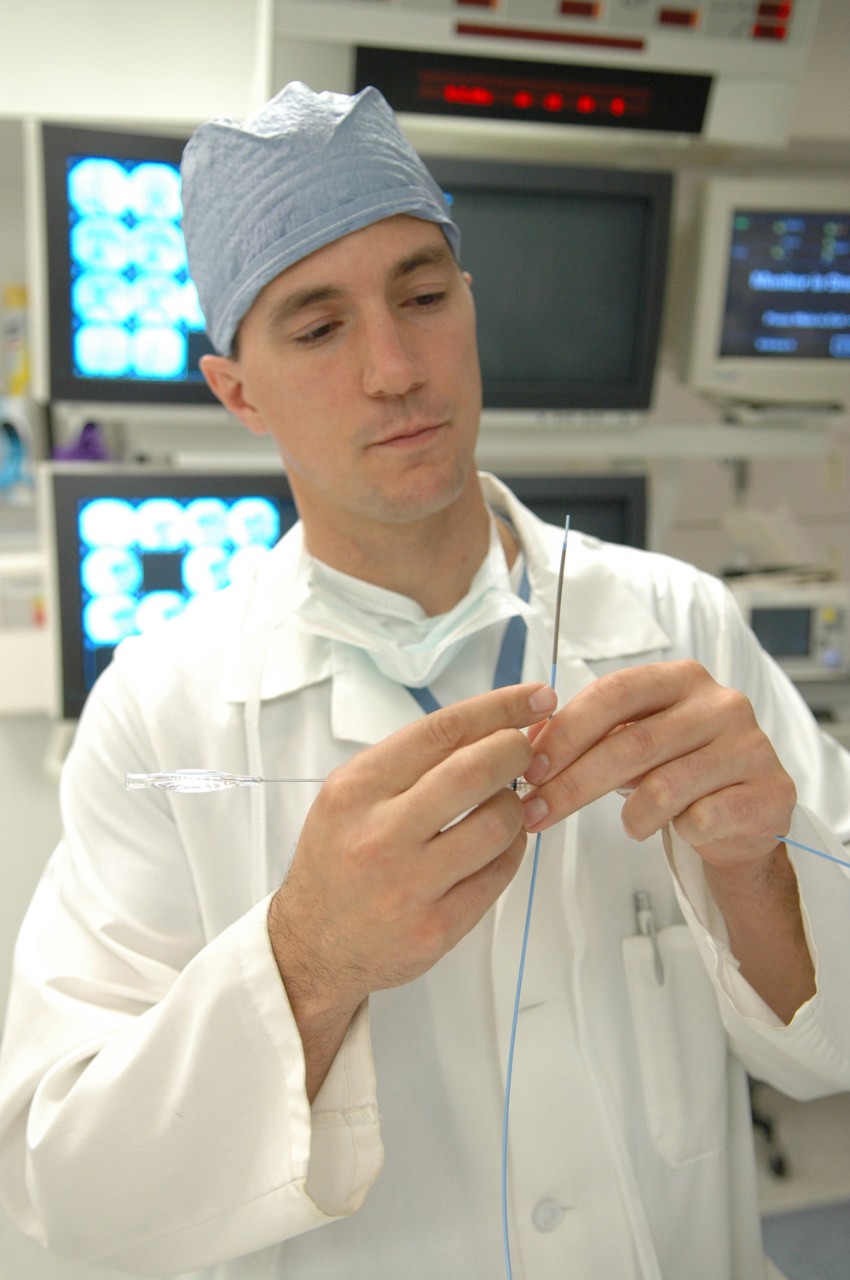
Surgeons also can use a minimally invasive procedure to treat saccular aneurysms through coiling. A catheter is inserted into an artery in the groin and threaded up through the body to the brain, and a tiny coil is discharged directly into the aneurysm. The minimally invasive procedure enables the patient to avoid surgery and the risks associated with opening the skull.
In an important drawback, however, coils may occasionally compact within the aneurysm. When compaction occurs, blood flows back into the aneurysm, making repeated treatment necessary.
Companies have tried to address the issue of recurrence after coiling by engineering coils using one of two different approaches, Ringer says. One is coated with a polymer designed to promote tissue healing at the neck (opening) of the aneurysm, and one is coated with a gel that, when exposed to blood, is designed to expand inside the aneurysm to fill all the nooks and crannies.
The purpose of our study was to assess the effectiveness of these new treatments, Ringer continues. We found that neither of these newerand more costlycoils performed any better than the bare platinum coils.
To determine whether the new strategies posed an improvement, Ringer and his research team analyzed the outcomes during a 3 ½-year period of 100 successively treated patients who had suffered ruptured aneurysms of medium size (five to 15 millimeters in diameter).
At the end of one year, the bare platinum coils were associated with the least number of repeated treatments. The percentage requiring repeated treatment was 6.4 percent in the platinum coils group, 11.5 percent in the expanding gel-coating group, and 20.9 percent in the polymer-coating group.
The results, Ringer says, suggest the possibility that a factor, or factors, other than coil-surface coating may be responsible for reducing aneurysm recurrence.
Other researchers involved in the study were Shah-Naz Khan, MD, a cerebrovascular fellow in the department of neurosurgery; Christopher Nichols, MD, an endovascular fellow in the department of neurology; and Todd Abruzzo, MD, assistant professor of neuroradiology. All are affiliated with the Neuroscience Institute.
The Neuroscience Institute, a regional center of excellence, is dedicated to patient care, research, education, and the development of new treatments for stroke, brain and spinal tumors, epilepsy, multiple sclerosis, traumatic brain and spinal injury, Alzheimers disease, Parkinsons disease, disorders of the senses (swallowing, voice, hearing, pain, taste and smell), and psychiatric conditions (bipolar disorder, schizophrenia and depression).
The Mayfield Clinic is a physician organization dedicated to clinical care, education, and research of the spine and brain. The group includes 20 neurosurgeons and treats 20,000 patients from 35 states and a dozen countries in a typical year. Mayfield's neurosurgeons are active participants in important clinical trials and have pioneered surgical procedures and instrumentation that have revolutionized the medical art of neurosurgery for brain tumors and neurovascular diseases and disorders.

Illustration of coiling procedure used to treat a type of aneursym.

Coil types used to treat aneurysms.
Tags
Related Stories
On-site training in Speech & Hearing Clinic sets UC’s programs apart
August 27, 2026
At the University of Cincinnati’s Speech & Hearing Clinic, Doctor of Audiology and Speech-Language Pathology graduate students gain real-world experience while providing free speech and hearing services to the community.
Funding expands UC research into weight gain side effects of bipolar medication
August 26, 2026
University of Cincinnati researchers have been approved for funding by the Patient-Centered Outcomes Research Institute (PCORI) to expand the implementation of healthy lifestyle interventions and metformin prescription to help manage weight gain in overweight or obese youth taking second-generation antipsychotic medications.
One in four NFL players had CTE at death
August 25, 2026

Forbes cites research on concussions and football helmets by the University of Cincinnati in a report that found one in four NFL players had brain damage at death.