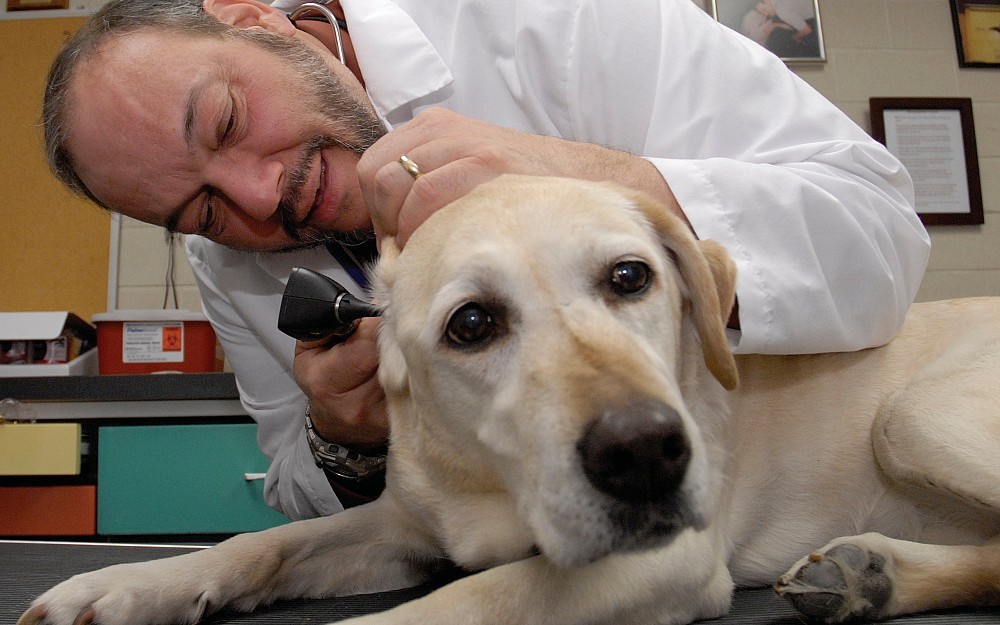
New Canine Clinic Adds Research Dimension to Audiology Program

Located on UCs campus in the French East buildinghome to the
UC assistant professor Pete Scheifele, PhD, says one in five Dalmatians is born deaf. Another 80 dog breeds are known to have genetic-based deafness, and countless aging dogs suffer from hearing loss.
But, says Scheifele, audiology isnt taught in veterinary school.
So what are dogs and their owners to do?
Scheifele, who arrived at UC in September 2007 and who has graced the pages of Dog World magazine for his interest in canine hearing, came up with the canine audiology clinic as a way to address the hearing needs of dogs and the questions of dog owners.
Scheifele says the common way pet owners and veterinarians test for deafness in dogs is by making a loud noise or dropping large objects on the floor near the pet.
Dogs, like people, are capable of feeling vibrations even when they cant hear sounds, says Scheifele. Making loud noises or dropping heavy objects arent foolproof ways to check for hearing loss in pets.
To determine the level of hearing loss in dogs, Scheifeles team will use a number of tests commonly used in humans that have been modified to accommodate the canine hearing range.
The things we employ to test infant hearing can be used to test hearing in an animal, says Scheifele, who also has serious interest in the ears of whales, dolphins, horses and ferrets.
The clinic staffwhich includes specialists from UC and Cincinnati Childrens Hospital Medical Centerwill test the cochlea (inner ear) as well as the brains response to sound and will use magnetic resonance imaging (MRI) to see inside dogs ears and provide thorough hearing loss assessments to owners and veterinarians.
But Scheifele says the work they are doing isnt just about the animal.
Here at UC, were training audiologists, but by adding this clinic, were providing a service to dogs and dog owners and also giving our students research opportunities that they didnt have before, says Scheifele.
Research at
They also believe the data they collect could translate to humans and to the development of advanced hearing screening equipment, according to Scheifele.
We have a faculty member here at
A retired member of the U.S. Navy, Scheifele, who also has a love for marine life and has long studied whale acoustics, says the ultimate goal for a clinic such as the one hes developed at
Right now, theres really no data about canine hearing loss, yet many dogs and families are dealing with this issue, says Scheifele. In addition, hearing screening is paramount for assistance, military and police dogs. I hope that the knowledge we gain will lead to the creation of an audiology subspecialty in veterinary medicine so that more animals can be diagnosed and treated at their vets office.
There is a fee for screening and dogs must be referred to the clinic by their veterinarian. For more information, contact Scheifele at peter.scheifele@uc.edu or call (513) 558-8519.
You can also check out Scheifeles work at Showcase 2008, Friday, March 7, 2008. The event is free and open to the public. Learn more at www.uc.edu/showcase.
Related Stories
Heavy social media use linked to depression
August 31, 2026

U.S. News and World Report, Yahoo! News, MSN, USA Today and other national media highlight a new study by the University of Cincinnati and Northwestern University that found a correlation between heavy social media use and depression in adults.
On-site training in Speech & Hearing Clinic sets UC’s programs apart
August 27, 2026
At the University of Cincinnati’s Speech & Hearing Clinic, Doctor of Audiology and Speech-Language Pathology graduate students gain real-world experience while providing free speech and hearing services to the community.
UC, NKU renew longstanding partnership supporting Army ROTC cadets
August 26, 2026
The University of Cincinnati Army ROTC and Northern Kentucky University (NKU) have renewed a longstanding partnership that supports students preparing to become Army officers and leaders in their communities. The universities formalized the renewed agreement during a signing event Aug. 11 at NKU.