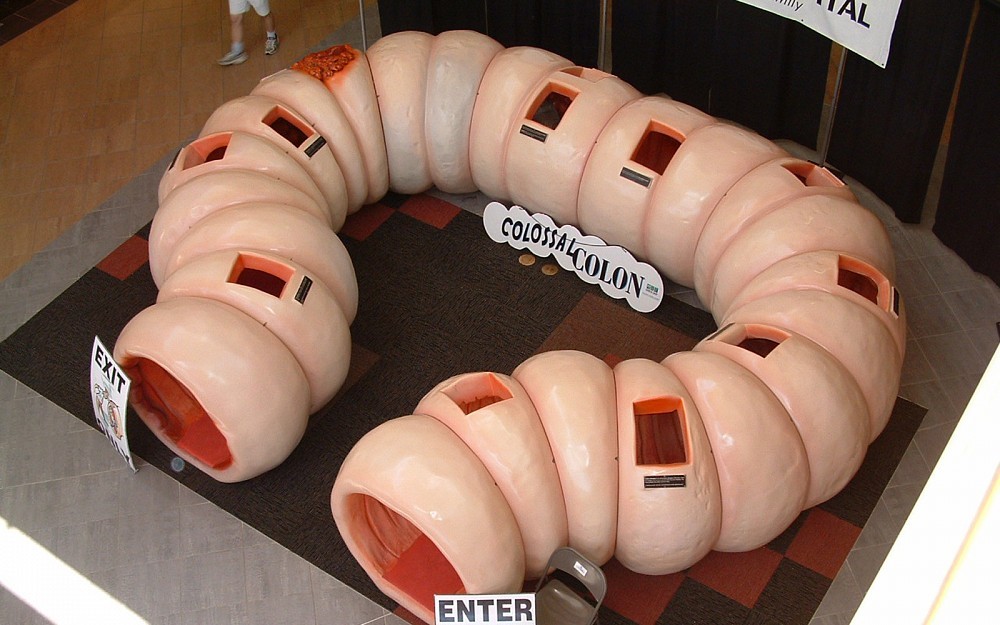
UC HEALTH LINE: Colossal Colon Provides an Up-Close and Personal Understanding of Uncomfortable Topic

Known as
This project is a great way to educate as many people as possibleas early as possibleabout colorectal cancer in an interesting, out-of-the-box way, says Janice Rafferty, MD, associate professor and chief of colorectal surgery at UC.
Were passionate about early cancer detection. When the disease is caught early, surgery is more likely to be curative so we encourage people to get screened by a gastrointestinal specialist, she adds. We hope this larger-than-life display encourages people to have colon talk with their loved ones, recognize their own personal risk for the disease and get screened when its appropriate.
Rafferty says most people resist getting the simple screening testknown as colonoscopyeven though colorectal cancer kills almost 50,000 Americans each year.
The Colossal Colon infuses a bit of humor into the topic and makes it easier for everyone to talk about, says Rafferty, who sees patients at
Colonoscopy is a screening exam that allows physicians to directly inspect the entire colon for potentially cancerous growths. Prior to both traditional and virtual colonoscopy, patients are required to follow a liquid-only diet for 24 to 48 hours and take laxatives to cleanse the colon and rectum. The colon is then inflated with carbon dioxide as a contrast material to improve the visual field.
During a traditional colonoscopy, the patient is sedated and the physician uses a fiber-optic scope equipped with a camera to inspect the entire colon for potentially cancerous growths. In contrast, the virtual exam requires no sedation and uses a series of rapidly acquired CT scans to diagnose any problems. The virtual procedure takes about 20 minutes and the patient can immediately resume normal activities. The traditional procedure takes about an hour, plus recovery time from sedation.
The Colossal Colon will be on display as part of a health fair from 9 a.m. to 5 p.m. on March 15 and 16. The event, which is free and open to the public, will take place at TriHealth Health & Fitness Pavilion,
In addition to self-guided tours through the Colossal Colon and free educational materials, the health fair will feature local doctors presentations on healthy lifestyles, cancer prevention and early detection and advanced treatments for colorectal cancer. Bradley Davis, MD, a UC colorectal surgeon, will talk about modern surgery for colorectal disease on Sunday, March 16, at 10 a.m.
These types of events are critical to spread the message that colorectal cancer is preventable and very treatable, says Davis, assistant professor of surgery at UC and cochair of the Hamilton County American Cancer Society (ACS) colorectal cancer taskforce. Coco the
According to the ACS, 90 percent of all early-stage colorectal cancers are curable, and about 75 percent of Americans who get the disease are over 50. The organization estimates that more than 150,000 people are diagnosed with invasive colorectal cancer annually.
For traditional colonoscopies, call (513) 475-7505. For virtual colonoscopies, call (513) 475-8755. To schedule an appointment with a colorectal surgeon, call (513) 929-0104.
For more information on vascular health, visit www.netwellness.org, a collaborative health-information Web site staffed by

The Colossal Colon is used to educate people about colorectal cancer.

Colossal Colon

Chief, Division of Colon and Rectal Surgery
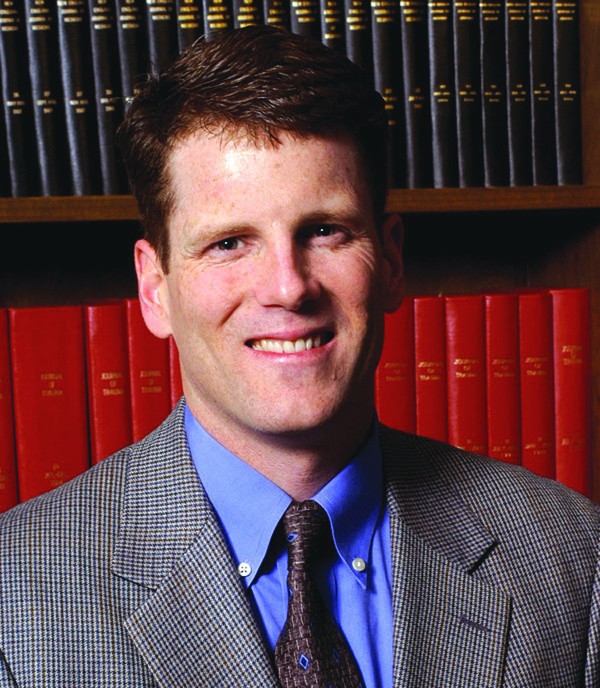
Bradley Davis, MD, is a colorectal surgeon and assistant professor of surgery at UC.
Tags
Related Stories
Cancer Center plays key role in lab research, clinical trials for new pancreatic cancer drug
September 1, 2026

WLWT and WCPO highlighted the contributions of University of Cincinnati Cancer Center researchers that helped lead to the recent FDA approval of daraxonrasib, a new treatment for pancreatic cancer.
Cancer Center physician receives $150,000 New Investigator Research Grant to study treatment-resistant leukemia
September 1, 2026
The University of Cincinnati Cancer Center’s Sarah Skuli, MD, PhD, received a two‑year, $150,000 Leukemia Research Foundation New Investigator Grant to study TP53‑mutated leukemia, a treatment‑resistant subtype with very poor outcomes.
Heavy social media use linked to depression
August 31, 2026

U.S. News and World Report, Yahoo! News, MSN, USA Today and other national media highlight a new study by the University of Cincinnati and Northwestern University that found a correlation between heavy social media use and depression in adults.