Surgical Technique Halts Cell Loss, Parkinson's Researchers Find

CINCINNATIDeep brain stimulation, a surgical technique often viewed as a last resort for people with Parkinsons disease, halts the progression of dopamine-cell loss in animal models, according to preliminary research by scientists at the Neuroscience Institute at the University of Cincinnati (UC) and
The scientists also discovered clues to why the technique works. The act of stimulating neurons with electrodes boosted the amount of an important protein in animals brains. The protein, a trophic factor known as BDNF (brain-derived neurotrophic factor), is a nurturing, growth-promoting chemical.
Parkinsons disease is a degenerative neurological disorder involving the death of dopamine-producing brain cells, or neurons.
Demonstrating that deep brain stimulation halts the progression of dopamine-cell loss was basically a confirmation and extension of previous findings, says Caryl Sortwell, PhD, associate professor of neurology at UC and the studys lead investigator. But finding the mechanism is a novel discovery that is even more critical. We now know not only that it works, we also are beginning to understand how it is working.
Sortwell recently announced her teams results at a professional conference held by the Cleveland Clinic and the National Institute of Neurological Disorders and Stroke.
The research holds important implications for patients with Parkinsons disease and could alter the current recommended timetable for surgical intervention.
In a typical treatment scenario, a patient has lost about 50 percent of his or her dopamine-producing neurons when symptoms first appear and a diagnosis is made. The typical patient then waits an average of 14 additional years before undergoing deep brain stimulation surgery. During that 14-year span, medications can offer symptomatic relief, but cell loss continues unabated. There is at present no cure for the disease.
Sortwells research was a response to an observation by physicians, including co-investigator George Mandybur, M.D., associate professor of neurosurgery, who have long been able to neutralize, in certain patients, some of the most debilitating symptoms of Parkinsons disease, including tremor, stiffness, and slowness, by stimulating an area deep within the brain.
The surgery for Parkinson's disease has been available for over 10 years, and in that time we have noticed that in some patients the disease does not seem to progress as rapidly after surgery as it did before the surgery, says Mandybur, a neurosurgeon with the Mayfield Clinic. As a result, he and others theorized that DBS not only alleviated symptoms, but also provided neuroprotection.
The UC study, Mandybur says, helps us to understand why this is going on and what may be happening in the brain. It also gives some evidence to support performing the surgery earlier to slow the overall progression of Parkinson's disease.
Sortwells study, which is continuing, is supported by a $120,000 grant from the Sunflower Revolution fundraiser, a partnership of the University Hospital Foundation and the Davis Phinney Foundation. The 2008 Sunflower Revolution, scheduled for Sept. 5-7, includes a gala, a free educational symposium for patients, families and caregivers, and bike rides of 20, 40, and 100 kilometers. (See www.sunflowerrev.org.)
During the DBS study, researchers implanted high-frequency stimulating electrodes in the subthalamic nucleus, an area of the brain associated with movement, in rats and then induced dopamine neuron loss. When the rats had experienced a 50 percent loss of dopamine neurons, the researchers initiated brain stimulation in half of the group. Measurements of surviving, functioning dopamine neurons in rats implanted with active stimulators were then compared to a control group implanted with inactive stimulators. While the control groups loss of dopamine neurons increased to 75 percent after two weeks, the rats implanted with active stimulators experienced no further loss of cells during that time.
Subsequent tissue analysis revealed that in rats implanted with active stimulators the trophic factor BDNF had tripled in the striatum, a part of the brain that houses dopamine terminals and receives the dopamine neurotransmitters that are produced in the substantia nigra.
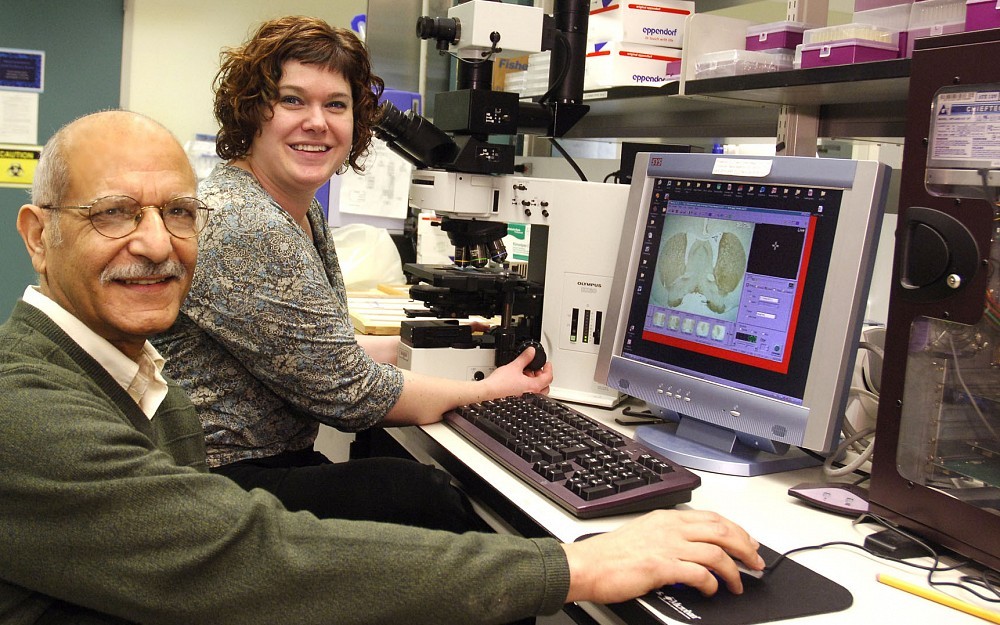
The study has brought together investigators from four academic disciplines: Sortwell, and Timothy Collier, PhD., and doctoral student Anne Spieles-Engemann, from UCs department of neurology; Michael Behbehani, PhD, from the department of physiology; Jack Lipton, PhD, from the department of psychiatry; and Mandybur, from the department of neurosurgery. Michael Behbehani, PhD, professor of molecular and cellular physiology and anesthesia, established the method for implanting the electrodes in the rats tiny subthalamic nucleus.
The initial study platform was funded by UCs Millennium Fund and subsequently by the Neuroscience Institute.
The Davis Phinney Foundation, named for the former Tour de France cyclist Davis Phinney and based in Boulder, Colo., is dedicated to supporting research aimed at understanding, preventing and treating Parkinsons disease, which affects an estimated 1.5 million Americans. In 2006 the foundation named the Neuroscience Institute and
The Neuroscience Institute, a regional center of excellence at the University of Cincinnati and University Hospital, is dedicated to patient care, research, education and the development of new treatments for stroke, brain and spinal tumors, epilepsy, traumatic brain and spinal injury, multiple sclerosis, Alzheimers disease, Parkinsons disease, disorders of the senses (swallowing, voice, hearing, pain, taste and smell) and psychiatric conditions (bipolar disorder, schizophrenia and depression).
Tags
Related Stories
Cancer Center plays key role in lab research, clinical trials for new pancreatic cancer drug
September 1, 2026

WLWT and WCPO highlighted the contributions of University of Cincinnati Cancer Center researchers that helped lead to the recent FDA approval of daraxonrasib, a new treatment for pancreatic cancer.
Cancer Center physician receives $150,000 New Investigator Research Grant to study treatment-resistant leukemia
September 1, 2026
The University of Cincinnati Cancer Center’s Sarah Skuli, MD, PhD, received a two‑year, $150,000 Leukemia Research Foundation New Investigator Grant to study TP53‑mutated leukemia, a treatment‑resistant subtype with very poor outcomes.
Heavy social media use linked to depression
August 31, 2026

U.S. News and World Report, Yahoo! News, MSN, USA Today and other national media highlight a new study by the University of Cincinnati and Northwestern University that found a correlation between heavy social media use and depression in adults.