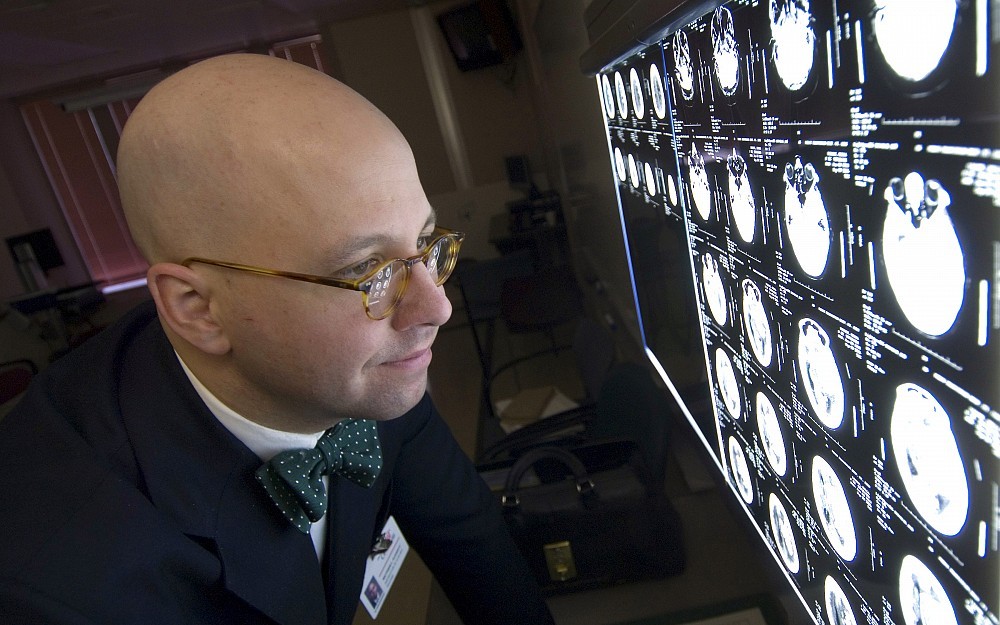
Surrogate Consent Crucial to Trial's Success, Researchers Conclude

CINCINNATIA groundbreaking stroke trial would not have been completed in a timely manner without the participation of subjects enrolled by surrogate consent, a study by University of Cincinnati (UC) researchers concludes.
The study is being published in the Nov. 11 issue of Neurology, the medical journal of the American Academy of Neurology. The lead author is Matthew Flaherty, MD, an assistant professor in the department of neurology and an AAN member.
Many stroke patients lack decision-making capacity to provide informed consent for research studies because of cognitive impairments caused by the stroke, including reduced levels of consciousness and impaired language. Decisions about their care must then be made by a surrogate, usually a spouse or another family member.
The U.S. Department of Health and Human Services has concluded that, while an investigator must obtain informed consent from the subject or the subjects legally authorized representative, the determination of who may be a legally authorized representative is a matter of state law. State laws regarding surrogate consent for medical research are variable and often lacking.
Researchers examined the importance of surrogate consent in the National Institute of Neurological Disorders and Stroke (NINDS) rt-PA Stroke Trial, which led to the only U.S. Food and Drug Administration-approved treatment for acute ischemic stroke. Acute ischemic stroke occurs when an artery to the brain is blocked by a blood clot.
The trial took slightly less than four years to complete, enrolling 624 participating subjects from Feb. 4, 1991, to Oct. 30, 1994. Of those subjects, 439 (about 70 percent) were enrolled via surrogate consent. The remaining 185 were enrolled by self-consent.
If the trial had enrolled the same sample size and recruited at the same rate but excluded patients who could not provide their own consent, the research shows, it would have taken about 12.5 years to complete. In addition, results from a study that excluded surrogate consent would have limited the studys value because patients unable to give self-consent tended to be older and have more severe strokes.
The NINDS rt-PA Stroke Trial provided firm evidence that rt-PArecombinant tissue plasminogen activatorimproves clinical outcomes after ischemic stroke when administered to appropriately selected stroke patients. Without the participation of subjects enrolled by surrogate consent, rt-PA might not have become available to the estimated 10,800 to 12,600 stroke patients who receive it annually in the United States.
In states without clear legal guidance, the studys authors point out, institutional review boards and researchers may be hesitant to allow surrogate consent, slowing progress in developing effective treatments for persons with stroke and other illnesses that impair cognition.
Legislative action is needed at the state level to clarify the place of surrogate consent in research and to ensure that future advances in medical research are as inclusive as possible, Flaherty concludes.
Study co-authors in addition to Flaherty are Joseph Broderick, MD, Dawn Kleindorfer, MD, and Daniel Woo, MD, of the University of Cincinnati; Jane Khoury, PhD, of the Center for Epidemiology and Biostatistics at Cincinnati Childrens Hospital Medical Center; and Jason Karlawish, MD, of the University of Pennsylvania.
Tags
Related Stories
Cancer Center plays key role in lab research, clinical trials for new pancreatic cancer drug
September 1, 2026

WLWT and WCPO highlighted the contributions of University of Cincinnati Cancer Center researchers that helped lead to the recent FDA approval of daraxonrasib, a new treatment for pancreatic cancer.
Cancer Center physician receives $150,000 New Investigator Research Grant to study treatment-resistant leukemia
September 1, 2026
The University of Cincinnati Cancer Center’s Sarah Skuli, MD, PhD, received a two‑year, $150,000 Leukemia Research Foundation New Investigator Grant to study TP53‑mutated leukemia, a treatment‑resistant subtype with very poor outcomes.
Heavy social media use linked to depression
August 31, 2026

U.S. News and World Report, Yahoo! News, MSN, USA Today and other national media highlight a new study by the University of Cincinnati and Northwestern University that found a correlation between heavy social media use and depression in adults.