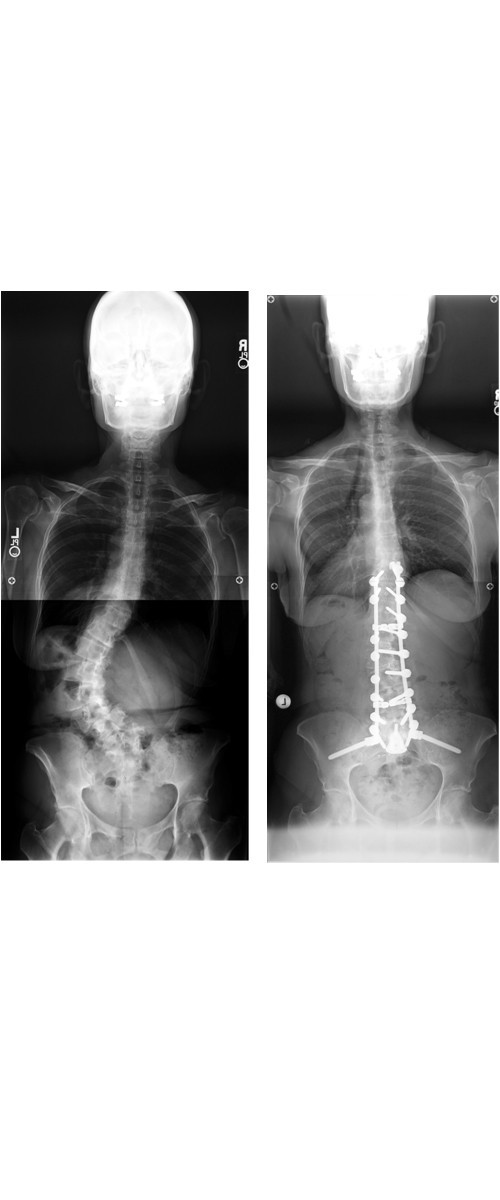
New Classification for Spinal Deformity Defines Range of Normalcy

CINCINNATIA University of Cincinnati (UC) neurosurgeon who has spent his career helping people with severe spine problems stand up straight has spearheaded the creation of a new spinal deformity classification system. The system, published this fall in the journal Neurosurgery, defines deformity in relation to the healthy, normal curve of the spine.
What weve done is define spinal deformity and its manifestations throughout the course of a lifetime, based on a systematic approach to the spine, from the head to the pelvis, says Charles Kuntz IV, MD, an associate professor in UCs neurosurgery department and director of the division of spine and peripheral nerve surgery at the UC Neuroscience Institute. Defining deformity with this degree of precision allows us to provide optimal treatment.
Kuntz, who practices at the Mayfield Clinic, and his co-authors defined spinal deformity by synthesizing published literature that describes normal neutral upright spinal alignment in asymptomatic juvenile, adolescent, adult and geriatric volunteers. The researchers used a total of 38 angles and displacements to define neutral upright spinal alignment, compiling their data over a period of five years.
The spine is a dynamic organ that changes during the course of a lifetime, Kuntz says, with normal curves increasing with age.
An estimated 1.5 percent of the population has some degree of spinal deformity, which can take many forms. Abnormal curvatures can occur from side to side, as in scoliosis; they can involve an abnormal forward curve of the spine, known as kyphosis, or hunchback; and they can involve an abnormal posterior curve of the lower spine, known as lordosis, or swayback.
Spinal deformity, depending on its severity, can cause pain, disability and a reduction in quality of life.
Kuntz, whose spinal reconstructions can take as long as 10 to 15 hours over a period of two days, strives for optimal spinal alignment with the finest cosmetic symmetry, even in the most severely disabled patients.
Some physicians may feel that the result doesnt have to be perfect, Kuntz says. But I do. Its a big deal when you have a patient who cant stand up straight, who cant look you in the eye, whos embarrassed to go out. Its a big deal when you help him or her become a person whos not only attractive to others but also attractive to himself or herself.
Other co-authors of the spinal classification are Linda Levin, PhD, and David Pettigrew, PhD, of UC; Atiq Durrani, MD, formerly of UC; Christopher Shaffrey, MD, of the University of Virginia; Stephen Ondra, MD, of Northwestern University; and Praveen Mummaneni, MD, of the University of California at San Francisco.
Tags
Related Stories
On-site training in Speech & Hearing Clinic sets UC’s programs apart
August 27, 2026
At the University of Cincinnati’s Speech & Hearing Clinic, Doctor of Audiology and Speech-Language Pathology graduate students gain real-world experience while providing free speech and hearing services to the community.
Funding expands UC research into weight gain side effects of bipolar medication
August 26, 2026
University of Cincinnati researchers have been approved for funding by the Patient-Centered Outcomes Research Institute (PCORI) to expand the implementation of healthy lifestyle interventions and metformin prescription to help manage weight gain in overweight or obese youth taking second-generation antipsychotic medications.
One in four NFL players had CTE at death
August 25, 2026

Forbes cites research on concussions and football helmets by the University of Cincinnati in a report that found one in four NFL players had brain damage at death.