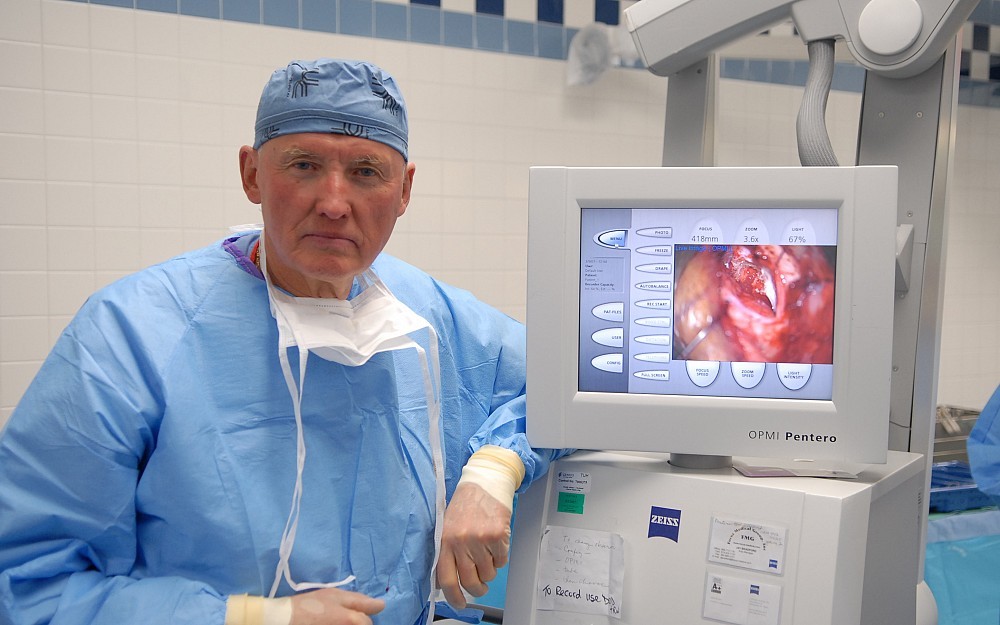
UC Brain Tumor Center Embraces Flexible 'Laser Scalpel'

CINCINNATINeurosurgeons at the Brain Tumor Center at the University of Cincinnati Neuroscience Institute are taking part in what they call a renaissance of the laser in neurosurgery.
The renaissance has been sparked by a new microsurgical laser scalpel that enables neurosurgeons to bend a CO2 laser beam in their quest to eradicate complicated tumors that are embedded in remote or sensitive areas of the brain and spine. The new tool, which consists of a flexible, CO2 laser-compatible fiber coupled to a pen-like surgical instrument, allows neurosurgeons to operate near critical structures, such as the spinal cord and brainstem, while minimizing thermal injury to healthy tissue.
This new microsurgical tool has led to the rebirth and renaissance of the CO2 laser, says John Tew, MD, clinical director of the UC Neuroscience Institute and a Mayfield Clinic neurosurgeon. Theres a lot of excitement among those of us who treat patients with tumors that are difficult to reach.
The laser, called BeamPath NEURO, is manufactured by OmniGuide, Inc., of Cambridge, Mass.
Aside from being a dramatic technological advance, this new laser redefines the limits of what can be performed safely along many difficult to reach corners of the brain, says Philip Theodosopoulos, MD, director of skull base surgery at the Brain Tumor Center and a Mayfield Clinic neurosurgeon.
Tew and Theodosopoulos have used the laser successfully in 10 cases since September. The neurosurgeons have used, or will use, the laser in the treatment of brain tumors (including pituitary tumors and acoustic neuromas), spinal cysts and tumors and arteriovenous malformations.
The laser is especially valuable in the treatment of tumors that have calcified or are entangled in areas of the central nervous system that are critical for speech, reasoning and movement.
Lasers were first used in neurosurgery 30 years ago. Pioneered by Tew and others in the late 1970s and 1980s, they enabled surgeons to carefully vaporize cancerous tissue, one thin layer at a time. In 1984 Tew became the first surgeon in the United States to receive FDA approval to use the YAG (yttrium-aluminum-garnet) laser to vaporize previously inoperable brain tumors.
But because of the long wavelength of CO2 laser energy, the early lasers were unwieldy. Mounted on a microscope, they used a rigid arm and could be directed only at tumors within the surgeons direct line of sight. This point-and-shoot process, which lacked flexibility, fell out of favor, especially as technological advances enabled physicians to target tumors in other ways.
Tew noted in a 1986 journal article that the inability to maneuver the CO2 beam is a practical handicap that will probably be solved by the development of more efficient fiber bundles.
That prediction came to fruition with the development of the BeamPath NEURO laser. BeamPath NEURO allows the laser beam to bend through a flexible fiber lined with layers of microscopic mirrors. The perfect mirror, which reflects lights of all wavelengths, was conceived of and developed by researchers at MIT and was initially intended for military applications. The technology was licensed to OmniGuide in 2003.
The laser provides significant benefits to patients by reducing the time required for surgery.
The UC Neuroscience Institute, a regional center of excellence at UC and University Hospital, is dedicated to patient care, research, education, and the development of new treatments for stroke, brain and spinal tumors, epilepsy, traumatic brain and spinal injury, Alzheimers disease, Parkinsons disease, disorders of the nerves and muscles, disorders of the senses (swallowing, voice, hearing, pain, taste and smell) and psychiatric conditions (bipolar disorder, schizophrenia and depression).
The Mayfield Clinic is recognized as one of the nation's leading physician organizations for clinical care, education and research of the spine and brain. Supported by 20 neurosurgeons, three neurointensivists, an interventional radiologist and a pain specialist, the clinic treats 20,000 patients from 35 states and 13 countries in a typical year. Mayfield's physicians have pioneered surgical procedures and instrumentation that have revolutionized the medical art of neurosurgery for brain tumors and neurovascular diseases and disorders.
Tags
Related Stories
Cancer Center plays key role in lab research, clinical trials for new pancreatic cancer drug
September 1, 2026

WLWT and WCPO highlighted the contributions of University of Cincinnati Cancer Center researchers that helped lead to the recent FDA approval of daraxonrasib, a new treatment for pancreatic cancer.
Cancer Center physician receives $150,000 New Investigator Research Grant to study treatment-resistant leukemia
September 1, 2026
The University of Cincinnati Cancer Center’s Sarah Skuli, MD, PhD, received a two‑year, $150,000 Leukemia Research Foundation New Investigator Grant to study TP53‑mutated leukemia, a treatment‑resistant subtype with very poor outcomes.
Heavy social media use linked to depression
August 31, 2026

U.S. News and World Report, Yahoo! News, MSN, USA Today and other national media highlight a new study by the University of Cincinnati and Northwestern University that found a correlation between heavy social media use and depression in adults.