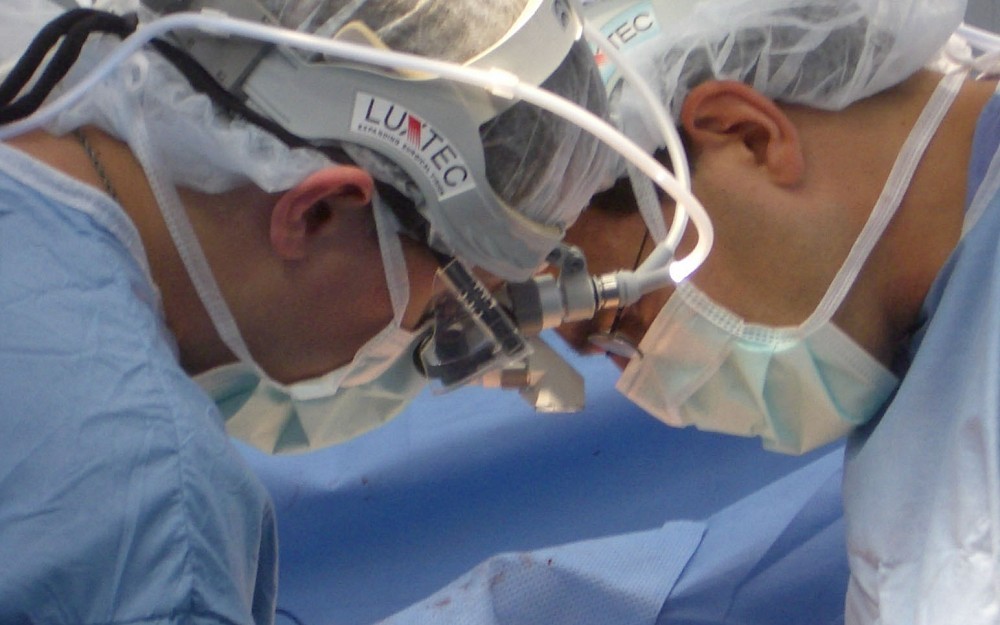
First Laparoscopic-Assisted Abdominal Aortic Aneurysm Repair in Greater Cincinnati Performed at University Hospital

Joseph Giglia, MD, successfully performed the procedure at University Hospital in late
The patient, a 66-year old man, had numerous factors to complicate his case, including: blocked iliac arteries, the vessels feeding blood to his lower body; an expanding AAA; and decreased lung function resulting from a lifetime of smoking.
Traditional vascular surgery requires a major incision and long periods of recovery, so patients with co-morbiditieslike poor lung functionare considered poor candidates for surgery, leaving them with few treatment options, explains Giglia, who is an associate professor of surgery at the University of Cincinnati (UC) College of Medicine.
It is extremely uncommon for surgeons in the
Vascular problems occur when fat and cholesterol (plaque) build up on artery walls. As plaque increases, the arteries harden and become narrow. In the aorta, this can cause the vessel to stretch and weaken, forming a bulge in the vessel wall. If that bulge, called an aneurysm, ruptures, it can rapidly result in death.
We were able to apply the same minimally invasive technique used to bypass blocked iliac arteries to fix the patients aortic aneurysm, says Giglia. By using advanced, minimally invasive surgical techniques, were able to give very fragile patients a viable option for recovery and a better quality of life that was not possible before.
Giglia and his colleagues specialize in minimally invasive vascular techniques not available at other Greater Cincinnati hospitals. This includes laparoscopic (minimally invasive) vascular surgery, a method of operating inside the abdomen through small ports using a fiber-optic light source, camera and specialized instruments.
Endovascular surgery, another type of minimally invasive surgery, is done through two small incisions in the groin. The patient is given local anesthesia, remaining awake to avoid further compromising his or her heart rate and blood pressure.
According to the American Vascular Society, about 200,000 people are diagnosed with an AAA annually, and many others live with the life-threatening condition without realizing they are at risk for rupture and death. Men over age 60 who smoke and have high blood pressure are at the most risk.
New Medicare Part B health insurance enrollees are eligible for a preventive abdominal aortic aneurysm screening. Upon completion of a physical examination, which is mandatory for new Medicare patients, male patients who have smoked at least 100 cigarettes during their lifetime and anyone with a family history of vascular disease can request the abdominal aortic aneurysm screening exam.
The test is done using ultrasound, a technology that uses sound waves to create a picture of organs and other structures inside the abdomen. If vascular problems are found, the patient may be referred for additional screening exams to determine the best course of treatment.
For appointments with UC Physicians vascular surgeons, call (513) 558-3700. Medicare patients will be required to show a current Medicare insurance card.
Related Stories
Cancer Center plays key role in lab research, clinical trials for new pancreatic cancer drug
September 1, 2026

WLWT and WCPO highlighted the contributions of University of Cincinnati Cancer Center researchers that helped lead to the recent FDA approval of daraxonrasib, a new treatment for pancreatic cancer.
Cancer Center physician receives $150,000 New Investigator Research Grant to study treatment-resistant leukemia
September 1, 2026
The University of Cincinnati Cancer Center’s Sarah Skuli, MD, PhD, received a two‑year, $150,000 Leukemia Research Foundation New Investigator Grant to study TP53‑mutated leukemia, a treatment‑resistant subtype with very poor outcomes.
Heavy social media use linked to depression
August 31, 2026

U.S. News and World Report, Yahoo! News, MSN, USA Today and other national media highlight a new study by the University of Cincinnati and Northwestern University that found a correlation between heavy social media use and depression in adults.