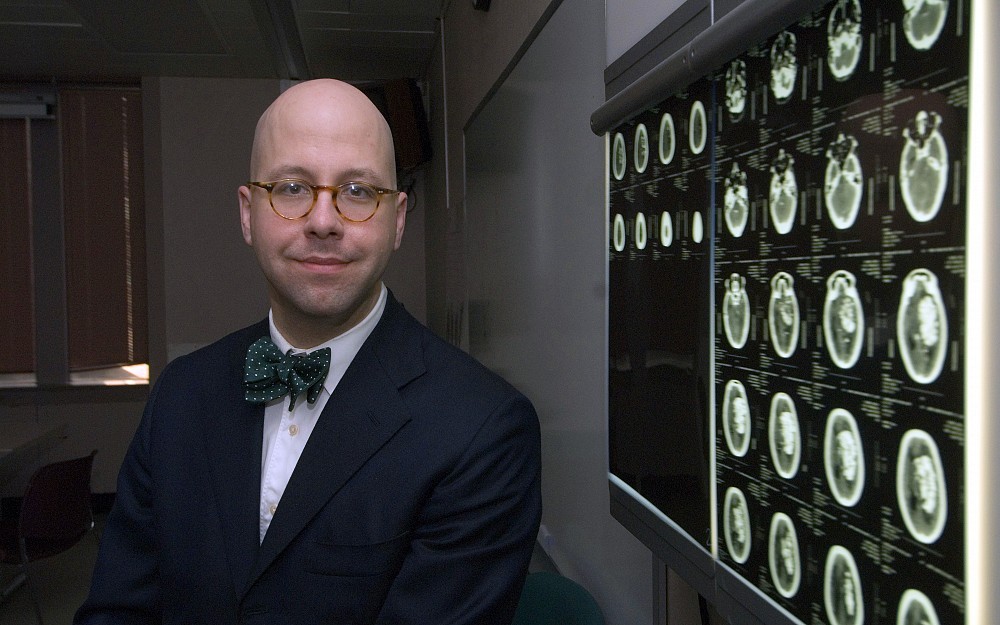
UC Faculty Member Winner of Stroke Leadership Prize

CINCINNATIMatthew Flaherty, MD, assistant professor of neurology at the University of Cincinnati (UC), is being awarded the 2009 Michael S. Pessin Stroke Leadership Prize for his research in stroke treatment.
Flaherty will receive the award during the 61st annual meeting of the
Flaherty is being recognized for his research accomplishments, including leadership of the Spot Sign for Predicting and Treating Intracerebral Hemorrhage Growth Study (STOP-IT Study), which was designed to find a better way of selecting stroke patients for treatment. The study includes a test to help doctors predict which patients who suffer a stroke with bleeding in the brain will experience further bleeding which can cause additional injury. Patients will be given either a fast-acting drug to stop bleeding or a placebo as part of the study.
While there are no proven, effective treatments for intracerebral hemorrhage, the model being evaluated in the STOP-IT Study may eventually lead to a medical treatment that improves outcomes for stoke patients, says Flaherty.
The Michael S. Pessin Stroke Leadership Prize is sponsored by the AAN and endowed by the family, friends and colleagues of Dr. Pessin, who died in 1996.
The
Tags
Related Stories
Cancer Center plays key role in lab research, clinical trials for new pancreatic cancer drug
September 1, 2026

WLWT and WCPO highlighted the contributions of University of Cincinnati Cancer Center researchers that helped lead to the recent FDA approval of daraxonrasib, a new treatment for pancreatic cancer.
Cancer Center physician receives $150,000 New Investigator Research Grant to study treatment-resistant leukemia
September 1, 2026
The University of Cincinnati Cancer Center’s Sarah Skuli, MD, PhD, received a two‑year, $150,000 Leukemia Research Foundation New Investigator Grant to study TP53‑mutated leukemia, a treatment‑resistant subtype with very poor outcomes.
Heavy social media use linked to depression
August 31, 2026

U.S. News and World Report, Yahoo! News, MSN, USA Today and other national media highlight a new study by the University of Cincinnati and Northwestern University that found a correlation between heavy social media use and depression in adults.