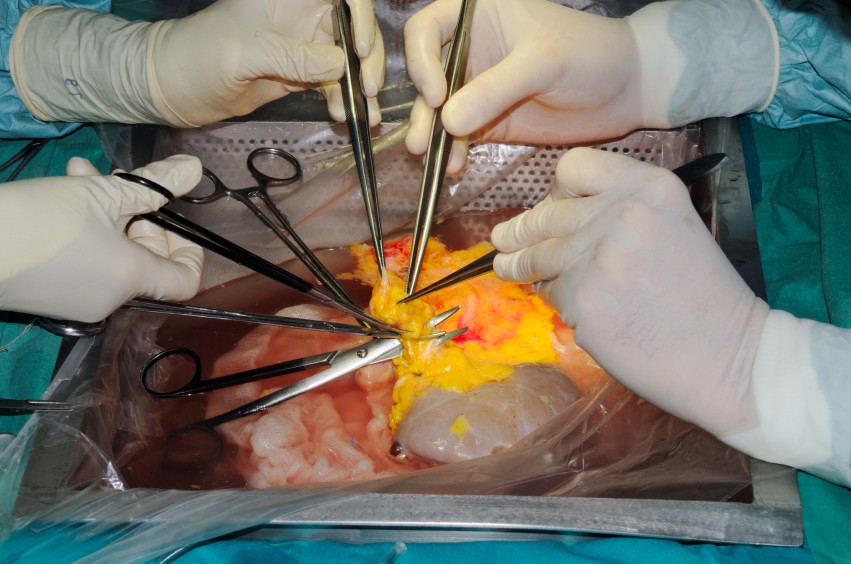
UC HEALTH LINE: Leery of Organ Donation? UC Surgeon Debunks Common Transplant Myths

But myths about organ donation are leaving some people uncertainand sometimes leeryabout donating their organs or tissue in the unfortunate case of a fatality, creating fewer options for the 100,000 people across the United States waiting for a life-saving transplant.
April is National Donate Life Month, and University of Cincinnati (UC) transplant surgeon Steven Rudich, MD, PhD, urges the general public not to believe everything they hear about donating organs and tissue.
There are only about 22,000 kidney transplants from deceased donors that are done in
Rudich says there are a number of donation myths that make people think twice about offering their kidneys or corneas for the cause.
Myth 1. If a patient is identified as a donor, the hospital staff will not work as hard to save his or her life and will remove his or her organs as soon as possibleeven prematurelyto help others.
This is absolutely not true, says Rudich, director of the liver transplant and hepatobiliary surgery programs at
Myth 2. Organ donation goes against religious beliefs.
We hear this from time to time, and every major religion stresses selflessness, says the professor of surgery, noting that organ donation is consistent with the beliefs of most religions including Catholicism, Protestantism, Islam and most branches of Judaism. This is one of the kindest, most selfless things that one human being could do for another: save a life.
Myth 3. A person can be too old or too young to be an organ donor.
If you are able to sign your drivers license, then youre not too old or young to donate, Rudich continues. We have seen organ and tissue donors who are well into their 70s. In many reconstruction surgeries, doctors use the bones, skin and ligamentsor tissuesfrom older donors. In addition, there are very few medical conditions that disqualify a person from donating organs. For example, if a person has diabetes, we may not be able to use their kidneys or pancreas, but we can potentially use their livers as well as other tissues, such as bone, tendons, etc.
Myth 4. Open casket funerals are impossible for organ donors.
Donation takes place under the same strict, sterile conditions as any surgical procedure, he says. A donor is treated with extreme care and respect, and the body is not disfigured in any manner whatsoever.
Myth 5. It is impossible to do a live kidney donation unless the donor is giving to a close family member.
This certainly isnt true, Rudich says. There are many avenues for live kidney donation if someone wants to donate to a random person in need. In fact, a kidney from a living donor is healthier in almost all ways than a kidney from a person who is deceased.
Also, live kidney donors often worry that they will face medical problems after giving up one of their kidneys. The chances for a kidney donor who is evaluated and deemed to be an acceptable candidate for donation to have a kidney problem are minuscule. Transplant programs that do live kidney donation have very specific rules as to who can be a live donor. In addition, the surgery is minimally invasive and a donor is usually out of the hospital in two days and back to work within several weeks.
Myth 6. Rich, famous or powerful people are moved to the top of the list when they need a donor organ.
There are stringent rules against this, he says. The United Network of Organ Sharing, or UNOS, makes sure that all aspects of transplantation are highly regulated. We list people for transplantation based on their needshow sick they arenot on how famous, rich, or well-connected they are. In addition, nearly 50 percent of all patients waiting for organ transplants are ethnic minorities. Some people think that minority patients do not receive organs in a timely manner. This is simply not the case. The chances of finding a match for transplant recipients are greatly increased if the donor is of the same ethnic background. To help ensure that more black and Latino patients receive a vital transplant, it is important that these same races become more involved in donor registration programs.
Myth 7. The family of the donor will be charged for the donation. In addition, the family has a say in the donors decision.
The only cost to the donor or to the donors family is for the time the donor is being treated in the hospital, Rudich continues. Once he or she is declared brain dead, the insurance provider of the recipient takes over the costs. The OPO is notified when the medical personnel declare the donor dead. The medical criteria are documented, and once the family has consented, the organ is recovered.
When a person obtains a drivers license or state ID, they are asked if they want to be an organ and tissue donor. When he or she says, Yes, this is considered first person consenta legally binding contract. Once a potential donor is determined to have given a first person consent, the family is not to be involved in the consent process. The wishes of the deceased are supposed to be respected, and donation is expected to proceed. However, OPOs want to be respectful of the familys wishes as well. This is why it is so important for people to discuss their donation plans with their family ahead of time.
Andi Johnson, director of public affairs for LifeCenter Organ Donor Network, says these myths are just that and that thousands more lives could be saved if people were informed.
There are approximately 400 patients in
Saving lives is as simple as saying Yes at the Bureau of Motor Vehicles next time you renew your license or signing up on your local registrys Web site. You have the power to save lives.

Steven Rudich, MD, PhD, professor in the transplant surgery division at UC
Tags
Related Stories
Cancer Center plays key role in lab research, clinical trials for new pancreatic cancer drug
September 1, 2026

WLWT and WCPO highlighted the contributions of University of Cincinnati Cancer Center researchers that helped lead to the recent FDA approval of daraxonrasib, a new treatment for pancreatic cancer.
Cancer Center physician receives $150,000 New Investigator Research Grant to study treatment-resistant leukemia
September 1, 2026
The University of Cincinnati Cancer Center’s Sarah Skuli, MD, PhD, received a two‑year, $150,000 Leukemia Research Foundation New Investigator Grant to study TP53‑mutated leukemia, a treatment‑resistant subtype with very poor outcomes.
Heavy social media use linked to depression
August 31, 2026

U.S. News and World Report, Yahoo! News, MSN, USA Today and other national media highlight a new study by the University of Cincinnati and Northwestern University that found a correlation between heavy social media use and depression in adults.