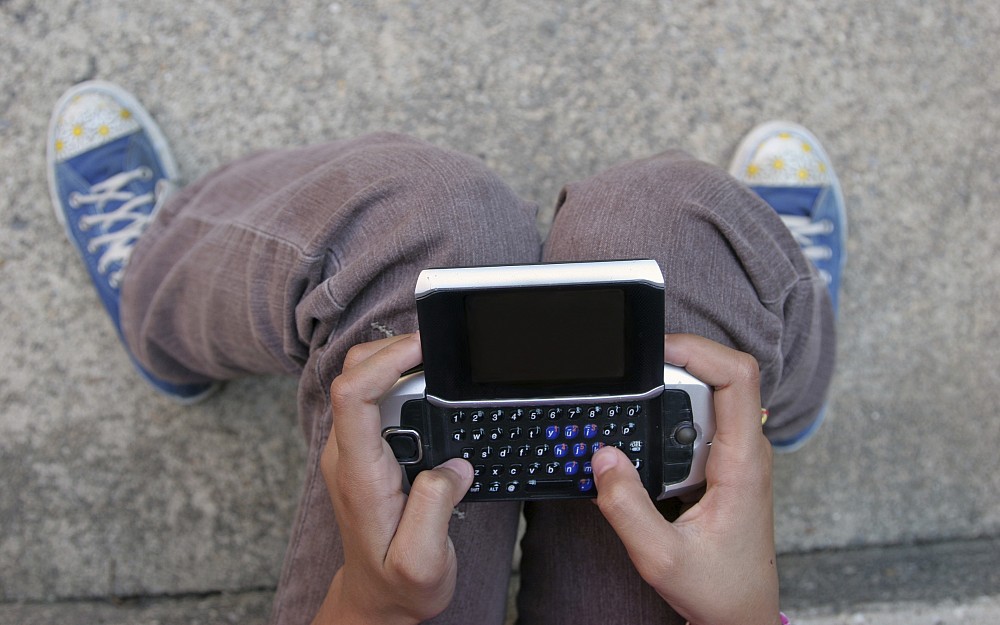
UC HEALTH LINE: Could Texting and Mobile E-mail Be Bad For Your Health?

CincinnatiIn a mobile communications era where we sometimes talk more with our fingers than our voices, a University of Cincinnati (UC) ergonomics expert says our thumbs could pay the price.
The typical U.S. mobile subscriber sends and receives more text messages than telephone calls, according to recent trend reports published by the Nielsen Company. U.S. teens between the ages of 13 to 17 are the most intense users of texting, sending and receiving an average of 1,742 messages per month.
The posture we assume while texting and e-mailing from mobile devicesusing our thumbs to type, crunched over a tiny keyboardis unnatural. That said, it only presents problems when we do it constantly without giving our body enough breaks, says Kermit Davis, PhD, an associate professor of environmental health at the UC College of Medicine and an expert in ergonomics (the science of people-machine relationships).
Few muscles come into play during texting, but Davis says the repeated use can still lead to problems.
Teenagers often engage in texting with multiple people simultaneously and for long periods of time, which forces their forearms and thumbs into a static contraction, he explains. When you combine this behavior with other hand-intensive activitiessuch as using a computer mouse or playing video games the cumulative effects on the hands and forearms may cause problems.
Davis recommends all regular users of mobile technologyregardless of agetake these basic steps to avoid muscle and forearm pain:
· Reduce your keystrokes. More keystrokes equals more strain on your handsparticularly the thumbsso keep your messages brief and use word recognition tools when possible.
· Take regular breaks. Doing any repetitive task for long periods of time without a break is a bad idea. Make it a habit to stop and take a break regularly to let your body recover.
· Orient your hands into a neutral posture. The wrist should be relatively straight during any typing activity. Avoid twisting your wrists into odd angles, as this will cause additional stress to the hand and forearm muscles and lead to chronic inflammation and pain.
· Choose a mobile device that gives you room to stretch. Davis says mobile devices with wider keyboards give people more motion flexibility.
· Use alternate fingers. Most people use their thumbs to text or write e-mails from their mobile devices. Although it may seem awkward at first, Davis recommends alternating between fingers to give the thumbs a break.
The more serious mobile users may be thinking: Perhaps I should do finger push-ups to beef up my hand muscles for texting? Davis says, in this case, strengthening isnt necessarily the solution; stretching and pausing are more effective ways to reduce strain.
Every person needs to look at how they are interacting with their environment and adjust to avoid bodily harm, he adds. Ergonomics hits you all around. Any time you are using one part of your body for long durations, youll start to have problems.
Davis and his team provide fee-for-service ergonomic assessments in a variety of workplaces, including health care facilities, administrative offices, manufacturing plants and other work environments. Their recommendations are aimed at creating better work environments with healthier and more productive workers. For more information on ergonomic assessments, contact Davis at Kermit.davis@uc.edu or (513) 558-2809.

Kermit Davis, PhD, specializes in occupational ergonomics.
Related Stories
Cancer Center plays key role in lab research, clinical trials for new pancreatic cancer drug
September 1, 2026

WLWT and WCPO highlighted the contributions of University of Cincinnati Cancer Center researchers that helped lead to the recent FDA approval of daraxonrasib, a new treatment for pancreatic cancer.
Cancer Center physician receives $150,000 New Investigator Research Grant to study treatment-resistant leukemia
September 1, 2026
The University of Cincinnati Cancer Center’s Sarah Skuli, MD, PhD, received a two‑year, $150,000 Leukemia Research Foundation New Investigator Grant to study TP53‑mutated leukemia, a treatment‑resistant subtype with very poor outcomes.
Heavy social media use linked to depression
August 31, 2026

U.S. News and World Report, Yahoo! News, MSN, USA Today and other national media highlight a new study by the University of Cincinnati and Northwestern University that found a correlation between heavy social media use and depression in adults.