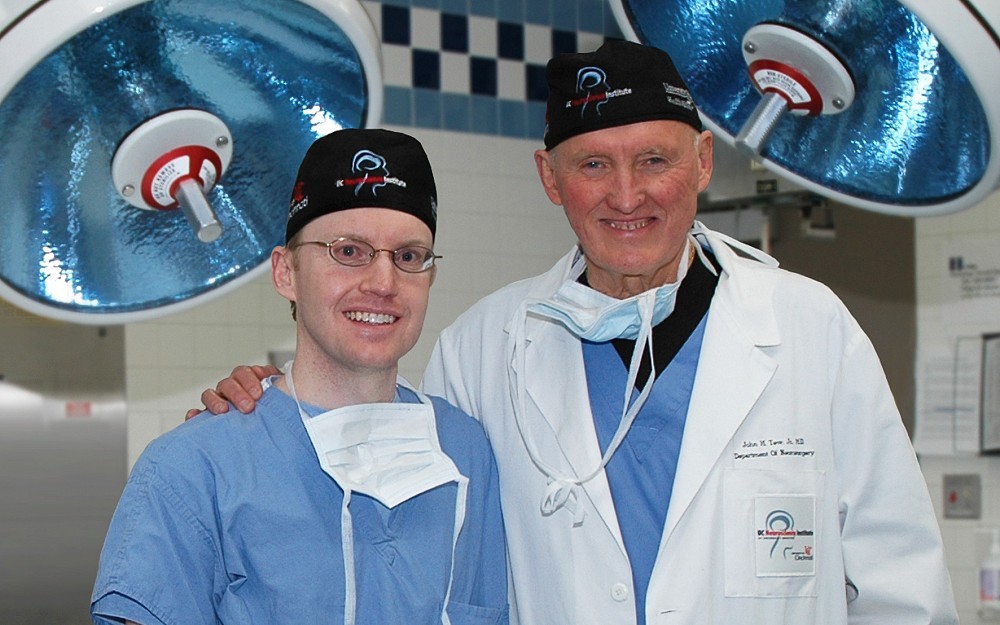
UC Neurosurgical Fellow Wins Van Wagenen Award

Grande will study with Professor Magdalena Götz at the Munich Institute of Stem Cell Research (Helmholtz Zentrum München). He will focus on neural (brain) stem cells, which were first discovered in the 1990s and which have the potential to divide and produce new cells, a process called neurogenesis.
The fellowship will enable Grande to investigate the ability of neural stem cells to replicate and communicate with other cells within the brains of animal models. The research could hold clues about how the brain tries to heal following an injury, such as stroke, and how stem cells that exist in the brain might be coaxed into creating a flood of healthy new cells for an injured area.
Specifically, Grande proposes to use retroviruses as a vehicle for inserting genes and transcription factorsspecial proteins that control the transfer of DNAinto various mouse models that have been engineered to express injury in different layers of brain tissue.
I will work with Professor Götz and learn the technique, Grande says. I hope to demonstrate that not only are new neurons produced, and not only do they establish a connection with other cells, but that they are in fact talking to one another. And then I would hope to demonstrate that this communication leads to function, whether it is related to movement or vision.
If scientists understand which transcription factors are important to the birth of new brain cells, or neurogenesis, they could potentially rev up the process by exposing the desired protein to a chemical. Turning on the switch that overexpresses the transcription factor should result in the production of more neurons, Grande says.
Grande envisions a day when physicians understanding of neural stem cells enables them to use endovascular techniques to treat injury caused by stroke by threading a tiny catheter up from the groin to the brain. Some people think that endovascular surgery could be used to deliver stem cells to the brain, Grande says. That seems far-fetched, however. I think it is more likely that we will utilize existing stem cells; but perhaps what we can do is deliver various chemicals that will promote neurogenesis to specific areas of the brain.
Grande is the third member of the Mayfield Clinic family to earn the Van Wagenen distinction. John Tew, MD, a Mayfield neurosurgeon who is clinical director of the UC Neuroscience Institute at University Hospital, was awarded the fellowship in 1969.
Mario Zuccarello, MD, interim chairman of the department of neurosurgery and a neurosurgeon with the Mayfield Clinic, describes Grande as a rare breed of clinical neurosurgeon who is committed both to patient care and laboratory investigations. He will be accomplished in both arenas, Zuccarello says. Dr. Grande has been a very active clinical investigator and has numerous publications in peer-review journals. Because he has a wealth of knowledge in both clinical and basic science areas, he has the potential to serve as a great model for his future residents and fellows, exemplifying the best qualities of both clinician and basic scientist.
Grande, a native of
Grande credits a long line of mentors with his success. While an undergraduate at
In 2007 Grande earned two notable grants for his work in the regenerative potential of neural stem/progenitor cells in the adult neocortex: the AANS/CNS Section of Cerebrovascular Neurosurgery Research Grant and the Research Updates in Neuroscience for Neurosurgeons (RUNN) Research Award. Grande conducted his research under the direction of Nakafuku.
Grande also won UCs 2009 Ellen and Stewart B. Dunsker, MD, Award for Clinical Research for demonstrating, in a cadaveric study, that shortening the vertebral column by 15 to 25 mm with a thoracolumbar osteotomy resulted in reduced tension in the spinal cord and nerve roots and could potentially be used to treat tethered cord syndrome. Grande conducted the research under the direction of Charles Kuntz IV, MD, associate professor and director of the division of spine and peripheral nerve surgery at UC. The approach to the rare spinal cord disorder was later used successfully by Kuntz and by neurosurgeons at
Related Stories
Cancer Center plays key role in lab research, clinical trials for new pancreatic cancer drug
September 1, 2026

WLWT and WCPO highlighted the contributions of University of Cincinnati Cancer Center researchers that helped lead to the recent FDA approval of daraxonrasib, a new treatment for pancreatic cancer.
Cancer Center physician receives $150,000 New Investigator Research Grant to study treatment-resistant leukemia
September 1, 2026
The University of Cincinnati Cancer Center’s Sarah Skuli, MD, PhD, received a two‑year, $150,000 Leukemia Research Foundation New Investigator Grant to study TP53‑mutated leukemia, a treatment‑resistant subtype with very poor outcomes.
Heavy social media use linked to depression
August 31, 2026

U.S. News and World Report, Yahoo! News, MSN, USA Today and other national media highlight a new study by the University of Cincinnati and Northwestern University that found a correlation between heavy social media use and depression in adults.