UC Center Chosen to Study Auditory Brainstem Implants

CINCINNATIIf a siren sounded but you were deaf, might you still be able to hear the sound?
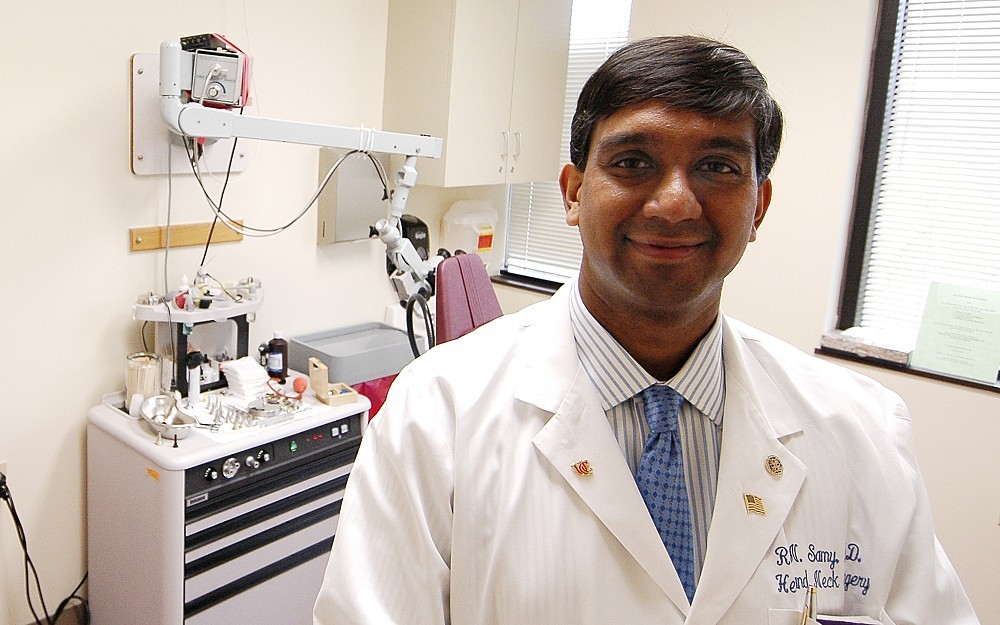
That is a challenge being addressed by Ravi Samy, MD, director of the Adult Cochlear Implant Program at the UC Neuroscience Institutes Functional Neuroscience Center, a center devoted to people who have diseases and disorders related to hearing, swallowing, voice, taste and smell.
Samy is working with an investigational device that will enable people who have lost hearing in both ears to still be able to process certain types of noise. The device bypasses structures within the ear and works by stimulating the brainstem, which sends a message to the brain that a noise has been "heard.
During the normal hearing process, Samy explains, "Sound waves pass through the ear canal and cause the ear drum to vibrate. Three little ear bones (ossicles) in the middle ear then vibrate, and fluid is moved in the snailshell-shaped cochlea. This sets off hair cell movement and subsequent electrical discharges through the cochlear nerve, which are transferred to the cochlear nucleus and the brainstem to the higher centers of the brain.
For more than 20 years, UCs collaborative functional team has been providing cochlear implants to patients who have become deaf for reasons related to genetic defects, infection, medication, age and noise. Candidates for cochlear implants have suffered damage to the hair cells in the cochlea but have a healthy cochlear nerve.
For the very small number of patients whose cochlear nerves are damaged, however, something else is needed. The most promising solution available is a device called an auditory brainstem implant.
"This implant bypasses the cochlea and the cochlear nerve and is placed right next to the cochlear nucleus of the brainstem, Samy explains. "We can stimulate that region, and then our patients have some sense of hearing. It wont be the level provided by cochlear implants; it wont be normal hearing. But our hope is that with day-to-day advancements and lip-reading skills, we can give patients an improved quality of life.
The Functional Neuroscience Center was recently designated one of a select number of national Auditory Brainstem Centers by Cochlear Corporation, and Samy will be heading up this important new clinical option. He and his team expect to perform their first auditory brainstem implant later this spring at University Hospital.
Candidates for auditory brainstem implants have suffered injury to both cochlear nerves, were born without a cochlear nerve, or suffer from neurofibromatosis type 2 (NF-2), a genetic condition that frequently causes tumors (acoustic neuromas) to form on the 8th cranial nerve near the ear on both sides of the head. Although the tumors are benign, they are disruptive and must be removed. Removal, unfortunately, can result in permanent hearing loss.
Cincinnatis multi-site team in cochlear implantation includes the UC Neuroscience Institute, Cincinnati Childrens Hospital Medical Center and the Veterans Administration Medical Center. Samy studied auditory brainstem implants while he was a fellow at the University of Iowa.
"Clinical management of patients with neurofibromatosis 2 is challenging, and the successful application of Auditory Brainstem Implant (ABI) technology in this population can be complex, says Christine Menapace, vice president of clinical studies, education and training at Cochlear Americas. "It requires an experienced, multi-disciplinary team that includes otology, neurosurgery, electrophysiology and audiology.
Samys continuing work with cochlear and auditory brainstem implants will include education of the community. "Many people are misinformed about the implants, he says. "They assume that because it doesnt return hearing to normal we shouldnt be using it. My thinking is that as we gain experience with this device we can also make strides in research. We can examine our results and recommend changes in design and software. Given enough time and research, who knows what the future will hold in 10 or 20 years? Heart bypass surgeries werent the best at first, nor were hip replacements.
Cochlear implants, Samy points out, "have achieved a level of success that have surpassed our imagination. He says that most cochlear implant recipients have a 75 to 90 percent chance of talking on the phone again within six months. Although people with auditory brainstem implants probably will not talk on the phone againat least not in the immediate futurethey will hear a ringing doorbell, a barking dog, a childs cry.
"They will hear something, but it will be hard to discriminate the sound, Samy says.
Samy reports no financial interest in Cochlear Corporation and is not on their speakers bureau.
Tags
Related Stories
On-site training in Speech & Hearing Clinic sets UC’s programs apart
August 27, 2026
At the University of Cincinnati’s Speech & Hearing Clinic, Doctor of Audiology and Speech-Language Pathology graduate students gain real-world experience while providing free speech and hearing services to the community.
Funding expands UC research into weight gain side effects of bipolar medication
August 26, 2026
University of Cincinnati researchers have been approved for funding by the Patient-Centered Outcomes Research Institute (PCORI) to expand the implementation of healthy lifestyle interventions and metformin prescription to help manage weight gain in overweight or obese youth taking second-generation antipsychotic medications.
One in four NFL players had CTE at death
August 25, 2026

Forbes cites research on concussions and football helmets by the University of Cincinnati in a report that found one in four NFL players had brain damage at death.