Clinical Trial May Reduce Stroke in Patients With Irregular Heartbeats

CINCINNATIA new study at UC Health University Hospital may help reduce stroke in patients with atrial fibrillation, a condition that causes irregular and dangerous heart rhythms.
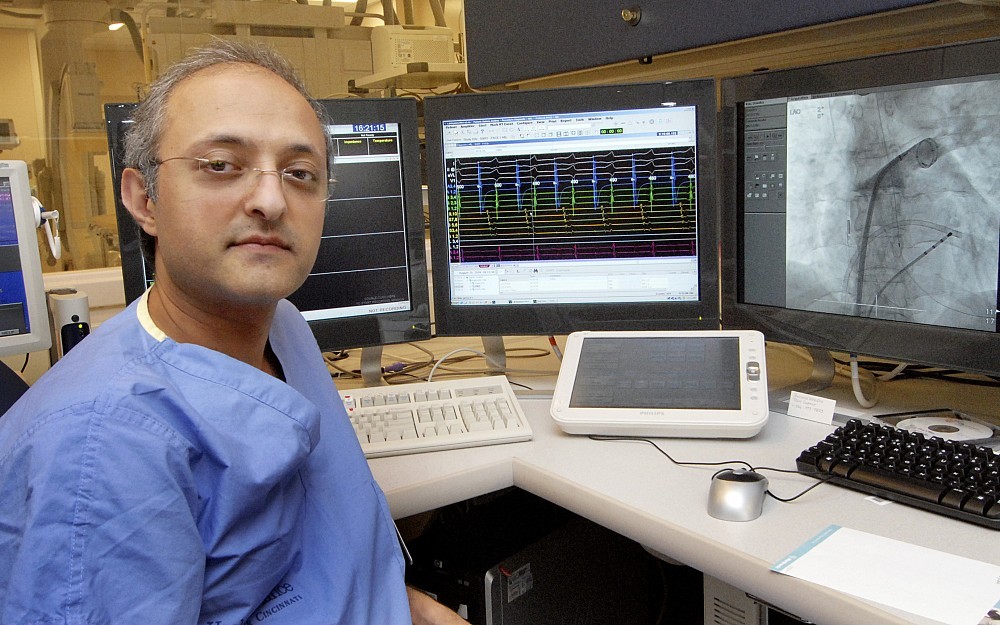
Mehran Attari, MD, UC Health electrophysiologist and lead investigator on the study, along with colleagues at University Hospital will be looking at the clinical benefits of the combined use of defibrillators or cardiac resynchronization devices (CRTs) and the daily use of warfarin, a blood thinner, to see if outcomes improve for patients at risk for stroke.
CRT involves the use of a specialized pacemaker to improve the electrical activation of the right and left ventricles in patients with heart failure.
"Atrial fibrillation is the most common arrhythmia requiring medical treatment, with a 25 percent lifetime risk of development in the general population; heart failure affects roughly 5 million Americans, he says. "These disorders are closely linked and contribute to an increased risk of embolism and stroke. In fact, one-sixth of all strokes are attributed to atrial fibrillation.
"In this study, we hope to detect atrial arrhythmias earlier using these new technologies and the predefined anticoagulation plan, reducing the rate of stroke, embolism, bleeding and death.
The studycalled IMPACTis a multicenter, single-blinded and randomized clinical trial. Roughly 2,700 patients from up to 100 clinical sites worldwide will be placed into two groups and implanted with one of two FDA-approved monitoring devices after being deemed eligible to participate.
"Patients in both groups will be observed using the home monitoring components of each of the devices; however, patients and researchers in group two will not have access to this data, Attari says. "These patients will receive physician directed anticoagulation therapy based on conventional criteria while patients in group one will receive warfarin therapy, if needed, based on the device readouts.
All study participants will be followed by physicians in the clinic every three to six months.
Stroke symptoms questionnaires will also be administered every three months to assess risk. This will take place either in the office visits or over the telephone.
Attari says researchers will use the CHADS2 model to estimate stroke risk in patients with atrial fibrillation.
"This model takes into account the patients age as well as other medical conditions, including congestive heart failure, hypertension, diabetes and prior stroke, Attari says. "We hope that this study will shed light on a new way to prevent stroke from occurring, improving the way physicians practice medicine and improving the quality of life for our patients.
This study is being sponsored by BIOTRONIK, Inc. Attari cites no conflict of interest.
Tags
Related Stories
Cancer Center plays key role in lab research, clinical trials for new pancreatic cancer drug
September 1, 2026

WLWT and WCPO highlighted the contributions of University of Cincinnati Cancer Center researchers that helped lead to the recent FDA approval of daraxonrasib, a new treatment for pancreatic cancer.
Cancer Center physician receives $150,000 New Investigator Research Grant to study treatment-resistant leukemia
September 1, 2026
The University of Cincinnati Cancer Center’s Sarah Skuli, MD, PhD, received a two‑year, $150,000 Leukemia Research Foundation New Investigator Grant to study TP53‑mutated leukemia, a treatment‑resistant subtype with very poor outcomes.
Heavy social media use linked to depression
August 31, 2026

U.S. News and World Report, Yahoo! News, MSN, USA Today and other national media highlight a new study by the University of Cincinnati and Northwestern University that found a correlation between heavy social media use and depression in adults.