New Vascular Access Center Improves Care for Dialysis Patients

CINCINNATIA new comprehensive Vascular Access Center opening today at the UC Health Surgical Hospital in West Chester will be helping specialists treat patients with hemodialysis vascular access problems.
Hemodialysis is a technique in which a machine filters wastes out of a patients blood once the kidney fails.
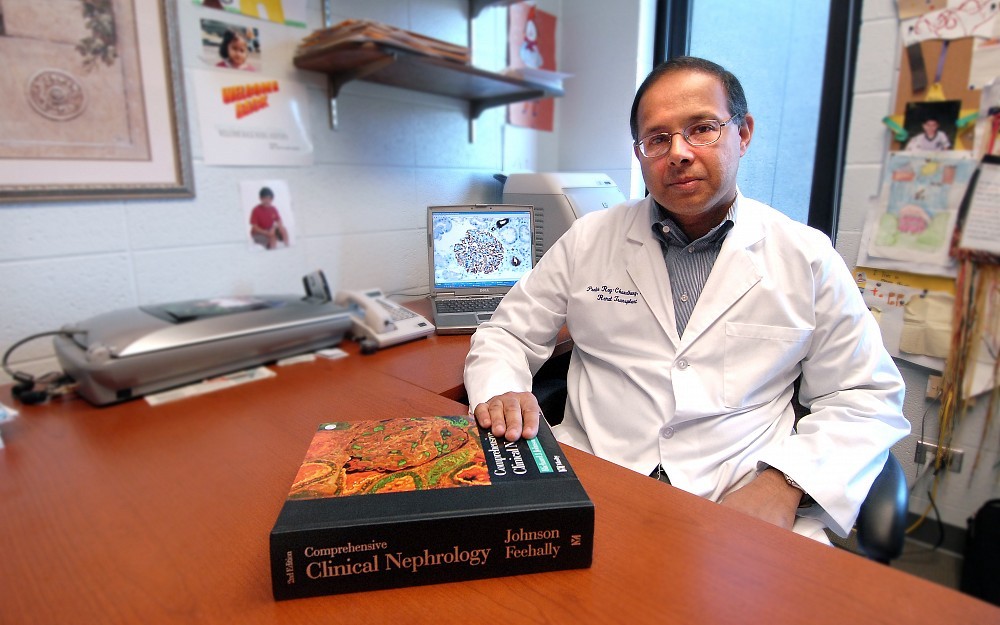
Prabir Roy-Chaudhury, MD, PhD, UC Health nephrologist and medical director of the new center, says the center will provide care for patients currently undergoing dialysis or those who are in need of dialysis treatment.
"There are currently about 400,000 hemodialysis patients in the United States who must use a catheter, fistula or graft for dialysis, he says. "Unfortunately, a patients lifelineor dialysis accessis often compromised because of stenosis, or narrowing of the veins. As a result, hemodialysis vascular access dysfunction is currently the Achilles heel of hemodialysis, resulting in a significant morbidity, at a cost of over $1 billion annually.
The UC Health Vascular Access Center will provide a full range of vascular access services including catheter placement and removal, angioplasty and thrombectomy (surgical removal of a blood clot) of arteriovenous fistulae and grafts as well as vein mapping prior to access placement.
In addition, the center will provide training for nephrologists in these procedures and will complement ongoing basic science and clinical research programs on vascular access within the University of Cincinnatis (UC) division of nephrology and hypertension.
"Our goal is to truly provide comprehensive vascular access care to our patients so that we can reduce the number of catheterswhich often cause infectionsand increase the number of functioning fistulas, the best form of dialysis access, he says. "We believe that this will reduce hospital admissions and cost for our patients and also improve their quality of life
Interventional services at the center will be provided by Davinder Wadehra, MD, also a UC Health nephrologist, and a team of trained professionals.
"The goal of this center is to provide prompt, professional, high-quality vascular access services to our patients and to do so with a caring touch, Wadehra says.
Manoocher Soleimani, MD, director of UCs division of nephrology and hypertension, agrees that this is a step in the right direction.
"This is just one of a number of initiatives in the division that focus on providing the Tristate region with the best possible health care opportunities and options for kidney disease, he says. "We are very proud of the center and hope to make a large impact on patient care.

Manoocher Soleimani, MD, director of UCÂ s nephrology division
Tags
Related Stories
Heavy social media use linked to depression
August 31, 2026

U.S. News and World Report, Yahoo! News, MSN, USA Today and other national media highlight a new study by the University of Cincinnati and Northwestern University that found a correlation between heavy social media use and depression in adults.
On-site training in Speech & Hearing Clinic sets UC’s programs apart
August 27, 2026
At the University of Cincinnati’s Speech & Hearing Clinic, Doctor of Audiology and Speech-Language Pathology graduate students gain real-world experience while providing free speech and hearing services to the community.
Funding expands UC research into weight gain side effects of bipolar medication
August 26, 2026
University of Cincinnati researchers have been approved for funding by the Patient-Centered Outcomes Research Institute (PCORI) to expand the implementation of healthy lifestyle interventions and metformin prescription to help manage weight gain in overweight or obese youth taking second-generation antipsychotic medications.